

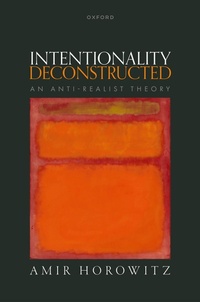
Intentionality Deconstructed
An Anti-Realist Theory
Published on 21. May 2024
Book
Hardback
224 pages
978-0-19-889643-2 (ISBN)
Description
Intentionality Deconstructed argues for the view that no concrete entity - mental, linguistic, or any other - can possess intentional content. Nothing can be about anything. The concept of intentionality is flawed, and so content ascriptions cannot be "absolutely" true or false - they lack truth conditions. Nonetheless, content ascriptions have truth conditions and can be true (or possess a related epistemic merit) relative to practices of content ascription, so that different practices may imply different (not real but practice-dependent) intentional objects for the same token mental state. The suggested view does not deny the existence of those mental states standardly considered intentional, notably the so-called propositional attitudes; it affirms it. That is, support is provided for the existence of those states with the properties usually attributed to them, but absent intentional properties. Specifically, it is argued that the so-called propositional attitudes possess logico-syntactic properties, whose postulation plays an important role in addressing the challenge of reconciling intentional anti-realism with beliefs being true or having alternative epistemic merits, the argument from the predictive and explanatory success of content ascription for intentional realism, and the cognitive suicide objection to views that deny intentionality. As part of the rejection of this final objection, intentional anti-realism is presented as a radical view, which claims "Nothing can possess intentional content" but not that nothing can possess intentional content, and it is argued that this is a legitimate characteristic of radical philosophy. In spite of rejecting the "claim that" talk, intentional anti-realism gives clear sense to its dispute with its rivals as well as to its own superiority. Various arguments for intentional anti-realism are presented. One argument rejects all possible accounts of intentionality, namely primitivism, intrinsic reductionism - the prominent example of which is the phenomenal intentionality thesis - and extrinsic reductionism (that is, reductive naturalistic accounts). According to another argument, since intentional properties are shown to be dispensable for all possibly relevant purposes, and no sound arguments support the claim that they ever are instantiated, the application of Ockham's razor shows that no such properties ever are instantiated, and another step shows that neither can they be.
More details
Language
English
Place of publication
Oxford
United Kingdom
Target group
Professional and scholarly
Product notice
sewn/stitched
Cloth over boards
Dimensions
Height: 231 mm
Width: 165 mm
Thickness: 33 mm
Weight
499 gr
ISBN-13
978-0-19-889643-2 (9780198896432)
Copyright in bibliographic data and cover images is held by Nielsen Book Services Limited or by the publishers or by their respective licensors: all rights reserved.
Schweitzer Classification
Other editions
Additional editions
E-Book
07/2024
1st Edition
OUP eBook
€76.99
Available for download
E-Book
04/2024
1st Edition
OUP eBook
€76.99
Available for download
Person
Professor Amir Horowitz is the head of the philosophy program and the PPE program of the Open University of Israel. His main areas of research are philosophy of mind and cognitive science and philosophy of language. He also studies issues in ethics, epistemology, philosophy of religion, and philosophy of sport.
Content
Preface
1: Introducing Intentionality
2: How to Settle Issues of Intentionality, and a Tentative Argument for Intentional Anti-Realism
3: Against Phenomenal Intentionality as Intrinsic Reductive Intentionality
4: Against Naturalistic Reductions of Intentionality
5: Intentional Anti-Realism I
6: Intentional anti-realism II: Objections and Further Developments
References
1: Introducing Intentionality
2: How to Settle Issues of Intentionality, and a Tentative Argument for Intentional Anti-Realism
3: Against Phenomenal Intentionality as Intrinsic Reductive Intentionality
4: Against Naturalistic Reductions of Intentionality
5: Intentional Anti-Realism I
6: Intentional anti-realism II: Objections and Further Developments
References