

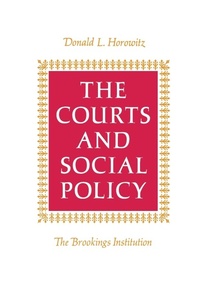
The Courts and Social Policy
Published on 1. January 1977
Book
Paperback/Softback
320 pages
978-0-8157-3733-9 (ISBN)
Description
Winner of the Louis Brownlow Award for Public Administration
In recent years, the power of American judges to make social policy has been significantly broadened. The courts have reached into many matters once thought to be beyond the customary scope of judicial decisionmaking: education and employment policy, environmental issues, prison and hospital management, and welfare administration?to name a few. This new judicial activity can be traced to various sources, among them the emergence of public interest law firms and interest groups committed to social change through the courts, and to various changes in the law itself that have made access to the courts easier. The propensity for bringing difficult social questions to the judiciary for resolution is likely to persist.
This book is the first comprehensive study of the capacity of courts to make and implement social policy. Donald L. Horowitz, a lawyer and social scientist, traces the imprint of the judicial process on the policies that emerge from it. He focuses on a number of important questions: how issues emerge in litigation, how courts obtain their information, how judges use social science data, how legal solutions to social problems are devised, and what happens to judge-made social policy after decrees leave the court house.
After a general analysis of the adjudication process as it bears on social policymaking, the author presents four cases studies of litigation involving urban affairs, educational resources, juvenile courts and delinquency, and police behavior. In each, the assumption and evidence with which the courts approached their policy problems are matched against data about the social settings from which the cases arose and the effects the decrees had. The concern throughout the book is to relate the policy process to the policy outcome.
From his analysis of adjudication and the findings of his case studies the author concludes that the resources of the courts are not adequate to the new challenges confronting them. He suggests various improvements, but warns against changes that might impair the traditional strengths of the judicial process.
In recent years, the power of American judges to make social policy has been significantly broadened. The courts have reached into many matters once thought to be beyond the customary scope of judicial decisionmaking: education and employment policy, environmental issues, prison and hospital management, and welfare administration?to name a few. This new judicial activity can be traced to various sources, among them the emergence of public interest law firms and interest groups committed to social change through the courts, and to various changes in the law itself that have made access to the courts easier. The propensity for bringing difficult social questions to the judiciary for resolution is likely to persist.
This book is the first comprehensive study of the capacity of courts to make and implement social policy. Donald L. Horowitz, a lawyer and social scientist, traces the imprint of the judicial process on the policies that emerge from it. He focuses on a number of important questions: how issues emerge in litigation, how courts obtain their information, how judges use social science data, how legal solutions to social problems are devised, and what happens to judge-made social policy after decrees leave the court house.
After a general analysis of the adjudication process as it bears on social policymaking, the author presents four cases studies of litigation involving urban affairs, educational resources, juvenile courts and delinquency, and police behavior. In each, the assumption and evidence with which the courts approached their policy problems are matched against data about the social settings from which the cases arose and the effects the decrees had. The concern throughout the book is to relate the policy process to the policy outcome.
From his analysis of adjudication and the findings of his case studies the author concludes that the resources of the courts are not adequate to the new challenges confronting them. He suggests various improvements, but warns against changes that might impair the traditional strengths of the judicial process.
Reviews / Votes
Donald L. Horowitz' study, The Courts and Social Policy, is likely tobecome a landmark in this literature because it shifts the focus from thelegitimacy of judicial review in democratic theory to the capacity ofcourts to make and implement social policy effectively. ?J. Woodford Howard Jr., Washington University Law ReviewMore details
Language
English
Place of publication
United States
Publishing group
Bloomsbury Publishing Plc
Dimensions
Height: 229 mm
Width: 152 mm
Thickness: 19 mm
Weight
522 gr
ISBN-13
978-0-8157-3733-9 (9780815737339)
Copyright in bibliographic data and cover images is held by Nielsen Book Services Limited or by the publishers or by their respective licensors: all rights reserved.
Schweitzer Classification
Other editions
Additional editions
Donald L. Horowitz
The Courts and Social Policy
E-Book
12/2010
Bloomsbury eBooks US
€24.99
Available for download
Donald L. Horowitz
The Courts and Social Policy
E-Book
12/2010
1st Edition
Brookings Institution
€24.99
Available for download
Person
Donald L. Horowitz is the James B. Duke Professor of Law and Political Science Emeritus at Duke University. He is the author of The Jurocracy (Lexington Books), a book about government lawyers, and numerous other books and articles. Elected to the American Academy of Arts and Sciences, Professor Horowitz is also a former President of the American Society for Political and Legal Philosophy. He wrote his book when he was a Research Associate at Brookings.