

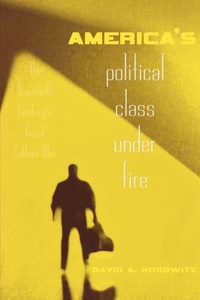
America's Political Class Under Fire
The Twentieth Century's Great Culture War
1st Edition
Published on 14. August 2003
Book
Paperback/Softback
302 pages
978-0-415-94691-9 (ISBN)
Description
While the clash between what has been called the modern and undeveloped worlds has led to America's military involvement in the Middle East and other places, few people realize the tension between the modern and the traditional within the United States. Beginning in the 1920's, professional intellectuals and academics began influencing the nation's public policy on matters as diverse as education, economics, and public health. In this thoughtful work, David A. Horowitz analyzes the tension between the so-called New Class of knowledge professionals and their critics, who accused them of being out of touch with the common sense of everyday people, strangers to the American Way, even Communists. America's Political Class Under Fire is organized over nine periods of 20th-century history, providing a window into everything from the Scopes evolution trial and McCarthyism to affirmative action and the Clinton health care fiasco. Along the way, the book explores the New Left, populist conservatism, and the mid-90's reaction to political liberalism, which saw Newt Gingrich rise to the top post in the House of Representatives. In telling these stories, Horowitz seeks to encourage a more balanced and fair-minded assessment of the consequences of expertise and applied intellect to democratic existence in the United States.
Reviews / Votes
"The American political system, as devised by the Federalist authors, the architects of the Constitution, was structured so as not to rely upon intellectuals. The "machinery of government" would operate on its own, and America had little possibility of becoming "a nation of philosophers." Yet, as David A. Horowitz has demonstrated, intellectuals as a political class have been at center of numerous public controversies throughout American history. Horowitz probes the problem of our own varying mandarin class with thorough research, lucid writing, and thoughtful reflection. Should the "brains trust" be trusted? That is the question." -- John Patrick Diggins, Distinguished Professor of History, Graduate Center, CUNY"David A. Horowitz mounts a vigorous challenge in this book to the conventional wisdom of political historians, both on the left and right. Rebels against the rule of the "best and the brightest" have often altered the outcome of elections and the shape of government policies. Now, at last, they have a full and empathetic treatment of what they believed and what they accomplished." -- Michael Kazin, author of The PopulistPersuasion: An American History and Professor of History, Georgetown University
More details
Language
English
Place of publication
London
United Kingdom
Publishing group
Taylor & Francis Ltd
Target group
College/higher education
Dimensions
Height: 229 mm
Width: 152 mm
Thickness: 16 mm
Weight
443 gr
ISBN-13
978-0-415-94691-9 (9780415946919)
Copyright in bibliographic data and cover images is held by Nielsen Book Services Limited or by the publishers or by their respective licensors: all rights reserved.
Schweitzer Classification
Other editions
Additional editions
E-Book
12/2013
1st Edition
Routledge
€78.99
Available for download
E-Book
12/2013
1st Edition
Routledge
€78.99
Available for download
Book
07/2003
1st Edition
Routledge
€178.27
Article exhausted; check different version
Person
David A. Horowitz is Professor of History at Portland State University. He is the co-author of Beyond Left andRight: Insurgency and the Establishment (1997).
Content
Introduction: America's Controversy with New Class Guardians 1. Secular Liberalism on Trial in the Turbulent 1920s 2. Shadow Government: The Brains Trust Under Fire, 1932-1936 3. The Welfare State and Its Discontents, 1936-1941 4. Planners versus Enterprisers: The Free World at Home During World War II 5. Pledging Allegiance: The Political Class and Cold War Loyalty, 1946-1952 6. Hidden Persuasions: The Disputed Agenda of 1950s Policy Elites 7. Zero Sum Governance: Social Interventionists and Race Politics, 1954-1968 8. Class War: The Liberal Establishment Besieged, 1968-1980 9. Far from Paradise: Social Guardians in the Postmodern Era, 1980-2000 Conclusion: The Guardian Class and American Democracy Notes Bibliography of Archival Sources and Public Documents