

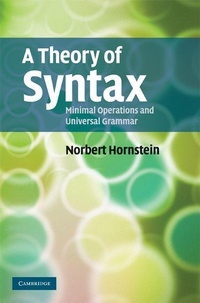
A Theory of Syntax
Minimal Operations and Universal Grammar
Published on 18. December 2008
Book
Hardback
204 pages
978-0-521-44970-0 (ISBN)
Description
Human language seems to have arisen roughly within the last 50-100,000 years. In evolutionary terms, this is the mere blink of an eye. If this is correct, then much of what we consider distinctive to language must in fact involve operations available in pre-linguistic cognitive domains. In this book Norbert Hornstein, one of the most influential linguists working on syntax, discusses a topical set of issues in syntactic theory, including a number of original proposals at the cutting edge of research in this area. He provides a theory of the basic grammatical operations and suggests that there is only one that is distinctive to language. If this theory is correct then this narrows the evolutionary gap between verbal and non-verbal primates, thus facilitating the rapid evolutionary emergence of our linguistic capacity.
More details
Language
English
Place of publication
Cambridge
United Kingdom
Target group
College/higher education
Product notice
sewn/stitched
Paper over boards
Dimensions
Height: 229 mm
Width: 155 mm
Thickness: 15 mm
Weight
454 gr
ISBN-13
978-0-521-44970-0 (9780521449700)
Copyright in bibliographic data and cover images is held by Nielsen Book Services Limited or by the publishers or by their respective licensors: all rights reserved.
Schweitzer Classification
Other editions
Additional editions
E-Book
01/2009
1st Edition
Cambridge University Press
€38.49
Available for download
Book
12/2008
Cambridge University Press
€55.20
Shipment within 15-20 days
Person
NORBERT HORNSTEIN is Professor in the Department of Linguistics at the University of Maryland, College Park. He has written several books on minimalist syntax including Understanding Minimalism (with J. Nunes and K. Grohmann, Cambridge, 2005) and Move!: A Minimalist Theory of Construal (2000).
Content
1. Minimalism and Darwin's problem; 2. Deriving c-command; 3. Labels, recursion and movement; 4. Some thoughts on adjunction; 5. The emerging picture: basic operations, FL and the minimalist program; 6. Stop AGREEing! Keep moving!; 7. Conclusions, consequences and more questions.