

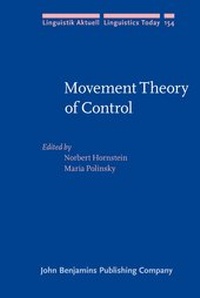
Movement Theory of Control
Published on 29. April 2010
Book
Hardback
330 pages
978-90-272-5537-2 (ISBN)
Description
Natural languages offer many examples of "displacement," i.e. constructions in which a non-local expression is critical for some grammatical end. Two central examples include phenomena such as raising and passive on the one hand, and control on the other. Though each phenomenon is an example of displacement, they have been theoretically distinguished. Movement rules have generated the former and formally very different construal rules, the latter. The Movement Theory of Control challenges this differentiation and argues that the operations that generate the two constructions are the same, the differences arising from the positions through which the displaced elements are moved. In the context of the Minimalist Program, reducing the class of basic operations is methodologically prized. This volume is a collection of original papers that argue for this approach to control on theoretical and empirical grounds as well. The papers also develop and constrain the movement theory to account for novel phenomena from a variety of languages.
More details
Series
Language
English
Place of publication
Amsterdam
Netherlands
Target group
Professional and scholarly
Illustrations
+ index
Dimensions
Height: 245 mm
Width: 164 mm
Weight
740 gr
ISBN-13
978-90-272-5537-2 (9789027255372)
Copyright in bibliographic data and cover images is held by Nielsen Book Services Limited or by the publishers or by their respective licensors: all rights reserved.
Schweitzer Classification
Other editions
Additional editions
Norbert Hornstein | Maria Polinsky
Movement Theory of Control
E-Book
04/2010
1st Edition
John Benjamins Publishing Company
€123.99
Available for download
Persons
Content
1. Abbreviations; 2. Control as movement: Across languages and constructions (by Hornstein, Norbert); 3. Part I. Expanding the movement analysis of control; 4. Movement Theory of Control and CP-infinitives in Polish (by Witkos, Jacek); 5. Obligatory control and local reflexives: Copies as vehicles for de se readings (by Hornstein, Norbert); 6. No objections to Backward Control (by Alexiadou, Artemis); 7. Possessor raising through thematic positions (by Rodrigues, Cilene); 8. Part II. Unexplored control phenomena; 9. Clitic climbing in archaic Chinese: Evidence for the movement analysis of control (by Aldridge, Edith); 10. Framing the syntax of control in Japanese (and English) (by Dubinsky, Stanley); 11. Split control and the Principle of Minimal Distance (by Fujii, Tomohiro); 12. Towards a typology of control in DP (by Sichel, Ivy); 13. Part III. Beyond control; 14. The argument structure of evaluative adjectives: A case of pseudo-raising (by Kertz, Laura); 15. Object control in Korean: A backward control impostor (by Kwon, Nayoung)