

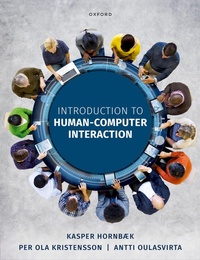
Introduction to Human-Computer Interaction
Published on 23. July 2025
Book
Hardback
864 pages
978-0-19-286454-3 (ISBN)
Description
This is an open access title available under the terms of a CC BY-NC-ND 4.0 International licence. It is free to read on the Oxford Academic platform and offered as a free PDF download from OUP and selected open access locations.
Aimed at undergraduate students in computer science, design, and engineering programs, and master students in dedicated programs, this is the first comprehensive textbook for students of human-computer interaction.
While HCI is primarily a research-driven field, the book focuses not only on scientific principles of interaction, but also on the very concrete goal of designing better computing systems. The book revises and synthesizes topics that have been previously scattered across multiple books and papers, including design, engineering, empirical methods, and technology.
Although it covers emerging topics like VR and AI, the book places its emphasis on the more time-enduring principles and methods. The book is open access and comes with associated materials for teachers and students, available on the book's companion website.
Aimed at undergraduate students in computer science, design, and engineering programs, and master students in dedicated programs, this is the first comprehensive textbook for students of human-computer interaction.
While HCI is primarily a research-driven field, the book focuses not only on scientific principles of interaction, but also on the very concrete goal of designing better computing systems. The book revises and synthesizes topics that have been previously scattered across multiple books and papers, including design, engineering, empirical methods, and technology.
Although it covers emerging topics like VR and AI, the book places its emphasis on the more time-enduring principles and methods. The book is open access and comes with associated materials for teachers and students, available on the book's companion website.
More details
Language
English
Place of publication
Oxford
United Kingdom
Target group
College/higher education
Product notice
sewn/stitched
Cloth over boards
Dimensions
Height: 248 mm
Width: 196 mm
Thickness: 48 mm
Weight
1982 gr
ISBN-13
978-0-19-286454-3 (9780192864543)
Copyright in bibliographic data and cover images is held by Nielsen Book Services Limited or by the publishers or by their respective licensors: all rights reserved.
Schweitzer Classification
Other editions
Additional editions
Kasper Hornbaek | Per Ola Kristensson | Antti Oulasvirta
Introduction to Human-Computer Interaction
Book
07/2025
Oxford University Press
€74.50
Shipment within 15-20 days
Persons
Kasper Hornbaek is a Professor of Computer Science at the University of Copenhagen. His core research interests are in human-computer interaction, theories of interaction, user experience, and extended reality.
Per Ola Kristensson is a Professor of Interactive Systems Engineering in the Department of Engineering at the University of Cambridge and a Fellow of Trinity College, Cambridge. He leads the Intelligent Interactive Systems group, which belongs to the Engineering Design Centre. He is also a co-founder and co-director of the Centre for Human-Inspired Artificial Intelligence at the University of Cambridge.
Antti Oulasvirta is a Professor of User Interfaces in the Department of Information and Communications Engineering at Aalto University. He leads the Computational Behaviour Lab. He is a computational cognitive scientist with an interest in predictive models of human performance in interactive computing.
Per Ola Kristensson is a Professor of Interactive Systems Engineering in the Department of Engineering at the University of Cambridge and a Fellow of Trinity College, Cambridge. He leads the Intelligent Interactive Systems group, which belongs to the Engineering Design Centre. He is also a co-founder and co-director of the Centre for Human-Inspired Artificial Intelligence at the University of Cambridge.
Antti Oulasvirta is a Professor of User Interfaces in the Department of Information and Communications Engineering at Aalto University. He leads the Computational Behaviour Lab. He is a computational cognitive scientist with an interest in predictive models of human performance in interactive computing.
Content
I Overview of Human-Computer Interaction
1: Introduction to human-computer interaction
II Understanding People
2: Introduction to Understanding People
3: Perception
4: Motor Control
5: Cognition
6: Needs and Motivations
7: Experience
8: Collaboration
9: Communication
III User Research
10: Introduction to User Research
11: Interviews
12: Field Research
13: Survey Research
14: Unobtrusive Research
15: Representations of User Research
IV Understanding Interaction
16: Introduction to Interaction
17: Information and Control
18: Dialogue
19: Tool Use
20: Automation
21: Rationality
22: Practice
V User Interfaces
23: Introduction to User Interfaces
24: Input Devices
25: Displays
26: Interaction Techniques
27: Commands and Navigation
28: Graphical User Interfaces
29: Reality-Based Interaction
VI Design
30: Introduction to Design
31: Design Cognition
32: Design Practice
33: Design Processes
VII Engineering
34: Introduction to Engineering
35: Systems
36: Design Engineering
37: Safety and Risk
38: Software
39: Computational Representations and Models
VIII Evaluation
40: Introduction to Evaluation
41: Analytical Evaluation Methods
42: Think-aloud Studies
43: Experiments
44: Field Evaluations
IX Conclusion
45: Growing into the HCI Discipline
46: Summary: HCI's Principles
1: Introduction to human-computer interaction
II Understanding People
2: Introduction to Understanding People
3: Perception
4: Motor Control
5: Cognition
6: Needs and Motivations
7: Experience
8: Collaboration
9: Communication
III User Research
10: Introduction to User Research
11: Interviews
12: Field Research
13: Survey Research
14: Unobtrusive Research
15: Representations of User Research
IV Understanding Interaction
16: Introduction to Interaction
17: Information and Control
18: Dialogue
19: Tool Use
20: Automation
21: Rationality
22: Practice
V User Interfaces
23: Introduction to User Interfaces
24: Input Devices
25: Displays
26: Interaction Techniques
27: Commands and Navigation
28: Graphical User Interfaces
29: Reality-Based Interaction
VI Design
30: Introduction to Design
31: Design Cognition
32: Design Practice
33: Design Processes
VII Engineering
34: Introduction to Engineering
35: Systems
36: Design Engineering
37: Safety and Risk
38: Software
39: Computational Representations and Models
VIII Evaluation
40: Introduction to Evaluation
41: Analytical Evaluation Methods
42: Think-aloud Studies
43: Experiments
44: Field Evaluations
IX Conclusion
45: Growing into the HCI Discipline
46: Summary: HCI's Principles