

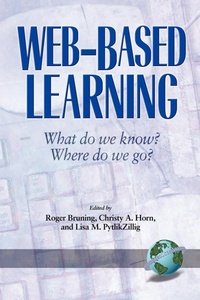
Web-Based Learning
What Do We Know? Where Do We Go?
Will be published approx. on 1. January 2003
Book
Paperback/Softback
300 pages
978-1-59311-002-4 (ISBN)
Description
Topics covered in this volume include: research on web-based learning; ways to reduce cognitive load in multimedia learning; gathering and organizing web-based information; the risks in cyberspace; engineering perspectives; and the pedagogical impact of course management systems.
More details
Language
English
Place of publication
Charlotte
United States
Publishing group
Emerald Publishing Inc
Target group
College/higher education
Professional and scholarly
Illustrations
references, index
Dimensions
Height: 234 mm
Width: 156 mm
Thickness: 16 mm
Weight
459 gr
ISBN-13
978-1-59311-002-4 (9781593110024)
Copyright in bibliographic data and cover images is held by Nielsen Book Services Limited or by the publishers or by their respective licensors: all rights reserved.
Schweitzer Classification
Other editions
Additional editions
E-Book
03/2003
1st Edition
Information Age Publishing
from
€62.33
Available for download
Persons
Content
Chapter 1. Research on Web-Based Learning: A Half-Full Glass; Richard Clark.
Chapter 2. Nine Ways to Reduce Cognitive Load in Multimedia Learning; Richard Mayer and Roxana Moreno.
Chapter 3. Technology: The Great Equalizer? Eric Jolly and Christy Horn.
Chapter 4. InfoGather: A Web-Based Tool for Gathering and Organizing Web-Based Information; Brent Igo, Roger Bruning, Matt McCrudden and Doug Kauffman.
Chapter 5. ThinkAboutIt! A Web-Based Tool for Promoting Critical Thinking; Steve Lehman and Roger Bruning.
Chapter 6. Teachers, Technology, and Students At Risk; Lisa PytlikZillig, Christy Horn and Mary Jane White.
Chapter 7. At Risk in Cyberspace: At-Risk Students' Experiences in Web-Based Courses; Christy Horn, Lisa PytlikZillig, Roger Bruning and Douglas Kauffman.
Chapter 8. Engineering Perspectives: The Technical Development of the CLASS Project Online Courses; Art Zygielbaum.
Chapter 9. The Pedagogical Impact of Course Management Systems on Faculty, Students, and Institution; Charles Ansorge and Oksana Bendus.
Chapter 10. Technological Indicators of Impact of Course Management Systems; Ashok Samal and Bhuvana Gopol.
Chapter 11. Intellectual Property Considerations for Online Educational Multimedia Projects: What You Don't Know Could Byte You; Turan Odabasi.
Chapter 12. Recommendations and "Voices from the Field": Thoughts from the CLASS Summative Evalutation; Patricia B. Campbell, Lesley K. Perlman, and Earl N. Hadley.
Chapter 2. Nine Ways to Reduce Cognitive Load in Multimedia Learning; Richard Mayer and Roxana Moreno.
Chapter 3. Technology: The Great Equalizer? Eric Jolly and Christy Horn.
Chapter 4. InfoGather: A Web-Based Tool for Gathering and Organizing Web-Based Information; Brent Igo, Roger Bruning, Matt McCrudden and Doug Kauffman.
Chapter 5. ThinkAboutIt! A Web-Based Tool for Promoting Critical Thinking; Steve Lehman and Roger Bruning.
Chapter 6. Teachers, Technology, and Students At Risk; Lisa PytlikZillig, Christy Horn and Mary Jane White.
Chapter 7. At Risk in Cyberspace: At-Risk Students' Experiences in Web-Based Courses; Christy Horn, Lisa PytlikZillig, Roger Bruning and Douglas Kauffman.
Chapter 8. Engineering Perspectives: The Technical Development of the CLASS Project Online Courses; Art Zygielbaum.
Chapter 9. The Pedagogical Impact of Course Management Systems on Faculty, Students, and Institution; Charles Ansorge and Oksana Bendus.
Chapter 10. Technological Indicators of Impact of Course Management Systems; Ashok Samal and Bhuvana Gopol.
Chapter 11. Intellectual Property Considerations for Online Educational Multimedia Projects: What You Don't Know Could Byte You; Turan Odabasi.
Chapter 12. Recommendations and "Voices from the Field": Thoughts from the CLASS Summative Evalutation; Patricia B. Campbell, Lesley K. Perlman, and Earl N. Hadley.