

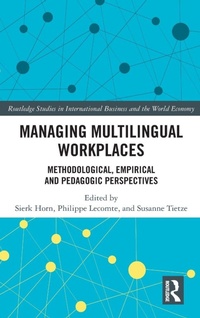
Managing Multilingual Workplaces
Methodological, Empirical and Pedagogic Perspectives
1st Edition
Published on 4. August 2020
Book
Hardback
236 pages
978-1-138-36479-0 (ISBN)
Description
This book sets new trajectories for language-sensitive business and management research and pedagogy. The existence of language plurality characterises these. Empirical studies have been established as important and relevant for contemporary research. It has shifted language-sensitive research from the periphery to the centre of international management research. However, this field is rapidly changing, and new thematic approaches have begun to emerge. By addressing this, the book offers genuine and more nuanced insights into existing themes and comes with applications of emergent conceptual developments in different settings. The second part of the book covers methodologies and gives examples and cutting-edge insights into the role of translation in the execution of empirical research and theorising arising from it. Finally, the book draws together innovative ways of how to address the challenges of a multilingual teaching classroom and how to innovate in order to incorporate such diversity through pedagogic practice.
This book provides a source that unites insights from multilingual empirical research, methodological considerations and pedagogic practice in order to advance knowledge and debate. It will be a 'handy source' of information that offers direct access to the latest guidance on language-sensitive management challenges. It will, therefore, appeal to an internationally-minded and mobile audience, including scholars, students and decision-makers.
This book provides a source that unites insights from multilingual empirical research, methodological considerations and pedagogic practice in order to advance knowledge and debate. It will be a 'handy source' of information that offers direct access to the latest guidance on language-sensitive management challenges. It will, therefore, appeal to an internationally-minded and mobile audience, including scholars, students and decision-makers.
More details
Series
Language
English
Place of publication
London
United Kingdom
Publishing group
Taylor & Francis Ltd
Target group
College/higher education
Illustrations
4 s/w Zeichnungen, 16 s/w Tabellen
16 Tables, black and white; 4 Line drawings, black and white
Dimensions
Height: 235 mm
Width: 157 mm
Thickness: 19 mm
Weight
540 gr
ISBN-13
978-1-138-36479-0 (9781138364790)
Copyright in bibliographic data and cover images is held by Nielsen Book Services Limited or by the publishers or by their respective licensors: all rights reserved.
Schweitzer Classification
Other editions
Additional editions
Sierk Horn | Philippe Lecomte | Susanne Tietze
Managing Multilingual Workplaces
Methodological, Empirical and Pedagogic Perspectives
Book
04/2022
1st Edition
Routledge
€65.50
Shipment within 15-20 days
Sierk Horn | Philippe Lecomte | Susanne Tietze
Managing Multilingual Workplaces
Methodological, Empirical and Pedagogic Perspectives
E-Book
06/2020
1st Edition
Routledge
€59.49
Available for download
Sierk Horn | Philippe Lecomte | Susanne Tietze
Managing Multilingual Workplaces
Methodological, Empirical and Pedagogic Perspectives
E-Book
06/2020
1st Edition
Routledge
€59.49
Available for download
Persons
Sierk Horn is Professor of International Management at the FH Vorarlberg, University of Applied Sciences, Austria. Until 2017 he held the Professorship of the Economy of Japan at Ludwig-Maximilian-University, Munich.
Philippe Lecomte is President and founding member of GEM&L. He has been Associate Professor at Toulouse Business School (TBS), France, for over 30 years. His current research interest is on language in international business and management education.
Susanne Tietze is Professor of Multilingual Management at Sheffield Hallam University, Sheffield Business School. She has a particular interest in translation as a method and concept to understand transformational process.
Philippe Lecomte is President and founding member of GEM&L. He has been Associate Professor at Toulouse Business School (TBS), France, for over 30 years. His current research interest is on language in international business and management education.
Susanne Tietze is Professor of Multilingual Management at Sheffield Hallam University, Sheffield Business School. She has a particular interest in translation as a method and concept to understand transformational process.
Content
Keynote foreword: Understanding Multilingual Workplaces;
DENICE AND LAWRENCE WELCH;
Preface;
SIERK HORN, PHILIPPE LECOMTE AND SUSANNE TIETZE;
SECTION 1: METHODS AND METHODOLOGIES IN MULTILINGUAL RESEARCH;
General introduction: New Perspectives and Approaches to Language-based Research;
Chapter 1: Moving beyond the baseline: Exploring the potential of experiments in language research.;
Chapter 2: How to Research 'Empowerment' in Russia: Absence, Equivalence and Method;
Chapter 3: Translating Western Research Methodology into Chinese: A Contextualised Approach in Practice;
Chapter 4: Translatorial Linguistic Ethnography in Organizations;
SECTION 2: EMPIRICAL RESEARCH ON LANGUAGE AT WORK;
Introduction to section 2: Innovation in empirical studies: The individual's reflexivity;
Chapter 5: The impact of language diversity on multinational teamwork.;
Chapter 6: Exploring Translanguaging in International Business. Towards a Comparison of Highly Context-embedded Practices: Evidence from France and Finland.;
Chapter 7: Towards a Framework of Individuals' Responses to Language Asymmetry;
Chapter 8: Learning in a Multilingual and Multicultural Business Setting: Polish Expatriates' Stories of Critical Incidents in China.;
SECTION 3: THE ROLE OF LANGUAGE IN INTERNATIONAL BUSINESS EDUCATION;
Introduction to section 3: A New Look at the Role of Language in Business Education;
Chapter 9: "At the Beginning, I Thought the Topic was Boring": Educating Business Students in Language Diversity through Transformative Learning;
Chapter 10: Language Management in the Global Firm: Transforming Research into Education;
Chapter 11: From the Multilingual Classroom to the Multilingual Workplace: Learning to View Language through a Different Lens.;
SECTION 4: CONCLUSION;
DENICE AND LAWRENCE WELCH;
Preface;
SIERK HORN, PHILIPPE LECOMTE AND SUSANNE TIETZE;
SECTION 1: METHODS AND METHODOLOGIES IN MULTILINGUAL RESEARCH;
General introduction: New Perspectives and Approaches to Language-based Research;
Chapter 1: Moving beyond the baseline: Exploring the potential of experiments in language research.;
Chapter 2: How to Research 'Empowerment' in Russia: Absence, Equivalence and Method;
Chapter 3: Translating Western Research Methodology into Chinese: A Contextualised Approach in Practice;
Chapter 4: Translatorial Linguistic Ethnography in Organizations;
SECTION 2: EMPIRICAL RESEARCH ON LANGUAGE AT WORK;
Introduction to section 2: Innovation in empirical studies: The individual's reflexivity;
Chapter 5: The impact of language diversity on multinational teamwork.;
Chapter 6: Exploring Translanguaging in International Business. Towards a Comparison of Highly Context-embedded Practices: Evidence from France and Finland.;
Chapter 7: Towards a Framework of Individuals' Responses to Language Asymmetry;
Chapter 8: Learning in a Multilingual and Multicultural Business Setting: Polish Expatriates' Stories of Critical Incidents in China.;
SECTION 3: THE ROLE OF LANGUAGE IN INTERNATIONAL BUSINESS EDUCATION;
Introduction to section 3: A New Look at the Role of Language in Business Education;
Chapter 9: "At the Beginning, I Thought the Topic was Boring": Educating Business Students in Language Diversity through Transformative Learning;
Chapter 10: Language Management in the Global Firm: Transforming Research into Education;
Chapter 11: From the Multilingual Classroom to the Multilingual Workplace: Learning to View Language through a Different Lens.;
SECTION 4: CONCLUSION;