

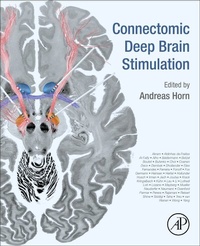
Connectomic Deep Brain Stimulation
Published on 13. September 2021
Book
Paperback/Softback
600 pages
978-0-12-821861-7 (ISBN)
Description
Connectomic Deep Brain Stimulation (DBS) covers this highly efficacious treatment option for movement disorders such as Parkinson's Disease, Essential Tremor and Dystonia. The book examines its impact on distributed brain networks that span across the human brain in parallel with modern-day neuroimaging concepts and the connectomics of the brain. It asks several questions, including which cortical areas should DBS electrodes be connected in order to generate the highest possible clinical improvement? Which connections should be avoided? Could these connectomic insights be used to better understand the mechanism of action of DBS? How can they be transferred to individual patients, and more.
This book is suitable for neuroscientists, neurologists and functional surgeons studying DBS. It provides practical advice on processing strategies and theoretical background, highlighting and reviewing the current state-of-the-art in connectomic surgery.
This book is suitable for neuroscientists, neurologists and functional surgeons studying DBS. It provides practical advice on processing strategies and theoretical background, highlighting and reviewing the current state-of-the-art in connectomic surgery.
More details
Language
English
Place of publication
San Diego
United States
Publishing group
Elsevier Science Publishing Co Inc
Target group
Professional and scholarly
Illustrations
Approx. 100 illustrations (100 in full color); Illustrations
Dimensions
Height: 235 mm
Width: 191 mm
Weight
1180 gr
ISBN-13
978-0-12-821861-7 (9780128218617)
Copyright in bibliographic data and cover images is held by Nielsen Book Services Limited or by the publishers or by their respective licensors: all rights reserved.
Schweitzer Classification
Other editions
Additional editions
Andreas Horn
Connectomic Deep Brain Stimulation
E-Book
09/2021
Academic Press
€155.00
Available for download
Person
Andreas Horn is the Director of Deep Brain Stimulation Research within the Center for Brain Circuit Therapeutics at Brigham and Women's Hospital and Director of Connectomic Neuromodulation Research at Massachusetts General Hospital. Furthermore, he leads the network stimulation laboratory in Boston and Berlin (www.netstim.org), where the main aims are to analyze and modulate brain networks that may improve treatment for various brain disorders. Central to the laboratory is the procedure of deep brain stimulation, in which fine electrodes are stereotactically implanted into deep structures of the brain to deliver weak electric pulses to specific structures. A second key concept is the one of the human connectome: A mathematical description of brain regions and their interconnections - in other words, a wiring-diagram of the human brain. By leveraging this concept, the laboratory investigates the impact of focal and multifocal brain stimulation techniques on distributed whole-brain networks. The laboratory leads development of an award-winning and widely used open source software (www.lead-dbs.org) that facilitates these kinds of studies. By developing this software alongside critical methodology, the laboratory was able to combine research on the fields of deep brain stimulation and the human connectome over the last ten years. In doing so, the laboratory has published central work toward establishing a novel and growing field of connectomic deep brain stimulation.
Content
Part I: Deep Brain Stimulation and Connectomics - A Fruitful Marriage?
1. Deep Brain Stimulation - an Introduction
2. The "connectomic revolution? in the field of neuroimaging
3. The mechanism of deep brain stimulation
Part II: DBS Imaging Methods
4. DBS Imaging - An Overview
5. DBS Imaging Methods I: Preprocessing
6. DBS Imaging Methods II: Electrode Localization
7. DBS Imaging Methods III: Estimating the electric field and Volume of Tissue Activated
8. DBS Imaging Methods IV: Stereotactic Spaces
9. DBS Imaging Methods IV: Group Analyses
Part III: Connectomics in DBS
10. Resting-State functional MRI based Connectivity
11. Diffusion-weighted MRI based Connectivity
12. Normative Connectomes and their use in DBS
13. Investigating Network Effects of DBS with fMRI
14. High-Resolution Resources and Histological Mesh Tractography
15. Using brain lesions to inform connectomic DBS
16. Electrophysiological connectivity measures from DBS-targets in Parkinson's disease and Dystonia
Part IV: Applications of Connectomic DBS
17. Predicting treatment response on a local level
18. Predicting treatment response based on DBS connectivity
19. Connectomic DBS in Parkinson's Disease, Essential Tremor and Dystonia
20. Connectomic DBS in Major Depression
21. Connectomic DBS in Obsessive Compulsive Disorder
22. Connectomics in the Operation Room
23. Investigating cognitive neuroscience concepts using connectomic DBS
24. Combining invasive and noninvasive neuromodulation techniques via connectomics
Part V: Outlook
25. Outlook: Toward Personalized Connectomic Deep Brain Stimulation
26. Whole-brain modelling to predict optimal DBS targeting
1. Deep Brain Stimulation - an Introduction
2. The "connectomic revolution? in the field of neuroimaging
3. The mechanism of deep brain stimulation
Part II: DBS Imaging Methods
4. DBS Imaging - An Overview
5. DBS Imaging Methods I: Preprocessing
6. DBS Imaging Methods II: Electrode Localization
7. DBS Imaging Methods III: Estimating the electric field and Volume of Tissue Activated
8. DBS Imaging Methods IV: Stereotactic Spaces
9. DBS Imaging Methods IV: Group Analyses
Part III: Connectomics in DBS
10. Resting-State functional MRI based Connectivity
11. Diffusion-weighted MRI based Connectivity
12. Normative Connectomes and their use in DBS
13. Investigating Network Effects of DBS with fMRI
14. High-Resolution Resources and Histological Mesh Tractography
15. Using brain lesions to inform connectomic DBS
16. Electrophysiological connectivity measures from DBS-targets in Parkinson's disease and Dystonia
Part IV: Applications of Connectomic DBS
17. Predicting treatment response on a local level
18. Predicting treatment response based on DBS connectivity
19. Connectomic DBS in Parkinson's Disease, Essential Tremor and Dystonia
20. Connectomic DBS in Major Depression
21. Connectomic DBS in Obsessive Compulsive Disorder
22. Connectomics in the Operation Room
23. Investigating cognitive neuroscience concepts using connectomic DBS
24. Combining invasive and noninvasive neuromodulation techniques via connectomics
Part V: Outlook
25. Outlook: Toward Personalized Connectomic Deep Brain Stimulation
26. Whole-brain modelling to predict optimal DBS targeting