

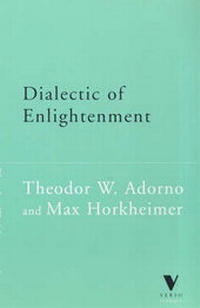
Dialectic of Enlightenment
Published on 1. January 1997
Book
Paperback/Softback
270 pages
978-1-85984-154-9 (ISBN)
Description
Dialectic of Enlightenment is, quite justifiably, one of the most celebrated and often cited works of modern social philosophy. It has been identified as the keystone of the 'Frankfurt School' of which Theodor Adorno and Max Horkheimer were the leading members, and does not cease to impress in its wide-randing ambition and panache.
Adorno and Horkheimer addressed themselves to a question which went to the very heart of the modern age, namely 'why mankind, instead of entering into a truly human condition, is sinking into a new kind of barbarism'. Modernity, far from redeeming the promises and hopes of the Enlightenment, had resulted in a stultification of mankind and administered society, characterised by simulation and candy-floss entertainment.
To seek an answer to the questions of how such a condition could arise, Adorno and Horkheimer subjected the whole history of Western categories of reason and nature, from Homer to Nietzche, to a searching philosophical and psychological critique. Drawing on psychoanalytical insights, their own work on the 'culture industry', deep knowledge of the key Enlightenment and anti-Enlightenment thinkers, as well as fascinating considerations on the relationship between reason and myth-the rational and the irrational-the authors exposed the domination and violence towards both nature and humanity that underpin the Enlightenment project.
Adorno and Horkheimer addressed themselves to a question which went to the very heart of the modern age, namely 'why mankind, instead of entering into a truly human condition, is sinking into a new kind of barbarism'. Modernity, far from redeeming the promises and hopes of the Enlightenment, had resulted in a stultification of mankind and administered society, characterised by simulation and candy-floss entertainment.
To seek an answer to the questions of how such a condition could arise, Adorno and Horkheimer subjected the whole history of Western categories of reason and nature, from Homer to Nietzche, to a searching philosophical and psychological critique. Drawing on psychoanalytical insights, their own work on the 'culture industry', deep knowledge of the key Enlightenment and anti-Enlightenment thinkers, as well as fascinating considerations on the relationship between reason and myth-the rational and the irrational-the authors exposed the domination and violence towards both nature and humanity that underpin the Enlightenment project.
Reviews / Votes
A classic of twentieth-century thought. * Times Literary Supplement * A sustained and serious critique of Western civilization. * Times Higher Education Supplement *More details
Series
Language
English
Place of publication
London
United Kingdom
Target group
College/higher education
Professional and scholarly
Dimensions
Height: 198 mm
Width: 129 mm
ISBN-13
978-1-85984-154-9 (9781859841549)
Copyright in bibliographic data and cover images is held by Nielsen Book Services Limited or by the publishers or by their respective licensors: all rights reserved.
Schweitzer Classification
Other editions
New editions
Max Horkheimer | Theodor Adorno
Dialectic of Enlightenment
Book
09/2016
Verso Books
€20.00
Available immediately
Persons
Theodor Adorno was director of the Institute for Social Research at the University of Frankfurt. His works include Aesthetic Theory and Negative Dialectics.
Max Horkheimer (1895-1973) was a philosopher and sociologist of the Frankfurt School. His books include A Critique of Instrumental Reason.
Max Horkheimer (1895-1973) was a philosopher and sociologist of the Frankfurt School. His books include A Critique of Instrumental Reason.