

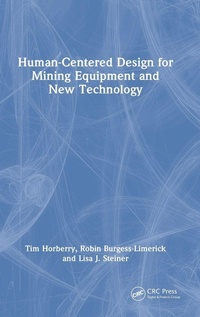
Human-Centered Design for Mining Equipment and New Technology
1st Edition
Published on 5. March 2018
Book
Hardback
125 pages
978-1-138-09514-4 (ISBN)
Description
Human-Centered Design for Mining Equipment and New Technology first introduces Human-Centered Design (HCD) and outlines the benefits of this approach for mining equipment and new technology: HCD is a process that aims to make equipment and systems more usable and acceptable by explicitly focusing on the end-user, their tasks and their work environment/use context. The book outlines three linked areas of mining HCD: key principles, examples of design processes, and what kinds of tools for data collection and evaluation are available.
The possible future uses of Human-Centered Design in more fully automated mining are presented, and the role of HCD within wider human system integration are outlined. The 'how to' nature of this book makes it attractive to mining equipment manufacturers, technology developers, mine site personnel, human factors researchers, safety scientists and regulators.
Features:
Includes an introduction useful to anyone wanting to learn about the field
Provides extensive case studies of HCD which also show failures when HCD was not considered
Covers cutting edge mining technology- such as proximity detection devices and new mining automation systems
Directly outlines the benefits of HCD for the minerals industry
Human-Centered Design for Mining Equipment and New Technology, through case studies, provides a much needed guide to undertaking HCD for mining equipment and new technology.
The possible future uses of Human-Centered Design in more fully automated mining are presented, and the role of HCD within wider human system integration are outlined. The 'how to' nature of this book makes it attractive to mining equipment manufacturers, technology developers, mine site personnel, human factors researchers, safety scientists and regulators.
Features:
Includes an introduction useful to anyone wanting to learn about the field
Provides extensive case studies of HCD which also show failures when HCD was not considered
Covers cutting edge mining technology- such as proximity detection devices and new mining automation systems
Directly outlines the benefits of HCD for the minerals industry
Human-Centered Design for Mining Equipment and New Technology, through case studies, provides a much needed guide to undertaking HCD for mining equipment and new technology.
More details
Series
Language
English
Place of publication
London
United Kingdom
Publishing group
Taylor & Francis Ltd
Target group
Professional and scholarly
Professional Practice & Development
Illustrations
28 s/w Abbildungen, 12 farbige Abbildungen
12 Illustrations, color; 28 Illustrations, black and white
Dimensions
Height: 240 mm
Width: 161 mm
Thickness: 13 mm
Weight
388 gr
ISBN-13
978-1-138-09514-4 (9781138095144)
Copyright in bibliographic data and cover images is held by Nielsen Book Services Limited or by the publishers or by their respective licensors: all rights reserved.
Schweitzer Classification
Other editions
Additional editions
Tim Horberry | Robin Burgess-Limerick | Lisa J. Steiner
Human-Centered Design for Mining Equipment and New Technology
Book
02/2018
1st Edition
CRC Press
€113.40
Shipment within 10-20 days
Tim Horberry | Robin Burgess-Limerick | Lisa J. Steiner
Human-Centered Design for Mining Equipment and New Technology
E-Book
02/2018
1st Edition
CRC Press
€96.49
Available for download
Persons
Professor Tim Horberry leads the Human Factors team at Monash University Accident Research Centre in Australia. He recently was a Senior Visiting Researcher on a 'Safety in Design Ergonomics' Fellowship at Cambridge University in England. Tim's background is in human factors, safe design and transport/mining safety. Email tim.horberry@monash.edu
Professor Robin Burgess-Limerick is Professorial Research Fellow at the Minerals Industry Safety and Health Centre, Sustainable Minerals Institute, The University of Queensland, Australia. Robin has been a qualified Ergonomist for over 20 years, and is a past-President and Fellow of the Human Factors and Ergonomics Society of Australia.
Dr. Lisa Steiner is Associate Director of Science at the Pittsburgh Mining Research Division at the National Institute for Occupational Safety & Health, Pittsburgh, USA. She completed her PhD 'Reducing Underground Coal Roof Bolting Injury Risks through Equipment Design' at the University of Queensland, Australia in 2014.
Professor Robin Burgess-Limerick is Professorial Research Fellow at the Minerals Industry Safety and Health Centre, Sustainable Minerals Institute, The University of Queensland, Australia. Robin has been a qualified Ergonomist for over 20 years, and is a past-President and Fellow of the Human Factors and Ergonomics Society of Australia.
Dr. Lisa Steiner is Associate Director of Science at the Pittsburgh Mining Research Division at the National Institute for Occupational Safety & Health, Pittsburgh, USA. She completed her PhD 'Reducing Underground Coal Roof Bolting Injury Risks through Equipment Design' at the University of Queensland, Australia in 2014.
Content
List of Table and Figure Captions
Foreword
Acknowledgements
Authors
Glossary of Terms and Acronyms
Chapter 1 Why HCD for Mining Equipment?
Chapter 2 Principles, Processes, and Tools for HCD
Chapter 3 Current Status of Mining HCD
Chapter 4 HCD Educational Material
Chapter 5 HCD Case Studies
Chapter 6 What Now for Mining HCD?
References
Index
Foreword
Acknowledgements
Authors
Glossary of Terms and Acronyms
Chapter 1 Why HCD for Mining Equipment?
Chapter 2 Principles, Processes, and Tools for HCD
Chapter 3 Current Status of Mining HCD
Chapter 4 HCD Educational Material
Chapter 5 HCD Case Studies
Chapter 6 What Now for Mining HCD?
References
Index