

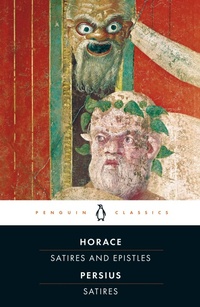
The Satires of Horace and Persius
Published on 29. September 2005
Book
Paperback/Softback
256 pages
978-0-14-045508-3 (ISBN)
Description
The Satires of Horace (65-8 BC), written in the troubled decade ending with the establishment of Augustus' regime, provide an amusing treatment of men's perennial enslavement to money, power, glory and sex. Epistles I, addressed to the poet's friends, deals with the problem of achieving contentment amid the complexities of urban life, while Epistles II and the Ars Poetica discuss Latin poetry - its history and social functions, and the craft required for its success. Both works have had a powerful influence on later Western literature, inspiring poets from Ben Jonson and Alexander Pope to W. H. Auden and Robert Frost. The Satires of Persius (AD 34-62) are highly idiosyncratic, containing a courageous attack on the poetry and morals of his wealthy contemporaries - even the ruling emperor, Nero.
More details
Language
English
Place of publication
London
United Kingdom
Publishing group
Penguin Books Ltd
Product notice
Paperback (UK-B)
Dimensions
Height: 198 mm
Width: 129 mm
Thickness: 20 mm
Weight
191 gr
ISBN-13
978-0-14-045508-3 (9780140455083)
Copyright in bibliographic data and cover images is held by Nielsen Book Services Limited or by the publishers or by their respective licensors: all rights reserved.
Schweitzer Classification
Other editions
Additional editions
Horace | Persius
The Satires of Horace and Persius
E-Book
09/2005
1st Edition
Penguin Books Ltd
€9.49
Available for download
Persons
Horace (65 BC-8 BC), or Quintus Horatius Flaccus, was a Roman lyric poet, satirist, and literary critic. He is generally considered one of the greatest lyric poets of the world. Aules Persius Flaccus was born in AD 34 in Etruria. Rich and well connected, he knew Lucan, Thrasea Paetus, and other members of the opposition to Nero's rule. His friendship with the philosopher Cornutus began when he was sixteen and remained a strong influence until his death at the age of twenty-seven. Although the satires are concerned with moral questions- a fact which endeared Persius to the Church Fathers and won him admiration in the Middle Ages and Renaissance- their main interest for us lies in their condensed, allusive, and highly metaphorical style.