

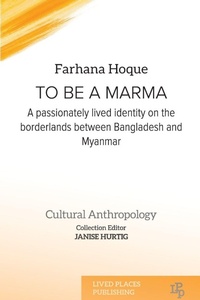
To be a Marma
A passionately lived identity on the borderlands between Bangladesh and Myanmar
Published on 22. August 2022
Book
Paperback/Softback
266 pages
978-1-915271-18-1 (ISBN)
Description
How does being located in borderlands impact cultural identity, through both assimilation and distinctness?
This exploration of the self-identified Marma group, the second largest ethnic group in the Chittagong Hill Tracts (CHT) of Bangladesh, discusses various aspects of identity creation, maintenance and adaptation in the unique setting of the geo-political border between South and Southeast Asia. With the fluidity of change and ethnic composition that is typical of geographical borders, the expectation is constant adaptation resulting in slow change of cultural identity over time. In the Marma case, adaptations are made in order to maintain their cultural distinctiveness.
Drawing from stories of the people who hold this identity, the book considers how cultural groups navigate the constant demands on their identity whilst living in borderlands.
More details
Series
Language
English
Product notice
Paperback (trade)
Unsewn / adhesive bound
Dimensions
Height: 229 mm
Width: 152 mm
Thickness: 15 mm
Weight
390 gr
ISBN-13
978-1-915271-18-1 (9781915271181)
Copyright in bibliographic data and cover images is held by Nielsen Book Services Limited or by the publishers or by their respective licensors: all rights reserved.
Schweitzer Classification
Other editions
Additional editions
Farhana Hoque
To Be a Marma
A Passionately Lived Identity on the Borderlands Between Bangladesh and Myanmar
E-Book
08/2022
1st Edition
Lived Places Publishing
€26.49
Available for download
Persons
Dr Farhana Hoque PhD conducted her doctoral research at University College London in the social anthropology of the Chittagong Hill Tracts in Bangladesh. She holds an MA in Social Anthropology from the Vrije University, with a specialism in Medical Anthropology from the University of Amsterdam in The Netherlands and a BA(Hons) in History and Politics from Liverpool University in the UK. Her work on marginalised communities began with a study of women and their reproductive health in Bamako in Mali in the 1990s and continued in her volunteering work at Amnesty International during the Sierra Leone Civil War. She has two children and lives in South London.