

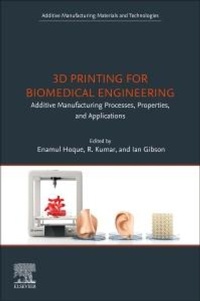
3D Printing for Biomedical Engineering
Additive Manufacturing Processes, Properties, and Applications
Published on 29. October 2025
Book
Paperback/Softback
680 pages
978-0-443-16100-1 (ISBN)
Description
3D Printing for Biomedical Engineering: Additive Manufacturing Processes, Properties, and Applications combines cutting-edge research developments with fundamental concepts related to processing, properties, and applications of advanced additive manufacturing technology in the medical field. State-of-the-art 3D bioprinting techniques such as the manufacturing of mini-organs for new drug testing as an alternative to animal testing are covered, as are reverse engineering techniques for the improvement of additive manufactured biomedical products. The book starts with chapters introducing readers to currently available additive manufacturing techniques for biomedical prototypes, along with design, development, process, and parameter considerations for these methods.
Following chapters cover the mechanical, thermal, electrical, and optical properties of 3D printed biomedical prototypes. The next section of the book discusses 3D printing in different biomedical fields, such as in heart surgery, intervertebral disc implants, dentistry, facial reconstructive surgery, oral surgery, spinal surgery, and more. The book concludes with a section outlining immediate and future challenges in the field as well as related environmental and ethical issues.
Following chapters cover the mechanical, thermal, electrical, and optical properties of 3D printed biomedical prototypes. The next section of the book discusses 3D printing in different biomedical fields, such as in heart surgery, intervertebral disc implants, dentistry, facial reconstructive surgery, oral surgery, spinal surgery, and more. The book concludes with a section outlining immediate and future challenges in the field as well as related environmental and ethical issues.
More details
Series
Language
English
Place of publication
Philadelphia
United States
Target group
Professional and scholarly
Dimensions
Height: 229 mm
Width: 154 mm
Thickness: 36 mm
Weight
1084 gr
ISBN-13
978-0-443-16100-1 (9780443161001)
Copyright in bibliographic data and cover images is held by Nielsen Book Services Limited or by the publishers or by their respective licensors: all rights reserved.
Schweitzer Classification
Other editions
Additional editions
Md Enamul Hoque Ph. D | R. Kumar | Ian Gibson
3D Printing for Biomedical Engineering
Additive Manufacturing Processes, Properties, and Applications
E-Book
11/2025
Elsevier
€220.00
Available for download
Persons
Prof. Dr. Md Enamul Hoque is a Professor in the Department of Mechanical Engineering, Faculty of Engineering, at the University of Tabuk, Saudi Arabia. Prior to joining the University of Tabuk, he held several senior academic and leadership positions at internationally reputed institutions. These include Senior Professor of Biomedical Engineering at the Military Institute of Science and Technology (MIST), Bangladesh; Head of the Department of Biomedical Engineering at King Faisal University (KFU), Saudi Arabia; and Founding Head of the Bioengineering Division at the University of Nottingham Malaysia Campus (UNMC). Professor Hoque obtained his PhD in 2007 from the National University of Singapore (NUS), Singapore. He also earned a Postgraduate Certificate in Higher Education (PGCHE) from the University of Nottingham, United Kingdom, in 2015. He is a Chartered Engineer (CEng) registered with the Engineering Council, UK; a Fellow of the Institution of Mechanical Engineers (FIMechE), UK; a Fellow of the Higher Education Academy (FHEA), UK; and a Member of the World Academy of Science, Engineering and Technology. He has been ranked among the top 2% of scientists worldwide, based on standardized citation metrics.
Dr. R. Kumar is an Associate Professor in the Department of Mechanical Engineering at Eritrea Institute of Technology. His research interests include manufacturing, friction drilling, welding, and machining of aluminum, polymer composites and metal matrix composites. Ian Gibson is a professor in Industrial Design Engineering and Scientific Director of the University's Fraunhofer Project Centre in complex systems engineering at the University of Twente. His first teaching position was at Nottingham University in 1992, where he was introduced to Rapid Prototyping, which is now more commonly known as 3D Printing (3DP) or Additive Manufacturing (AM). Ian has spent the last 25+ years working with this extremely enabling technology to solve problems in healthcare, automotive, aerospace, and other industrial sectors by engaging in applied research. In 2017, Ian was awarded the Freeform and Additive Manufacturing Excellence (FAME) award in the US for his contribution to the academic AM community, something that only 9 other people have so far received.
Dr. R. Kumar is an Associate Professor in the Department of Mechanical Engineering at Eritrea Institute of Technology. His research interests include manufacturing, friction drilling, welding, and machining of aluminum, polymer composites and metal matrix composites. Ian Gibson is a professor in Industrial Design Engineering and Scientific Director of the University's Fraunhofer Project Centre in complex systems engineering at the University of Twente. His first teaching position was at Nottingham University in 1992, where he was introduced to Rapid Prototyping, which is now more commonly known as 3D Printing (3DP) or Additive Manufacturing (AM). Ian has spent the last 25+ years working with this extremely enabling technology to solve problems in healthcare, automotive, aerospace, and other industrial sectors by engaging in applied research. In 2017, Ian was awarded the Freeform and Additive Manufacturing Excellence (FAME) award in the US for his contribution to the academic AM community, something that only 9 other people have so far received.
Content
Section A: Introduction, Fabrication, Properties and Testing
1. Introduction to 3D Printing Technologies and Biomedical Prototypes
2. 3D Printing Methods for Making Biomedical Components: Process and Parameters
3. Design and Development of Biomedical Devices
4. Mechanical Properties of 3D Printed Biomedical Prototypes
5. Thermal Properties of 3D Printed Biomedical Prototypes
6. Dielectric and Optical Properties of 3D Printed Biomedical Prototypes
7. Surface Properties of 3D Printed Biomedical Prototypes
8. Errors and Accuracy of 3D Printed Biomedical Prototypes
9. Improvement of 3D Printing with Reverse Engineering
Section B: Implementation of 3D Printing in Biomedical Fields
10. 3D Printing for Congenital Heart Surgery
11. 3D Printing for Cranioplasty Implants
12. 3D Printing for Customized Intervertebral Disc Implants
13. 3D Printing for Dentistry
14. 3D Printing for Facial Reconstructive Surgery
15. 3D Printing for Oral and Maxillofacial Surgery
16. 3D Printing for Orthopaedic Surgery
17. 3D Printing for Prosthetic Sockets
18. 3D Printing for Repairing Fracture Bone Defects
19. 3D Printing for Spinal Surgery
20. 3D Printing for Surgical Aid Tools
21. 3D Printing for Tissue Engineering
22. 3D Printing for Therapeutic Strategy
Section C: Challenges, Risks and Scopes
23. Opportunities, Challenges and Potentials of 3DPrinting
24. Environmental Issues and Welfares of 3D Printing
25. Ethical and Legal Issues with 3D Printing
1. Introduction to 3D Printing Technologies and Biomedical Prototypes
2. 3D Printing Methods for Making Biomedical Components: Process and Parameters
3. Design and Development of Biomedical Devices
4. Mechanical Properties of 3D Printed Biomedical Prototypes
5. Thermal Properties of 3D Printed Biomedical Prototypes
6. Dielectric and Optical Properties of 3D Printed Biomedical Prototypes
7. Surface Properties of 3D Printed Biomedical Prototypes
8. Errors and Accuracy of 3D Printed Biomedical Prototypes
9. Improvement of 3D Printing with Reverse Engineering
Section B: Implementation of 3D Printing in Biomedical Fields
10. 3D Printing for Congenital Heart Surgery
11. 3D Printing for Cranioplasty Implants
12. 3D Printing for Customized Intervertebral Disc Implants
13. 3D Printing for Dentistry
14. 3D Printing for Facial Reconstructive Surgery
15. 3D Printing for Oral and Maxillofacial Surgery
16. 3D Printing for Orthopaedic Surgery
17. 3D Printing for Prosthetic Sockets
18. 3D Printing for Repairing Fracture Bone Defects
19. 3D Printing for Spinal Surgery
20. 3D Printing for Surgical Aid Tools
21. 3D Printing for Tissue Engineering
22. 3D Printing for Therapeutic Strategy
Section C: Challenges, Risks and Scopes
23. Opportunities, Challenges and Potentials of 3DPrinting
24. Environmental Issues and Welfares of 3D Printing
25. Ethical and Legal Issues with 3D Printing