

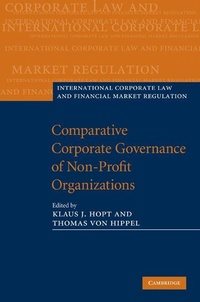
Comparative Corporate Governance of Non-Profit Organizations
1st Edition
Published on 22. April 2010
Book
Hardback
1048 pages
978-0-521-76184-0 (ISBN)
Description
The economic importance of the non-profit sector is growing rapidly in the USA and Europe. However, the law has not kept abreast with its development. The European Court of Justice has extended certain freedoms of the EC Treaty to non-profit organisations, and more case law is expected to follow in the near future, but the observations, theories, solutions and legal and non-legal rules in this field are manifold. The chances of harmonising the law on a European level are slim. Despite these differences, a common core of international corporate governance problems and regulatory solutions can be seen. This volume of essays brings together a variety of international experts from both corporate governance and governance of non-profit organisations to compare the two areas and explore the lessons that can be learned regarding comparative corporate governance for non-profit organisations.
More details
Series
Language
English
Place of publication
Cambridge
United Kingdom
Target group
Professional and scholarly
Illustrations
4 Tables, unspecified
Dimensions
Height: 235 mm
Width: 157 mm
Thickness: 60 mm
Weight
1635 gr
ISBN-13
978-0-521-76184-0 (9780521761840)
Copyright in bibliographic data and cover images is held by Nielsen Book Services Limited or by the publishers or by their respective licensors: all rights reserved.
Schweitzer Classification
Other editions
Additional editions
Klaus J. Hopt | Thomas Von Hippel
Comparative Corporate Governance of Non-Profit Organizations
E-Book
05/2010
Cambridge University Press
€196.99
Available for download
E-Book
04/2010
Cambridge University Press
€164.99
Available for download
Persons
Klaus J. Hopt is Professor of Law and Director Emeritus at the Max Planck Institute for Comparative and International Private Law, Hamburg. Thomas Von Hippel is a project coordinator of several interdisciplinary and legal comparative research projects on non-profit organisations, foundations, taxation and philanthropy.
Content
Part I. Economic Findings and Theories on Non-Profit Organizations: 1. The non-profit sector: introductory remarks; What kind of non-profit sector, what kind of society? Comparative policy reflections Helmut K. Anheier; 2. Good and not so good governance of non-profit organizations: factual observations from the USA and Europe; Good and not so good governance of non-profit organizations: factual observations from the USA John A. Edie; Good and not so good governance of non-profit organizations: factual observations from foundations in Germany Christoph Mecking; 3. Economic theories of non-profit organizations; The economics of non-profit organizations Henry Hansmann; principle-agent theory and non-profit accountability Richard Steinberg; Part II. The Non-Profit Sector: Private Law, Trust Law, Tax Law in Selected Countries: 4. Anglo-American countries; Non-profit organizations in the United States James Fishman; Harmonising non-profit law in the European Union: an English perspective and digest Hubert Picarda; 5. Germanic countries; Non-profit organizations in Germany Thomas von Hippel; Non-profit organizations in the Netherlands Tymen J. van der Ploeg; 6. Romanic countries; Non-profit organizations in France Katrin Deckert; 7. Transformation countries; Non-profit organizations in Hungary Zoltan Csehi; Non-profit organizations in the Czech Republic Katerina Ronovska; Non-profit organizations in the People's Republic of China Thomas Von Hippel and Knut B. Pissler; Part III. The Board of Non-Profit Organizations: 8. The board of non-profit organizations: law and practice; The board of non-profit organizations: puzzling through the gaps between law and practice: a view from the United States Evelyn Brody; The board of non-profit organizations: some corporate governance thoughts from Europe Klaus J. Hopt; 9. The duty of obedience; Rediscovering the duty of obedience: Toward a trinitarian theory of fiduciary duty Robert Atkinson; Duty of obedience: the German perspective Rainer Huettemann; Part IV. Good Governance of Non-Profit Organizations: Activities and Regulatory Problems: 10. Fundraising; Regulation of fundraising by charities and voluntary organisations in England and Wales Peter Luxton; Comparing regulation of fundraising: self-regulation or governmental regulation? W. J. M. van Veen; 11. Asset management in non-profit organizations; asset management in non-profit organizations Carsten Carstensen; Legal standards for capital investments by foundations in hedge funds according to German and American law Maximilian Haag and Andreas Richter; 12. Non-profit organizations and economic activities/Enterprises; Non-profit organizations and economic activities/enterprises Carl Hemstroem; Non-profit organizations and enterprises: the Danish foundation law as an example Soeren Friis Hansen; Part V. Good Governance of Non-Profit Organizations: Internal Governance, Self-Regulation, Disclosure and Supervision: 13. Internal governance and self-regulation; The protection of members and creditors of non-profit organisations Susanne Kalss; Foundation governance in Switzerland Thomas Sprecher; 14. Disclosure, reporting, auditing; Financial reporting by non-profit organizations: United States developments Stanley Siegel; Charity commission regulation of the charity sector in England and Wales: the key role of charity audit regulation Greyham Dawes; 15. Enforcement by state supervision and tax authorities; The charity commission for England and Wales Richard Fries; Internal revenue service and states revenue department oversight of non-profit organizations in the United States John D. Colombo; Tax law as an instrument to strengthen the corporate governance of the non-profit sector Thomas von Hippel and Rainer Walz.