

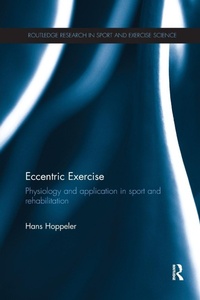
Eccentric Exercise
Physiology and application in sport and rehabilitation
1st Edition
Published on 1. June 2016
Book
Paperback/Softback
198 pages
978-1-138-69522-1 (ISBN)
Description
Eccentric muscle contraction, during which a muscle lengthens while under tension, is a fundamental process of human movement but a surprisingly under-researched area of exercise science. Evidence suggests that training programmes which incorporate both eccentric and concentric contractions can result in greater strength gains than concentric contractions alone, and this clearly has important implications for training and rehabilitation in sport and health.
In Eccentric Exercise, leading international sport scientist Hans Hoppeler introduces the fundamental physiology and pathophysiology of eccentric muscle work, and explores the key applications of eccentric exercise in sport, rehabilitation and health. The book examines the molecular mechanisms responsible for tissue and organismic adaptations and discusses eccentric muscle-related pathology, specifically delayed onset muscle soreness. It assesses the use of eccentric exercise training in the treatment of certain disease states such as chronic obstructive pulmonary disease, heart insufficiency and sarcopenia, while a concluding chapter points to open research questions, shows the limits of the available data and highlights problems with current exercise modalities.
This book is important reading for all sport and exercise scientists, clinicians working in rehabilitation, and high-level strength and conditioning coaches and trainers.
In Eccentric Exercise, leading international sport scientist Hans Hoppeler introduces the fundamental physiology and pathophysiology of eccentric muscle work, and explores the key applications of eccentric exercise in sport, rehabilitation and health. The book examines the molecular mechanisms responsible for tissue and organismic adaptations and discusses eccentric muscle-related pathology, specifically delayed onset muscle soreness. It assesses the use of eccentric exercise training in the treatment of certain disease states such as chronic obstructive pulmonary disease, heart insufficiency and sarcopenia, while a concluding chapter points to open research questions, shows the limits of the available data and highlights problems with current exercise modalities.
This book is important reading for all sport and exercise scientists, clinicians working in rehabilitation, and high-level strength and conditioning coaches and trainers.
More details
Series
Language
English
Place of publication
London
United Kingdom
Publishing group
Taylor & Francis Ltd
Target group
College/higher education
Illustrations
31 s/w Photographien bzw. Rasterbilder, 26 s/w Zeichnungen
26 Line drawings, black and white; 31 Halftones, black and white
Dimensions
Height: 234 mm
Width: 156 mm
Thickness: 12 mm
Weight
330 gr
ISBN-13
978-1-138-69522-1 (9781138695221)
Copyright in bibliographic data and cover images is held by Nielsen Book Services Limited or by the publishers or by their respective licensors: all rights reserved.
Schweitzer Classification
Other editions
Additional editions
Book
08/2014
1st Edition
Routledge
€231.50
Shipment within 15-20 days
E-Book
08/2014
1st Edition
Routledge
€64.49
Available for download
E-Book
08/2014
1st Edition
Routledge
€64.49
Available for download
Person
Hans Hoppeler was born in Switzerland in 1948, is married, has four adult children and lives in Bern. He studied Medicine at the University of Bern and worked as an MD at the Hospital of Burgdorf for three years before taking up an academic career. His main research interests are the plasticity of skeletal muscle tissue from the molecular to motion, as well as the design of the respiratory system. He has authored or co-authored over 300 publications, which have been cited over 10,000 times. He is a member of the Leopoldina and the Swiss Academies of Medical Sciences.
Content
1. Muscle Structure and Function 2. Modes of Muscle Contraction 3. Properties of Eccentric Contractions 4. Eccentric Exercise in Resistance Training 5. Moderate Load Eccentric Exercise 6. The Role of Eccentric Exercise Training in Alpine Skiers 7. Eccentric Exercise in Orthopedic Rehabilitation and Injury Prevention 8. Eccentric Exercise in Medical Conditions with Muscle Wastage.