

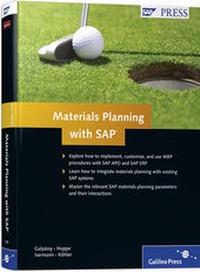
Materials Planning with SAP
SAP ERP and SAP APO
1st Edition
Published on 25. August 2009
Book
Hardback
564 pages
978-1-59229-259-2 (ISBN)
Description
All manufacturing businesses will face the problem of not having enough product to meet customer demand, but this can be avoided with good o avoid or manufacturing and material planning (MRP) is required. With this comprehensive reference users will learn how to implement, optimize, and use SAP ERP and APO for effective material planning. They'll learn about cross-component material planning with SAP ERP 6.0 (MM, PP, SD) and SAP SCM 5.1 (APO), and review modern MRP procedures. And they'll discover how to configure and use the different SAP ERP applications and integrate them with an existing SAP system. In addition, the topics of how to optimize the tools and determine which settings are useful and how they affect other settings are covered.The book uses SAP screenshots and diagrams to illustrate key points, and includes numerous examples, check lists, and other useful information to clarify the topics.
Highlights:
Strategic versus Operational Materials Planning
Item Classification
MRP Parameters
Planning and Forecast Methods
Planning Strategies and Requirements Consumption
MRP Procedures
Procurement Quantity Calculation
Safety Stock Planning
Determination of the Sources of Supply Scheduling
Interactions
MRP Optimization
Processing of the MRP Results
Global ATP, VMI and SMI
Kanban
Inventory Controlling
More details
Other editions
New editions
Uwe Goehring
Materials Planning with SAP ERP
Book
10/2015
1st Edition
SAP PRESS
€79.95
Shipment within 10-15 days
Persons
Author
After finishing his studies in business administration at Fachhochschule Nordostniedersachsen in Lüneburg, Germany, and at John Moores University in Liverpool, England, Marc Hoppe joined CAS AG, Germany as an SAP developer in the logistics and production planning areas. Later, he became a logistics consultant and was responsible for implementing national and international SAP R/3 projects. Since 1998, he has worked as a Supply Chain Management (SCM) consultant at SAP SI AG. Marc Hoppe is responsible for the business-relevant and IT-based implementation and optimization of SCM processes, as well as the re-engineering of entire supply chain processes. In 2001, he became Consulting Director for SCM, and since 2003, he has managed additionally the Supplier Relationship Management (SRM) unit. Marc Hoppe consults for large corporations such as Siemens, Unilever, Gillette, Philips, Deutsche Telekom, and Philip Morris, as well as medium-sized companies like G+H Isover or Fertiva. He has published numerous works on inventory optimization.
Ferenc Gulyássy has worked as an SCM consultant at SAP Deutschland AG & Co. KG since completing his degree in business administration and economics at the University of Cologne in Germany. The focus of his work is capacity-based project and production planning. Within the framework of PS, PP, PP/DS, and CTM components and functions, he has implemented a wide range of projects for large companies such as Siemens, Bosch, and GEA, and medium-sized businesses such as Metabo and Samas. His activities in addition to implementing SAP systems include optimizing system settings to improve processes. Based on these experiences, he played a significant role in the specialist design of the SAP Consulting add-on tools for optimizing MRP settings.
Martin Isermann works as an SCM consultant for SAP Deutschland AG & Co. KG. He graduated with a degree in industrial engineering as part of a dual-mode degree program in combination with the German FH Nordakademie university and Airbus Deutschland GmbH, with work and study placements in Hamburg, Germany; Toulouse, France; and at the University of Nottingham, England. He later qualified as a Master of Science in industrial and systems engineering on a U.S. Fulbright scholarship at the University of Florida, USA. His consulting activities are focused on materials planning and production planning with SAP ERP and SAP SCM (SAP APO). He has worked in this area on a large number of international projects for companies such as Siemens, Daimler, and the Schaeffler Group. In the area of process consulting, he has also managed several inventory and materials planning optimization projects for medium-sized customers, including the SHT Group, Samas, and KHS AG.
Oliver Köhler has worked as a logistics consultant and developer at SAP Deutschland AG & Co. KG since he graduated with a degree in business data processing (from the BA Dresden university in Germany) and a degree in information and communication technology (from the Hogeschool Zeeland university in the Netherlands). His work is concentrated on implementing SAP planning systems in SAP ERP and SAP APO environments. He has implemented a large amount of projects for companies such as Daimler, ThyssenKrupp, CLAAS, Sartorius, and Almatis within the scope of DP, SPP, SNP, BW, and MM and SOP modules and functions. As well as implementing SAP systems, he is also responsible for optimizing processes and system settings in the areas of planning and materials planning.
Content
1 ... Basic Principles of Materials Planning ... 25
... 1.1 ... Goals and Tasks of Materials Planning ... 25
... 1.2 ... Core Functions of Materials Planning ... 26
... 1.3 ... Requirements Calculation ... 27
... 1.4 ... Accumulate Balances ... 30
... 1.5 ... Purchase Order Calculation ... 32
... 1.6 ... Impact of Materials Planning on Inventory ... 40
... 1.7 ... Conclusion ... 48
2 ... Strategic versus Operational Materials Planning ... 49
... 2.1 ... Tasks in Materials Planning ... 49
... 2.2 ... Organizational Integration of Materials Planning ... 51
... 2.3 ... Conclusion ... 54
3 ... Item Classification as the Basis for Materials Planning Decisions ... 55
... 3.1 ... Options Provided by Item Classification ... 56
... 3.2 ... ABC Analysis with SAP ... 63
... 3.3 ... XYZ Analysis in the SAP System ... 81
... 3.4 ... Combining ABC and XYZ Analyses ... 83
... 3.5 ... Conclusion ... 96
4 ... Materials Planning Process in SAP ... 97
... 4.1 ... Business Overview ... 97
... 4.2 ... Overview of the Materials Planning Process in the SAP System ... 102
... 4.3 ... Materials Planning Process in SAP ERP ... 104
... 4.4 ... Materials Planning Process in SAP APO ... 114
... 4.5 ... Conclusion ... 124
5 ... General Materials Planning Master Data ... 127
... 5.1 ... Differences Between SAP ERP and SAP APO ... 127
... 5.2 ... Mass Maintenance of MRP Master Data ... 131
... 5.3 ... Special Materials ... 133
... 5.4 ... Conclusion ... 134
6 ... Planning Strategies and Requirements Consumption ... 135
... 6.1 ... System Settings in SAP ERP ... 135
... 6.2 ... Planning Strategies in SAP ERP ... 142
... 6.3 ... Planning Strategies in SAP APO ... 168
... 6.4 ... Conclusion ... 171
7 ... Determination of Requirements Through Planning and Forecasts ... 173
... 7.1 ... Forecasts in SAP ERP and SAP APO ... 173
... 7.2 ... Forecasting Accuracy ... 192
... 7.3 ... Forecast Results and Demand Management ... 197
... 7.4 ... Conclusion ... 201
8 ... Materials Planning Procedures ... 203
... 8.1 ... Materials Planning Procedures in SAP ERP ... 203
... 8.2 ... Materials Planning Procedures in SAP APO ... 214
... 8.3 ... Conclusion ... 227
9 ... Procurement Quantity Calculation ... 229
... 9.1 ... Business Background ... 229
... 9.2 ... Procurement Quantity Calculation in SAP ERP ... 233
... 9.3 ... Procurement Quantity Calculation in SAP APO ... 242
... 9.4 ... Conclusion ... 252
10 ... Safety Stock Planning ... 253
... 10.1 ... The Purpose of Safety Stock ... 253
... 10.2 ... Uncertainties in Materials Planning ... 254
... 10.3 ... Selecting and Defining the Service Level ... 255
... 10.4 ... Safety Stocks and Multilevel BOMs ... 258
... 10.5 ... Safety Stock Planning in SAP ERP ... 259
... 10.6 ... Safety Stock Planning in SAP APO ... 268
... 10.7 ... Conclusion ... 285
11 ... Determining Sources of Supply ... 287
... 11.1 ... Source Determination in SAP ERP ... 287
... 11.2 ... Source Determination in SAP APO ... 307
... 11.3 ... Conclusion ... 322
12 ... Scheduling Parameters ... 323
... 12.1 ... Scheduling in SAP ERP ... 324
... 12.2 ... Scheduling in SAP APO ... 339
... 12.3 ... Conclusion ... 348
13 ... Interactions ... 349
... 13.1 ... Parameter Dependencies ... 349
... 13.2 ... Relationship Model of Parameter Optimization ... 353
... 13.3 ... Conclusion ... 356
14 ... Processing Materials Planning Results ... 359
... 14.1 ... Tasks of the MRP Controller and SAP System Support ... 359
... 14.2 ... Materials Planning Controlling ... 361
... 14.3 ... Personal Settings ... 367
... 14.4 ... Exception Messages and Troubleshooting (Alert Monitoring ... 369
... 14.5 ... Conclusion ... 371
15 ... Availability Check ... 373
... 15.1 ... Availability Check in SAP ERP ... 373
... 15.2 ... Availability Check in SAP APO ... 381
... 15.3 ... Conclusion ... 385
16 ... Collaborative Materials Planning Procedures ... 387
... 16.1 ... Vendor-Managed Inventory (VMI) ... 388
... 16.2 ... Supplier-Managed Inventory (SMI ... 399
... 16.3 ... Conclusion ... 404
17 ... Materials Planning with Kanban Control ... 405
... 17.1 ... The Pull Principle ... 405
... 17.2 ... Elements of Kanban Control ... 407
... 17.3 ... A Comparison of Kanban Control and Conventional Production Planning ... 409
... 17.4 ... Kanban Procedures ... 410
... 17.5 ... The Kanban Process ... 413
... 17.6 ... Automatic Kanban Calculation ... 416
... 17.7 ... Procedure for Selecting Products Suitable for Kanban ... 420
... 17.8 ... Conclusion ... 424
18 ... Inventory Controlling ... 425
... 18.1 ... Why Inventory Monitoring ... 425
... 18.2 ... Introduction to Logistics Controlling ... 426
... 18.3 ... Problems with Data Collection ... 434
... 18.4 ... Important Inventory Key Figures ... 435
... 18.5 ... Tools for Inventory Analysis ... 457
... 18.6 ... Inventory Monitoring in SAP ERP ... 461
... 18.7 ... Inventory Controlling with SAP APO and SAP NetWeaver BW ... 464
... 18.8 ... Conclusion ... 479
19 ... Materials Planning Optimization ... 481
... 19.1 ... Classic Problems and Optimization Potential ... 481
... 19.2 ... Example of the Process Flow of an Optimization Project ... 486
... 19.3 ... Product Classification ... 491
... 19.4 ... Optimization Tools from SAP Consulting ... 510
... 19.5 ... Conclusion ... 519
20 ... Outlook ... 521
A ... Literature ... 527
B ... Materials Planning Parameters and Influencing Factors ... 529
... B.1 ... Planning Strategy ... 529
... B.2 ... Materials Planning Type ... 534
... B.3 ... Forecast Method ... 536
... B.4 ... Lot-Size Procedure ... 540
... B.5 ... Safety Stock ... 543
C ... Materials Planning Optimization -- Four Steps for Implementation with the Support of SAP Consulting ... 547
... C.1 ... Introduction ... 547
... C.2 ... "Materials Planning Optimization" Service Offering ... 547
... C.3 ... Objectives of the "Materials Planning Optimization" Service Offering ... 549
... C.4 ... Contents During the Implementation ... 549
... C.5 ... Procedure When Implementing the Service Offering ... 550
... C.6 ... Results of Service Offering ... 550
D ... Add-Ons for SAP ERP ... 551
... D.1 ... Forecast Monitor ... 551
... D.2 ... MRP Monitor ... 551
... D.3 ... Replenishment Lead Time Monitor ... 551
... D.4 ... Simulating Safety Stocks ... 551
... D.5 ... Service Level Monitor ... 551
E ... The Authors ... 553