

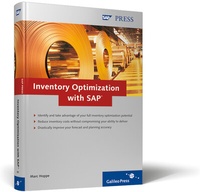
Inventory Optimization with SAP
Effective Inventory Management with MySAP ERP and MySAP SCM
1st Edition
Published on 28. June 2006
Book
Hardback
483 pages
978-1-59229-097-0 (ISBN)
Description
To protect against shortages, companies tend to maintain additional inventory at various points in the supply chain. This priceless reference illustrates in detail how those costly buffers can be significantly reduced in order to sustain profitability and operational efficiency - without putting at risk customer satisfaction or the ability to deliver.
This book provides readers with a systematic description of the options and functions available for mastering inventory management with mySAP ERP and mySAP SCM. Relevant business principles are discussed in detail and help introduce readers to each of the key processes. Learn about factors influencing inventories, inventory analysis, sales planning and forecasting, disposition, batch sizes, inventory monitoring, and much more.
Demand planners, MRP controllers, and production planners - as well as consultants, IT administrators, department managers, and anyone requiring comprehensive, task-related information on how to optimize inventory using SAP - will find this book to be very useful.
Highlights include:
Why Inventory Is Necessary: Inventory Concepts, Factors Influencing Inventory, Optimization Potentials
Inventory Analysis: ABC and XYZ Analysis, Creating ABC-XYZ Matrices
Demand Planning and Forecasting: Bullwhip Effect, Selecting and Running Forecasts
Material Requirements Planning: Make-to-Stock and Make-to-Order Production, MRP Strategies
Service Level and Safety Stocks: Global ATP in SAP APO, Safety Stock Planning in mySAP ERP
Lot Sizes: Lot-Sizing Procedures in mySAP ERP and SAP APO
Production: Reduction of Backlogs, MRP-II and APS, Planning with SAP APO PP/DS
Inventory Controlling
This book provides readers with a systematic description of the options and functions available for mastering inventory management with mySAP ERP and mySAP SCM. Relevant business principles are discussed in detail and help introduce readers to each of the key processes. Learn about factors influencing inventories, inventory analysis, sales planning and forecasting, disposition, batch sizes, inventory monitoring, and much more.
Demand planners, MRP controllers, and production planners - as well as consultants, IT administrators, department managers, and anyone requiring comprehensive, task-related information on how to optimize inventory using SAP - will find this book to be very useful.
Highlights include:
Why Inventory Is Necessary: Inventory Concepts, Factors Influencing Inventory, Optimization Potentials
Inventory Analysis: ABC and XYZ Analysis, Creating ABC-XYZ Matrices
Demand Planning and Forecasting: Bullwhip Effect, Selecting and Running Forecasts
Material Requirements Planning: Make-to-Stock and Make-to-Order Production, MRP Strategies
Service Level and Safety Stocks: Global ATP in SAP APO, Safety Stock Planning in mySAP ERP
Lot Sizes: Lot-Sizing Procedures in mySAP ERP and SAP APO
Production: Reduction of Backlogs, MRP-II and APS, Planning with SAP APO PP/DS
Inventory Controlling
More details
Other editions
New editions
Book
06/2008
2nd Edition
SAP PRESS
€79.95
Article is exhausted, reprint undefined
Person
Author
After finishing his studies in business administration at Fachhochschule Nordostniedersachsen in Lüneburg, Germany, and at John Moores University in Liverpool, England, Marc Hoppe joined CAS AG, Germany as an SAP developer in the logistics and production planning areas. Later, he became a logistics consultant and was responsible for implementing national and international SAP R/3 projects. Since 1998, he has worked as a Supply Chain Management (SCM) consultant at SAP SI AG. Marc Hoppe is responsible for the business-relevant and IT-based implementation and optimization of SCM processes, as well as the re-engineering of entire supply chain processes. In 2001, he became Consulting Director for SCM, and since 2003, he has managed additionally the Supplier Relationship Management (SRM) unit. Marc Hoppe consults for large corporations such as Siemens, Unilever, Gillette, Philips, Deutsche Telekom, and Philip Morris, as well as medium-sized companies like G+H Isover or Fertiva. He has published numerous works on inventory optimization.
Content
Introduction ... 19
1. Why Inventory Is Necessary ... 27
... 1.1 Different Inventory Concepts ... 28
... 1.2 Uncertainties in the Supply Chain ... 36
... 1.3 How to Deal With Uncertainties ... 39
2. Factors Influencing Inventory ... 45
... 2.1 Five Instruments ... 45
... 2.2 Controlling by Inventory Monitoring ... 52
3. Inventory Analysis ... 53
... 3.1 Inventory Analysis Options ... 54
... 3.2 ABC Analysis With SAP ... 61
... 3.3 XYZ Analysis With SAP ... 81
... 3.4 Combining ABC and XYZ Analyses ... 87
4. Demand Planning and Forecasting ... 93
... 4.1 The Influence of Demand Planning on Inventories ... 93
... 4.2 The Bullwhip Effect ... 96
... 4.3 Optimization Potentials for the Forecast ... 97
... 4.4 Selecting the Forecast Method ... 132
... 4.5 Details of the Individual Forecast Methods ... 148
... 4.6 Running a Forecast ... 170
... 4.7 Forecast Accuracy and Alert Functions ... 186
5. Material Requirements Planning ... 207
... 5.1 MRP Strategies ... 208
... 5.2 Impact of Material Requirements Planning on Inventory ... 209
... 5.3 Strategies for Make-to-Stock Production in mySAP ERP ... 211
... 5.4 Strategies for Planning Components in mySAP ERP ... 229
... 5.5 Strategies for Make-to-Order Production in mySAP ERP ... 234
... 5.6 Consumption-Based Material Requirements Planning Using mySAP ERP ... 239
... 5.7 Requirements Strategies in SAP APO ... 248
... 5.8 Potential for Optimization in Material Requirements Planning ... 251
6. Service Level and Safety Stocks ... 257
... 6.1 Safety Stock ... 257
... 6.2 Service Level ... 259
... 6.3 Replenishment Lead Time ... 280
... 6.4 Forecast Quality ... 283
... 6.5 Safety Stock ... 286
7. Lot Sizes ... 325
... 7.1 How Do Lot Sizes Affect Stocks ... 325
... 7.2 Stochastic (Static) Lot-Sizing Procedure in mySAP ERP and SAP APO ... 327
... 7.3 Deterministic (Periodic) Lot-Sizing Procedures in mySAP ERP and SAP APO ... 333
... 7.4 Optimal Lot-Sizing Procedures in mySAP ERP and SAP APO ... 347
... 7.5 Restrictions in the Lot-Size Calculation ... 361
... 7.6 Selecting Lot-Sizing Procedures ... 363
8. Production ... 365
... 8.1 How Do Backlogs in Production Affect Stocks? ... 365
... 8.2 Why Do Backlogs Occur in Production Planning? ... 370
... 8.3 Reduction of Backlogs ... 373
... 8.4 Finite Planning and Optimization in SAP APO ... 379
9. Inventory Controlling ... 437
... 9.1 Why Inventory Monitoring? ... 437
... 9.2 An Introduction to Logistics Controlling ... 438
... 9.3 The Information System of the Supply Chain Council ... 440
... 9.4 Problems with Data Collection ... 445
... 9.5 Important Inventory Key Figures ... 446
... 9.6 Tools for Inventory Analysis ... 458
... 9.7 Inventory Monitoring in mySAP ERP ... 462
10. Afterword ... 467
Appendix ... 473
A. Literature ... 473
B. The Author ... 475
Index ... 477
1. Why Inventory Is Necessary ... 27
... 1.1 Different Inventory Concepts ... 28
... 1.2 Uncertainties in the Supply Chain ... 36
... 1.3 How to Deal With Uncertainties ... 39
2. Factors Influencing Inventory ... 45
... 2.1 Five Instruments ... 45
... 2.2 Controlling by Inventory Monitoring ... 52
3. Inventory Analysis ... 53
... 3.1 Inventory Analysis Options ... 54
... 3.2 ABC Analysis With SAP ... 61
... 3.3 XYZ Analysis With SAP ... 81
... 3.4 Combining ABC and XYZ Analyses ... 87
4. Demand Planning and Forecasting ... 93
... 4.1 The Influence of Demand Planning on Inventories ... 93
... 4.2 The Bullwhip Effect ... 96
... 4.3 Optimization Potentials for the Forecast ... 97
... 4.4 Selecting the Forecast Method ... 132
... 4.5 Details of the Individual Forecast Methods ... 148
... 4.6 Running a Forecast ... 170
... 4.7 Forecast Accuracy and Alert Functions ... 186
5. Material Requirements Planning ... 207
... 5.1 MRP Strategies ... 208
... 5.2 Impact of Material Requirements Planning on Inventory ... 209
... 5.3 Strategies for Make-to-Stock Production in mySAP ERP ... 211
... 5.4 Strategies for Planning Components in mySAP ERP ... 229
... 5.5 Strategies for Make-to-Order Production in mySAP ERP ... 234
... 5.6 Consumption-Based Material Requirements Planning Using mySAP ERP ... 239
... 5.7 Requirements Strategies in SAP APO ... 248
... 5.8 Potential for Optimization in Material Requirements Planning ... 251
6. Service Level and Safety Stocks ... 257
... 6.1 Safety Stock ... 257
... 6.2 Service Level ... 259
... 6.3 Replenishment Lead Time ... 280
... 6.4 Forecast Quality ... 283
... 6.5 Safety Stock ... 286
7. Lot Sizes ... 325
... 7.1 How Do Lot Sizes Affect Stocks ... 325
... 7.2 Stochastic (Static) Lot-Sizing Procedure in mySAP ERP and SAP APO ... 327
... 7.3 Deterministic (Periodic) Lot-Sizing Procedures in mySAP ERP and SAP APO ... 333
... 7.4 Optimal Lot-Sizing Procedures in mySAP ERP and SAP APO ... 347
... 7.5 Restrictions in the Lot-Size Calculation ... 361
... 7.6 Selecting Lot-Sizing Procedures ... 363
8. Production ... 365
... 8.1 How Do Backlogs in Production Affect Stocks? ... 365
... 8.2 Why Do Backlogs Occur in Production Planning? ... 370
... 8.3 Reduction of Backlogs ... 373
... 8.4 Finite Planning and Optimization in SAP APO ... 379
9. Inventory Controlling ... 437
... 9.1 Why Inventory Monitoring? ... 437
... 9.2 An Introduction to Logistics Controlling ... 438
... 9.3 The Information System of the Supply Chain Council ... 440
... 9.4 Problems with Data Collection ... 445
... 9.5 Important Inventory Key Figures ... 446
... 9.6 Tools for Inventory Analysis ... 458
... 9.7 Inventory Monitoring in mySAP ERP ... 462
10. Afterword ... 467
Appendix ... 473
A. Literature ... 473
B. The Author ... 475
Index ... 477