

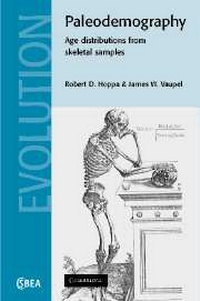
Paleodemography
Age Distributions from Skeletal Samples
Published on 3. January 2002
Book
Hardback
274 pages
978-0-521-80063-1 (ISBN)
Description
Paleodemography is the field of enquiry that attempts to identify demographic parameters from past populations (usually skeletal samples) derived from archaeological contexts, and then to make interpretations regarding the health and well-being of those populations. However, paleodemographic theory relies on several assumptions that cannot easily be validated by the researcher, and if incorrect, can lead to large errors or biases. In this book, physical anthropologists, mathematical demographers and statisticians tackle these methodological issues for reconstructing demographic structure for skeletal samples. Topics discussed include how skeletal morphology is linked to chronological age, assessment of age from the skeleton, demographic models of mortality and their interpretation, and biostatistical approaches to age structure estimation from archaeological samples. This work will be of immense importance to anyone interested in paleodemography, including biological and physical anthropologists, demographers, geographers, evolutionary biologists and statisticians.
Reviews / Votes
Review of the hardback: '... a must for all palaeodemographers and biological statisticians.' International Journal of Osteoarchaeology Review of the hardback: 'Paleodemography has a checkered history and this book will mark a milepost.' American Journal of Human Biology Review of the hardback: 'There are many excellent aspects of this well-produced book, not least the standardisation of terminology and notation across the contributions which makes the statistical reasoning less impenetrable than would otherwise be the case.' Journal of Human Evolution Review of the hardback: 'In sum, palaodemographers, skeletal biologists, forensic anthropologists, bioarchaeologists, as well as archaeologists will find Paleodemography an important resource.' Society for Archaeological Sciences Bulletin Review of the hardback: '... essential for everyone with an interest in palaeodemography, including researchers and graduate students in biological anthropology, palaeopathology and biostatistics.' Annals of Human Biology 'This very important book is an essential reference for anyone attempting to estimate demographic parameters through the study of human remains. ... this volume is a carefully crafted contribution to palaeodemography, focused upon methodological concerns. Essential for practitioners, its contents should also appeal to a broader scientific community, including statisticians, demographers and evolutionary biologists.' AntiquityMore details
Series
Language
English
Place of publication
Cambridge
United Kingdom
Target group
Professional and scholarly
Illustrations
25 Tables, unspecified; 4 Halftones, unspecified; 28 Line drawings, unspecified
Dimensions
Height: 237 mm
Width: 157 mm
Thickness: 21 mm
Weight
580 gr
ISBN-13
978-0-521-80063-1 (9780521800631)
Copyright in bibliographic data and cover images is held by Nielsen Book Services Limited or by the publishers or by their respective licensors: all rights reserved.
Schweitzer Classification
Other editions
New editions
Book
10/2008
Cambridge University Press
€71.70
Shipment within 15-20 days
Additional editions
Book
10/2008
Cambridge University Press
€71.70
Shipment within 15-20 days
E-Book
12/2004
1st Edition
Cambridge University Press
€49.99
Available for download
Persons
ROBERT D. HOPPA is a physical anthropologist in the Department of Anthropology at the University of Manitoba. His research interests include historical demography, epidemiology, human skeletal biology, growth and development and forensic anthropology. He has also co-edited Human Growth in the Past: Studies from Bones and Teeth (1999; ISBN 0 521 63153 X). JAMES W. VAUPEL is a demographer and is currently Director of the Max Planck Institute for Demographic Research in Rostock, Germany. He is also Professor of Demography and Epidemiology at the Institute of Public Health, University of Southern Denmark, Odense, and Senior Research Scientist at the Sanford Institute at Duke University in North Carolina. His research focuses on human biodemography, human longevity and centenarian research. He has authored or edited numerous books in the field of demography, particularly oldest old mortality, including Population Data at a Glance (1997), The Force of Mortality at Ages 80 to 120 (1998), and Validation of Exceptional Longevity (1999).
Content
1. The Rostock Manifesto for paleodemography: the way from stage to age Robert D. Hoppa and James W. Vaupel; 2. Paleodemography: looking back and thinking ahead Robert D. Hoppa; 3. Reference samples: the first step in linking biology and age in the human skeleton Bethany M. Usher; 4. Aging through the ages: historical perspectives on age-indicator methods Ariane Kemkes-Grottenthaler; 5. Transition analysis: a new method for estimating age-indicator methods Jesper L. Boldsen, George R. Milner, Lyle W. Konigsberg and James W. Wood; 6. Age estimation by tooth cementum annulation - perspectives of a new validation study Ursula Wittwer-Backofen and H. Buba; 7. Mortality models for paleodemography James W. Wood, Darryl J. Holman, Kathleen A. O'Connor and Rebecca J. Ferrell; 8. Linking age-at-death distributions and ancient population dynamics: a case study Richard R. Paine and Jesper L. Boldsen; 9. A solution to the problem of obtaining a mortality schedule for paleodemographic data Bradley Love and Hans-Georg Mueller; 10. Estimating age-at-death distributions from skeletal samples: a multivariate latent trait approach Darryl J. Holman, James W. Wood and Kathleen A. O'Connor; 11. Markov Chain Monte Carlo estimation of hazard model parameters in paleodemography Lyle W. Konigsberg and Nicholas P. Herrmann; 12. A re-examination of the age-at-death distribution of Indian Knoll Nicholas P. Herrmann and Lyle W. Konigsberg.