

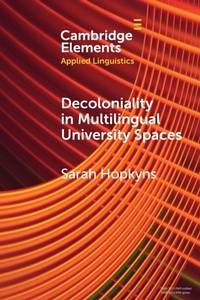
Decoloniality in Multilingual University Spaces
Published on 28. May 2026
Book
Paperback/Softback
100 pages
978-1-009-56909-5 (ISBN)
Description
This Element explores multilingual university spaces and decoloniality, critically examining how coloniality and neoliberalism intersect. While neoliberal language policies aim to equip students with English as a 'lingua academia', critical issues relating to students' translingual identities and belonging are often overlooked. Empirical data are shared from a linguistic landscape study involving a walking ethnography of a university educationscape in the United Arab Emirates, whereby Emirati students share insights on signage and spaces as 'intertextual products' connected to (un)belonging. Data are analysed through thematic and nexus analysis with main themes including the dominance of English, imbalanced bilingualism, bottom-up translanguaging, everyday nationalism, and sticky places and objects. Findings are discussed in relation to the study setting and other global contexts. The Element closes with practical suggestions on decolonising action relevant to a range of multilingual university spaces and future research directions.
More details
Series
Language
English
Place of publication
Cambridge
United Kingdom
Target group
College/higher education
Product notice
Paperback (trade)
Illustrations
Worked examples or Exercises
Dimensions
Height: 229 mm
Width: 152 mm
Thickness: 5 mm
Weight
147 gr
ISBN-13
978-1-009-56909-5 (9781009569095)
Copyright in bibliographic data and cover images is held by Nielsen Book Services Limited or by the publishers or by their respective licensors: all rights reserved.
Schweitzer Classification
Other editions
Additional editions
Sarah Hopkyns
Decoloniality in Multilingual University Spaces
Book
05/2026
Cambridge University Press
€68.50
Shipment within 15-20 days
Person
Content
1. English-medium university spaces and decoloniality; 2. The dominance of English and imbalanced bilingualism; 3. Bottom-up translanguaging; 4. Everyday nationalism and sticky places/objects; 5. Conclusion: decolonial agentive shaping of spaces; References.