

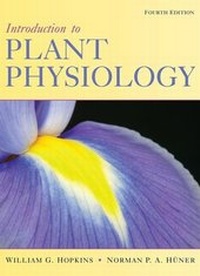
Introduction to Plant Physiology
4th Edition
Published on 16. December 2008
Book
Hardback
528 pages
978-0-470-24766-2 (ISBN)
Description
Introduction to Plant Physiology became the best-selling first edition plant physiology text of the 1990's! Now, we're building on the success of prior editions to provide an even more effective fourth edition. Plant Physiology has been praised for its excellent balance of traditional and modern topics, presented in a straightforward style, without overwhelming undergraduates with excessive detail. Its focus is on the ideas and experimental approaches in plant physiology. This is a one-semester course. It assumes that the student has had introductory biology or botany as a pre-requisite.
Reviews / Votes
"Hopkins is concise and straightforward, emphasizing the 'big picture.' It is readable and the figures are clearly described and support the text. Students who use Hopkins come away with a strong foundation in basic principles for a range of areas."--Donald P, Briskin, University of Illinois "Writing style is a real strength of this book. The level of detail is just right and the language is easy to follow."--Clemson UniversityMore details
Product info
gebunden
Edition
4. Auflage
Language
English
Place of publication
New York
United States
Target group
College/higher education
Illustrations
Photos: 0 B&W, 0 Color; Drawings: 0 B&W, 0 Color
Dimensions
Height: 28.4 cm
Width: 22.4 cm
Thickness: 2.3 cm
Weight
1241 gr
ISBN-13
978-0-470-24766-2 (9780470247662)
Schweitzer Classification
Other editions
Previous edition
William G. Hopkins | Norman P. A. Hüner
Introduction to Plant Physiology
Book
04/2003
3rd Edition
Wiley
€139.00
Article exhausted; check for reprint
Persons
Dr. William G. Hopkins is a Professor Emeritus of Biology from the University of Western Onterio.
Content
Chapter 1. Plant Cells and Water.
Chapter 2. Whole Plant Water Relations.
Chapter 3. Roots, Soils, and Nutrient Uptake.
Chapter 4. Plants and Inorganic Nutrients
Chapter 5. Bioenergetics and ATP Synthesis.
Chapter 6. The Dual Role of Sunlight: Energy and Information.
Chapter 7. Energy Conservation in Photosynthesis: Harvesting Sunlight.
Chapter 8. Energy Conservation in Photosynthesis: Co2 Assimilation.
Chapter 9. Allocation, Translocation, and Partitioning Of Photoassimilates.
Chapter 10. Cellular Respiration: Unlocking the Energy Stored In Photoassimilates.
Chapter 11. Nitrogen Assimilation.
Chapter 12. Carbon and Nitrogen Assimilation and Plant Productivity.
Chapter 13. Responses of Plants to Environmental Stress.
Chapter 14. Acclimation to Environmental Stress.
Chapter 15. Adaptations to the Environment.
Chapter 16. Development: An Overview.
Chapter 17. Growth and Development of Cells.
Chapter 18. Hormones I: Auxins.
Chapter 19. Hormones II: Gibberellins.
Chapter 20. Hormones III: Cytokinins.
Chapter 21. Hormones IV: Abscisic Acid, Ethylene, and Brassinosteroids.
Chapter 22. Photomorphogenesis: Responding To Light.
Chapter 23. Tropisms and Nastic Movements: Orienting Plants in Space.
Chapter 24. Measuring Time: Controlling Development by Photoperiod and Endogenous Clocks.
Chapter 25. Flowering and Fruit Development.
Chapter 26. Temperature: Plant Development and Distribution.
Chapter 27. Secondary Metabolism.
Appendix 1. Building Blocks: Lipids, Proteins, and Carbohydrates.
Glossary/Index.