

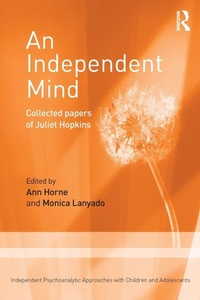
An Independent Mind
Collected papers of Juliet Hopkins
Published on 5. June 2015
Book
Paperback/Softback
170 pages
978-1-138-01532-6 (ISBN)
Description
'Juliet Hopkins has quietly encouraged and inspired generations of colleagues and students' (Dilys Daws).
An Independent Mind: Collected Papers of Juliet Hopkins follows the professional journey and influence of an innovative figure in the history of child psychotherapy. Juliet Hopkins spans Kleinian and Independent psychoanalytic traditions and brings a critical scientific mind to these theories. Amongst her main influences were Winnicott and Bowlby - both of whom her work addresses. This book contains her most important papers, bringing together psychoanalytic theory, family and individual approaches, attachment theory and infant-parent work. With a writing style that is clear, straightforward and readily accessible, Juliet Hopkins promotes a scholarly integrative way of thinking about psychotherapy without compromising the basic psychoanalytic principles that inform her work.
The papers have been gathered chronologically into four sections, each given context by the Editors with a brief introduction:
Trauma and child psychotherapy
Attachment and child psychotherapy
Infant-parent psychotherapy
Integrating and exploring Winnicott
An Independent Mind: Collected Papers of Juliet Hopkins is a collection of classic papers whose relevance today is undiminished. It will be essential reading for established and trainee child and adult psychotherapists and psychoanalysts; counsellors, psychologists, psychiatrists interested in psychoanalytic approaches; social workers, nursery workers and those who work with children in voluntary organizations.
An Independent Mind: Collected Papers of Juliet Hopkins follows the professional journey and influence of an innovative figure in the history of child psychotherapy. Juliet Hopkins spans Kleinian and Independent psychoanalytic traditions and brings a critical scientific mind to these theories. Amongst her main influences were Winnicott and Bowlby - both of whom her work addresses. This book contains her most important papers, bringing together psychoanalytic theory, family and individual approaches, attachment theory and infant-parent work. With a writing style that is clear, straightforward and readily accessible, Juliet Hopkins promotes a scholarly integrative way of thinking about psychotherapy without compromising the basic psychoanalytic principles that inform her work.
The papers have been gathered chronologically into four sections, each given context by the Editors with a brief introduction:
Trauma and child psychotherapy
Attachment and child psychotherapy
Infant-parent psychotherapy
Integrating and exploring Winnicott
An Independent Mind: Collected Papers of Juliet Hopkins is a collection of classic papers whose relevance today is undiminished. It will be essential reading for established and trainee child and adult psychotherapists and psychoanalysts; counsellors, psychologists, psychiatrists interested in psychoanalytic approaches; social workers, nursery workers and those who work with children in voluntary organizations.
Reviews / Votes
"This is a beautiful book, full of wisdom, clarity, and stunningly subtle clinical work. It is also, in its quiet way, very inspiring." - Anne Alvarez, PhD MACP Consultant Child and Adolescent Psychotherapist"In this aptly named book we encounter a truly independent thinker, able to range freely across the attachment and psychotherapy worlds. At the same time we find a therapeutic mind at its best: curious and self-examining; 'slightly quizzical'; penetrating and intelligent, yet alive to the gamut of feelings from love and concern through to horror and hatred. Hopkins' ability to bring clinical material to life while remaining true to theory is virtuosic. Like her child and adolescent patients, the reader comes away calmed, sensitively challenged, and with hope restored." - Professor Jeremy Holmes MD FRCPsych University of Exeter, UK 'Juliet Hopkins has quietly encouraged and inspired generations of colleagues and students' (Dilys Daws).
"This is a beautiful book, full of wisdom, clarity, and stunningly subtle clinical work. It is also, in its quiet way, very inspiring." - Anne Alvarez, PhD MACP Consultant Child and Adolescent Psychotherapist
"In this aptly named book we encounter a truly independent thinker, able to range freely across the attachment and psychotherapy worlds. At the same time we find a therapeutic mind at its best: curious and self-examining; 'slightly quizzical'; penetrating and intelligent, yet alive to the gamut of feelings from love and concern through to horror and hatred. Hopkins' ability to bring clinical material to life while remaining true to theory is virtuosic. Like her child and adolescent patients, the reader comes away calmed, sensitively challenged, and with hope restored." - Professor Jeremy Holmes MD FRCPsych University of Exeter, UK
More details
Series
Language
English
Place of publication
London
United Kingdom
Publishing group
Taylor & Francis Ltd
Target group
College/higher education
Professional and scholarly
Postgraduate, Professional, and Professional Practice & Development
Dimensions
Height: 234 mm
Width: 156 mm
Thickness: 11 mm
Weight
304 gr
ISBN-13
978-1-138-01532-6 (9781138015326)
Copyright in bibliographic data and cover images is held by Nielsen Book Services Limited or by the publishers or by their respective licensors: all rights reserved.
Schweitzer Classification
Other editions
Additional editions
E-Book
06/2015
Routledge
€52.49
Available for download
E-Book
06/2015
Routledge
€52.99
Available for download
Book
06/2015
Routledge
€243.00
Shipment within 10-20 days
Persons
Ann Horne was head of the Independent child psychotherapy training and post-graduate development at the BAP (now IPCAPA). She is co-editor of The Handbook of Child and Adolescent Psychotherapy and of the three earlier books in this series. Now retired, she gives talks and writes, retaining a special interest in children who act with the body rather than reflect.
Monica Lanyado was founding Course Organising Tutor of the Child and Adolescent Psychotherapy Training at the Scottish Institute of Human Relations (now Human Development Scotland). She is author of The Presence of the Therapist (2004), co-editor of The Handbook of Child and Adolescent Psychotherapy and of the three earlier books in this series. Retired from clinical practice, she supervises (at IPCAPA and privately), and enjoys teaching and writing.
Monica Lanyado was founding Course Organising Tutor of the Child and Adolescent Psychotherapy Training at the Scottish Institute of Human Relations (now Human Development Scotland). She is author of The Presence of the Therapist (2004), co-editor of The Handbook of Child and Adolescent Psychotherapy and of the three earlier books in this series. Retired from clinical practice, she supervises (at IPCAPA and privately), and enjoys teaching and writing.
Content
Daws, Foreword. Horne, Introduction. Part I: Trauma and child psychotherapy. Lanyado, Introduction. Solving the Mystery of Monsters: Steps Towards the Recovery From Trauma. Living Under the Threat of Death. The Impact of a Congenital Illness on an 8 Year Old Boy. The Role of Trauma in the Development of a Borderline State and a Foot-and-Shoe Fetish in a 6-Year-Old Girl. Part II: Attachment and Child Psychotherapy. Horne, Introduction. The Observed Infant of Attachment Theory. Failure of the Holding Relationship: Some Effects of Physical Rejection on the Child's Attachment and on His Inner Experience. Facilitating the Development of Intimacy Between Nurses and Infants in a Day Nursery. Overcoming a Child's Resistance to Late Adoption: How One New Attachment Can Facilitate Another. Part III: Infant-parent psychotherapy. Horne, Introduction. Infant Parent Psychotherapy: Selma Fraiberg's Contribution to Understanding the Past in the Present. Therapeutic Interventions in Infancy. Crying Babies: Who is Crying About What? Part IV: Integrating and exploring Winnicott. Lanyado, Introduction. The Dangers and Deprivations of Too-Good Mothering. From Baby Games to Let's Pretend: The Achievement of Playing. Narcissistic Illusions in Late Adolescence: Defensive Kleinian Retreats or Winnicottian Opportunities?