

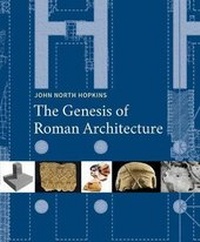
The Genesis of Roman Architecture
Published on 2. February 2016
Book
Hardback
268 pages
978-0-300-21181-8 (ISBN)
Description
An important new look at Rome's earliest buildings and their context within the broader tradition of Mediterranean culture
This groundbreaking study traces the development of Roman architecture and its sculpture from the earliest days to the middle of the 5th century BCE. Existing narratives cast the Greeks as the progenitors of classical art and architecture or rely on historical sources dating centuries after the fact to establish the Roman context. Author John North Hopkins, however, allows the material and visual record to play the primary role in telling the story of Rome's origins, synthesizing important new evidence from recent excavations. Hopkins's detailed account of urban growth and artistic, political, and social exchange establishes strong parallels with communities across the Mediterranean. From the late 7th century, Romans looked to increasingly distant lands for shifts in artistic production. By the end of the archaic period they were building temples that would outstrip the monumentality of even those on the Greek mainland. The book's extensive illustrations feature new reconstructions, allowing readers a rare visual exploration of this fragmentary evidence.
This groundbreaking study traces the development of Roman architecture and its sculpture from the earliest days to the middle of the 5th century BCE. Existing narratives cast the Greeks as the progenitors of classical art and architecture or rely on historical sources dating centuries after the fact to establish the Roman context. Author John North Hopkins, however, allows the material and visual record to play the primary role in telling the story of Rome's origins, synthesizing important new evidence from recent excavations. Hopkins's detailed account of urban growth and artistic, political, and social exchange establishes strong parallels with communities across the Mediterranean. From the late 7th century, Romans looked to increasingly distant lands for shifts in artistic production. By the end of the archaic period they were building temples that would outstrip the monumentality of even those on the Greek mainland. The book's extensive illustrations feature new reconstructions, allowing readers a rare visual exploration of this fragmentary evidence.
Reviews / Votes
"[An] engrossing account ... Even when texts and objects seem to point in the same direction, it takes a generous dose of ingenuity to weave together a credible story from such random clues-part of archaeology's eternal fascination. Hopkins is a master of this exacting art."-Ingrid D. Rowland, New York Review of Books -- Ingrid Rowland The New York Review of Books "A valuable contribution to the study of early Rome... There is little published, or unpublished, that escapes [Hopkins's] notice."-Seth Bernard, American Journal of Archaeology -- Seth Bernard American Journal of Archaeology "Hopkins has written nothing less than a highly original history of early Rome, based on a balanced and up-to-date reading of the available archaeological evidence... This is an important book and highly recommended to anyone interested in the art, architecture and society of early Rome."-Dominik Maschek, Bryn Mawr Classical Review -- Dominik Maschek Bryn Mawr Classical ReviewMore details
Language
English
Place of publication
United States
Product notice
Cloth over boards
Illustrations
62 color + 58 b-w illus.
Dimensions
Height: 254 mm
Width: 203 mm
Weight
726 gr
ISBN-13
978-0-300-21181-8 (9780300211818)
Copyright in bibliographic data and cover images is held by Nielsen Book Services Limited or by the publishers or by their respective licensors: all rights reserved.
Schweitzer Classification
Other editions
Additional editions
John North Hopkins
The Genesis of Roman Architecture
E-Book
02/2016
1st Edition
De Gruyter
€64.80
Available for download
Person
John North Hopkins is assistant professor of art history and classical studies at Rice University.