

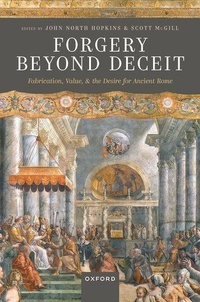
Forgery Beyond Deceit
Fabrication, Value, and the Desire for Ancient Rome
Published on 27. July 2023
Book
Hardback
462 pages
978-0-19-286958-6 (ISBN)
Description
What do forgeries do? Forgery Beyond Deceit: Fabrication, Value, and the Desire for Ancient Rome explores that question with a focus on forgery in ancient Rome and of ancient Rome. Its chapters reach from antiquity to the twentieth century and cover literature and art, the two areas that predominate in forgery studies, as well as the forgery of physical books, coins, and religious relics. The book examines the cultural, historical, and rhetorical functions of forgery that extend beyond the desire to deceive and profit. It analyses forgery in connection with related phenomena like pseudepigraphy, fakes, and copies; and it investigates the aesthetic and historical value that forgeries possess when scholarship takes seriously their form, content, and varied uses within and across cultures. Of particular interest is the way that forgeries embody a desire for the ancient and for the recovery of the fragmentary past of ancient Rome.
Reviews / Votes
Across this collection there are many points of connection, nuanced arguments, and fascinating details. Desire appears in almost every chapter, as generative, intensifying, or destructive. And while the Epilogue reiterates many of the themes discussed here, Collins draws an especially salient point from the contributions: forgery is in so many of these chapters linked to vitality. "Ancient Rome, real and forged, is very much alive". Like the forgeries which it explores, this volume demonstrates that the field of forgery studies is thriving. * Rebecca Menmuir, Bryn Mawr Classical Review *More details
Language
English
Place of publication
Oxford
United Kingdom
Target group
Professional and scholarly
Product notice
sewn/stitched
Cloth over boards
Illustrations
81 images, primarily photographs of ancient art and writings
Dimensions
Height: 236 mm
Width: 164 mm
Thickness: 30 mm
Weight
934 gr
ISBN-13
978-0-19-286958-6 (9780192869586)
Copyright in bibliographic data and cover images is held by Nielsen Book Services Limited or by the publishers or by their respective licensors: all rights reserved.
Schweitzer Classification
Other editions
Additional editions
John North Hopkins | Scott Mcgill
Forgery Beyond Deceit
Fabrication, Value, and the Desire for Ancient Rome
E-Book
06/2023
1st Edition
OUP eBook
€98.99
Available for download
John North Hopkins | Scott Mcgill
Forgery Beyond Deceit
Fabrication, Value, and the Desire for Ancient Rome
E-Book
05/2023
1st Edition
OUP eBook
€98.99
Available for download
Persons
John Hopkins is Associate Professor of the art and archaeology of ancient Mediterranean peoples at New York University. He is author of The Genesis of Roman Architecture and Unbinding Rome: Art and Craft in a Fluid Landscape, 700-200 BCE (2016). He is co-editor with Sarah Kielt Costello and Paul R. Davis of Object Biographies: Collaborative Approaches to Ancient Mediterranean Art (2020).
Scott McGill is Deedee McMurty Professor in the Humanities at Rice University. He is the author of four books, including most recently Virgil: Aeneid 11. A Commentary (2020), and the co-editor of three volumes. His translation, with Susannah Wright, of Virgil's Aeneid is forthcoming with Norton Press.
Scott McGill is Deedee McMurty Professor in the Humanities at Rice University. He is the author of four books, including most recently Virgil: Aeneid 11. A Commentary (2020), and the co-editor of three volumes. His translation, with Susannah Wright, of Virgil's Aeneid is forthcoming with Norton Press.
Content
John North Hopkins and Scott McGill: Introduction
Kenneth Lapatin: Prologue: Ideas of Forgery
1: Christopher H. Hallett: 'Corinthian Bronzes': Miniature Masterpieces - Flagrant Forgeries
2: Joseph A. Howley: Reading Against the Grain: Book Forgery and Book Labor at Rome
3: Lawrence Kim: Imperial Greek Atticism: A Culture of Forgery? Phrynicus and the Terminology of 'Authenticity'
4: Irene Peirano Garrison: Forgery, Pseudepigrapha, and Other Typologies of Continuation in Latin Literature
5: Carolyn Higbie: The Fluidity of False Coins
6: Kathryn A. Langenfeld: Ancient Texts and Sibylline Truths: A Reflection on Forged Documentary Evidence and its Value in the Historia Augusta
7: Frederic Clark: Thinking with Antiquity's Ancient Beginnings: The "First Pagan Historian" from Isidore of Seville to Thomas Jefferson
8: Jacqueline M. Burek: Forgery and the Desire for the Classical Author in the Pseudo-Ovidian De vetula
9: Talia Di Manno: Archaeology and the Invention of Holy Bodies in Post-Tridentine Rome
10: Sascha Kansteiner: Deceptively Authentic Additions
11: Elizabeth Bartman: Is Restoration Forgery?
12: Sean Alexander Gurd: Fictional Forgeries and the Twilight of the Self: The Tablets of Armand Schwerner and Pascale Quignard
Jeffrey Collins: Epilogue: Beyond Deceit and Beyond: Situating Scholarship on Forgery
List of illustrations
Bibliography
Kenneth Lapatin: Prologue: Ideas of Forgery
1: Christopher H. Hallett: 'Corinthian Bronzes': Miniature Masterpieces - Flagrant Forgeries
2: Joseph A. Howley: Reading Against the Grain: Book Forgery and Book Labor at Rome
3: Lawrence Kim: Imperial Greek Atticism: A Culture of Forgery? Phrynicus and the Terminology of 'Authenticity'
4: Irene Peirano Garrison: Forgery, Pseudepigrapha, and Other Typologies of Continuation in Latin Literature
5: Carolyn Higbie: The Fluidity of False Coins
6: Kathryn A. Langenfeld: Ancient Texts and Sibylline Truths: A Reflection on Forged Documentary Evidence and its Value in the Historia Augusta
7: Frederic Clark: Thinking with Antiquity's Ancient Beginnings: The "First Pagan Historian" from Isidore of Seville to Thomas Jefferson
8: Jacqueline M. Burek: Forgery and the Desire for the Classical Author in the Pseudo-Ovidian De vetula
9: Talia Di Manno: Archaeology and the Invention of Holy Bodies in Post-Tridentine Rome
10: Sascha Kansteiner: Deceptively Authentic Additions
11: Elizabeth Bartman: Is Restoration Forgery?
12: Sean Alexander Gurd: Fictional Forgeries and the Twilight of the Self: The Tablets of Armand Schwerner and Pascale Quignard
Jeffrey Collins: Epilogue: Beyond Deceit and Beyond: Situating Scholarship on Forgery
List of illustrations
Bibliography