

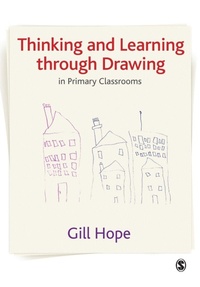
Thinking and Learning Through Drawing
In Primary Classrooms
1st Edition
Published on 12. September 2008
Book
Paperback/Softback
192 pages
978-1-84787-040-7 (ISBN)
Description
'The text is clear and accessible and gives a fascinating overview of how drawing can help children to learn and understand the thinking of others...It is highly recommended for all students and practitioners interested in understanding more about how children express their ideas and theories about the world' - Early Years Update
'This book is an invaluable resource for anyone who recognises the potential of 'drawing' as an essential element for developing thinking and learning in the Primary Classroom...and a 'must read' for those who are sceptical!....This is a fascinating read that invokes a variety of feelings including a sense of wonder and curiosity about the many facets of drawing, which leaves you with a thirst to try out more and explore ways of releasing the untapped potential of 'drawing' in your own classroom' - thinkingclassroom.co.uk
Children use drawing as a means through which they create, develop, communicate and record their thoughts and ideas. Whether it's to play, or to express feelings and meaning, drawing enables them to learn about the world, explore their imaginations, and to invent and present new ideas.
With an extensive background in teaching and researching children's uses of drawing, Gill Hope describes the ways in which multiple forms of drawing are used by Primary school children. She explains why it should be actively promoted as a means of supporting thinking and learning across a wide range of subject areas, and provides practical support for teachers.
Demonstrating the importance of drawing, and combining a thematic approach with practical guidance, this informative and enjoyable book:
- widens teachers' understanding of the multiple uses of drawing;
- shows how children can be guided to use it to support thinking and learning;
- explores the range of applications in which drawing can be used across all areas of the curriculum;
- looks to the future and at the ever increasing importance of graphic literacy.
Providing a fresh insight into the uses of drawing as a powerful tool which supports children's thinking and learning, this book will be of interest to everyone involved in the development of children's capabilities, including teachers, student teachers and teaching assistants.
'This book is an invaluable resource for anyone who recognises the potential of 'drawing' as an essential element for developing thinking and learning in the Primary Classroom...and a 'must read' for those who are sceptical!....This is a fascinating read that invokes a variety of feelings including a sense of wonder and curiosity about the many facets of drawing, which leaves you with a thirst to try out more and explore ways of releasing the untapped potential of 'drawing' in your own classroom' - thinkingclassroom.co.uk
Children use drawing as a means through which they create, develop, communicate and record their thoughts and ideas. Whether it's to play, or to express feelings and meaning, drawing enables them to learn about the world, explore their imaginations, and to invent and present new ideas.
With an extensive background in teaching and researching children's uses of drawing, Gill Hope describes the ways in which multiple forms of drawing are used by Primary school children. She explains why it should be actively promoted as a means of supporting thinking and learning across a wide range of subject areas, and provides practical support for teachers.
Demonstrating the importance of drawing, and combining a thematic approach with practical guidance, this informative and enjoyable book:
- widens teachers' understanding of the multiple uses of drawing;
- shows how children can be guided to use it to support thinking and learning;
- explores the range of applications in which drawing can be used across all areas of the curriculum;
- looks to the future and at the ever increasing importance of graphic literacy.
Providing a fresh insight into the uses of drawing as a powerful tool which supports children's thinking and learning, this book will be of interest to everyone involved in the development of children's capabilities, including teachers, student teachers and teaching assistants.
Reviews / Votes
'The text is clear and accessible and gives a fascinating overview of how drawing can help children to learn and understand the thinking of others...It is highly recommended for all students and practitioners interested in understanding more about how children express their ideas and theories about the world' - Early Years UpdateMore details
Language
English
Place of publication
London
United Kingdom
Target group
Professional and scholarly
Dimensions
Height: 244 mm
Width: 170 mm
Thickness: 11 mm
Weight
345 gr
ISBN-13
978-1-84787-040-7 (9781847870407)
Copyright in bibliographic data and cover images is held by Nielsen Book Services Limited or by the publishers or by their respective licensors: all rights reserved.
Schweitzer Classification
Other editions
Additional editions
E-Book
09/2008
1st Edition
SAGE Publications Ltd
€77.79
Available for download
Book
09/2008
1st Edition
SAGE Publications Ltd
€213.10
Shipment within 15-20 days
E-Book
09/2008
1st Edition
SAGE Publications Ltd
from
€77.79
Available for download
Person
Dr. Gill Hope is a Senior Lecturer in the Primary Education Department of Canterbury Christ Church University, where she is Course Leader for Design and Technology
Content
Introduction: Drawing to think
Drawing to play
Drawing to mean
Drawing to feel
Drawing to see
Drawing to know
Drawing to design
Fianle: Drawing to conclusions
Drawing to play
Drawing to mean
Drawing to feel
Drawing to see
Drawing to know
Drawing to design
Fianle: Drawing to conclusions