

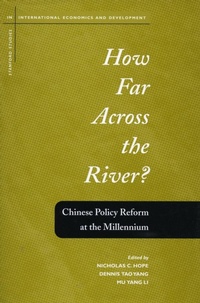
How Far Across the River?
Chinese Policy Reform at the Millennium
Published on 13. August 2003
Book
Hardback
536 pages
978-0-8047-4766-0 (ISBN)
Description
Gradual change has been a hallmark of the Chinese reform experience, and China's success in its sequential approach makes it unique among the former command economies. Since 1979, with the inception of the continuing era of reform, the Chinese economy has flourished. Growth has averaged nine percent a year, and China is now a trillion dollar economy. China has become a major trading power and the predominant target among developing countries for foreign direct investment. Despite all this, China remains poor and the reform process unfinished.
This book takes its defining theme from Deng Xiaopeng's famous metaphor for gradual reform: "feeling the stones to cross the river." How far has China progressed in fording the river? The experts who contributed to this volume tackle many aspects of that question, assessing Chinese progress in policy reform, priorities for further reform, and the research still needed to inform policymakers' decisions.
This book takes its defining theme from Deng Xiaopeng's famous metaphor for gradual reform: "feeling the stones to cross the river." How far has China progressed in fording the river? The experts who contributed to this volume tackle many aspects of that question, assessing Chinese progress in policy reform, priorities for further reform, and the research still needed to inform policymakers' decisions.
Reviews / Votes
"An excellent examination of many of the crucial issues characterizing China's transition to a market economy. The book will be of great value not only to those people interested in China, but-with increasing globalization-to those interested in the world economy at large." -Carl Riskin,Weatherhead East Asian Institute, Columbia UniversityMore details
Series
Edition
New edition
Language
English
Place of publication
Palo Alto
United States
Target group
College/higher education
Professional and scholarly
Edition type
New edition
Product notice
Cloth
Illustrations
91 tables, 47 illustrations
Dimensions
Height: 237 mm
Width: 156 mm
Thickness: 35 mm
Weight
830 gr
ISBN-13
978-0-8047-4766-0 (9780804747660)
Copyright in bibliographic data and cover images is held by Nielsen Book Services Limited or by the publishers or by their respective licensors: all rights reserved.
Schweitzer Classification
Persons
Nicholas C. Hope is Deputy Director of the Stanford Center for International
Development (formerly the Center for Research on Economic Development and
Policy Reform) at Stanford University. Dennis Tao Yang is Associate Professor of Economics at Virginia Polytechnic Institute. Mu Yang Li is a postdoctoral research associate at Stanford Graduate School of Business.
Development (formerly the Center for Research on Economic Development and
Policy Reform) at Stanford University. Dennis Tao Yang is Associate Professor of Economics at Virginia Polytechnic Institute. Mu Yang Li is a postdoctoral research associate at Stanford Graduate School of Business.
Content
Contents @toc4:Figures Tables Acknowledgments About the Contributors @toc2:1 Economic Policy Reform in China @tocca:Nicholas C. Hope, Dennis Tao Yang, and Mu Yang Li @toc1:Section I: Policy Reform in China: What Is Needed Next? @toc2:2 China's Transition to a Market Economy: How Far Across the River? @tocca:Yingyi Qian and Jinglian Wu @toc1:Section II: Building Market-Supporting Institutions @toc2:3 When Will China's Financial System Meet China's Needs? @tocca:Nicholas R. Lardy @toc2:4 Thriving on a Tilted Playing Field: China's Nonstate Enterprises in the Reform Era @tocca:Chong-En Bai, David D. Li, and Yijiang Wang @toc2:5 The More Law, the More ... ? Measuring Legal Reform in the People's Republic of China @tocca:William P. Alford @toc1:Section III: Toward Greater Economic Integration @toc2:6 Trade Policy, Structural Change, and China's Trade Growth @tocca:William Martin, Betina Dimaranan, Thomas W. Hertel, and Elena Ianchovichina @toc2:7 Sizing Up Foreign Direct Investment in China and India @tocca:Shang-jin Wei @toc2:8 How Much Can Regional Integration Do to Unify China's Markets? @tocca:Barry Naughton @toc1:Section IV: Sharing Rising Incomes @toc2:9 China's War on Poverty @tocca:Scott Rozelle, Linxiu Zhang, and Jikun Huang @toc2:10 Social Welfare in China in the Context of Three Transitions @tocca:Athar Hussain @toc2:11 Housing Reform in Urban China @tocca:Jeffrey S. Zax @toc1:Section V: Sustaining Policy Reform @toc2:12 Can China Grow and Safeguard Its Environment? The Case of Industrial Pollution @tocca:David Wheeler, Hua Wang, and Susmita Dasgupta @toc2:13 The Political Economy of China's Rural-Urban Divide @tocca:Dennis Tao Yang and Cai Fang @toc2:14 What Will Make Chinese Agriculture More Productive? @tocca:Jikun Huang, Justin Y. Lin, and Scott Rozelle @toc2:15 Bending Without Breaking: The Adaptability of Chinese Political Institutions @tocca:Jean C. Oi @toc1:Section VI: Further Research @toc2:16 Agenda for Future Research @tocca:Nicholas C. Hope, Dennis Tao Yang, and Mu Yang Li @toc4:Index Library of Congress Subject Headings for this publication: