

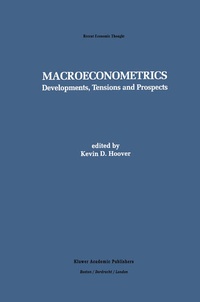
Macroeconometrics
Developments, Tensions, and Prospects
Published on 31. December 1995
Book
Hardback
XI, 577 pages
978-0-7923-9589-8 (ISBN)
Description
Each chapter of
Macroeconometrics
is written by respected econometricians in order to provide useful information and perspectives for those who wish to apply econometrics in macroeconomics. The chapters are all written with clear methodological perspectives, making the virtues and limitations of particular econometric approaches accessible to a general readership familiar with applied macroeconomics. The real tensions in macroeconometrics are revealed by the critical comments from different econometricians, having an alternative perspective, which follow each chapter.
More details
Series
Edition
1995 ed.
Language
English
Place of publication
Dordrecht
Netherlands
Target group
College/higher education
Professional and scholarly
Research
Illustrations
XI, 577 p.
Dimensions
Height: 241 mm
Width: 160 mm
Thickness: 37 mm
Weight
1051 gr
ISBN-13
978-0-7923-9589-8 (9780792395898)
DOI
10.1007/978-94-011-0669-6
Schweitzer Classification
Other editions
Additional editions
Book
12/2012
Springer
€213.99
Shipment within 15-20 days
E-Book
12/2012
Springer
€213.99
Available for download
Content
1 The Problem of Macroeconometrics.- I. Alternative Econometric Methodologies.- 2 Recent Advances in Solving and Estimating Dynamic Macroeconomic Models.- 3 The Economics of VAR Models.- 4 Progressive Modeling of Macroeconomic Time Series: The LSE Methodology.- 5 The Econometrics of the General Equilibrium Approach toBusiness Cycles.- II. The Lucas Critique Reconsidered.- 6 Causal Orderings.- 7 On Policy Regimes.- 8 The Lucas Critique in Practice: Theory Without Measurement.- 9 Rational Expectations and the Economic Consequences ofChanges in Regime.- 10 Historical Macroeconomics and Macroeconomic History.- Ill. Frontiers of Macroeconometrics.- 11 Modeling Volatility Dynamics.- 12 Dynamic Specification and Testing for Unit Roots and Cointegration.- 13 Nonlinear Models of Economic Fluctuations.