

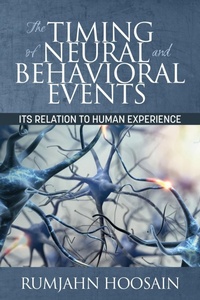
The Timing of Neural and Behavioral Events
Its Relation to Human Experience
Published on 13. January 2017
Book
Paperback/Softback
332 pages
978-1-68123-770-1 (ISBN)
Description
This monograph reviews cognitive and neuroscience studies of the relations between timing of both neural and behavioral events and human experience. The historical roots of these discussions are traced to the beginning of modern psychology. In the beginning of experimental psychology in Leibzig, Wundt worked on how elements of sensation relate to consciousness. In later development of psychology, the timing of conscious and unconscious processing of information, the timing of events in learning including language learning, mental speed and intelligence, and the speed of cognition vis-a-vis emotion are all crucial questions.
Systematic consideration of neural times is complementary to conventional neuroscience research, such as the Blue Brain Project focusing on neural structure. The discussion of neural times in the literature tends to be fragmented, incidental to whatever is the subject matter. This book attempts to treat neural times in the whole range of basic psychological processes more systematically, and shows how they are germane to the understanding of many cognitive and behavioral phenomena. Neural times are related to the evolutionary development of the brain and the human experience. A crucial dynamic in the interaction of evolutionarily older and newer regions of the brain depends on timing. The interaction of the generally faster unconscious processes, including emotions, and more deliberate processes results in greater variation of experiences and behaviors which is central to free will and adaptive for humankind as a whole.
This monograph is intended for senior undergraduates, graduate students, and professionals interested in an in-depth look at the role of timing of neural and behavioral processes in affecting human experience. It is not a textbook as such. It is a complementary resource for students of cognitive psychology, learning, and evolutionary psychology.
Systematic consideration of neural times is complementary to conventional neuroscience research, such as the Blue Brain Project focusing on neural structure. The discussion of neural times in the literature tends to be fragmented, incidental to whatever is the subject matter. This book attempts to treat neural times in the whole range of basic psychological processes more systematically, and shows how they are germane to the understanding of many cognitive and behavioral phenomena. Neural times are related to the evolutionary development of the brain and the human experience. A crucial dynamic in the interaction of evolutionarily older and newer regions of the brain depends on timing. The interaction of the generally faster unconscious processes, including emotions, and more deliberate processes results in greater variation of experiences and behaviors which is central to free will and adaptive for humankind as a whole.
This monograph is intended for senior undergraduates, graduate students, and professionals interested in an in-depth look at the role of timing of neural and behavioral processes in affecting human experience. It is not a textbook as such. It is a complementary resource for students of cognitive psychology, learning, and evolutionary psychology.
More details
Language
English
Place of publication
Charlotte
United States
Publishing group
Emerald Publishing Inc
Target group
Professional and scholarly
Dimensions
Height: 234 mm
Width: 156 mm
Thickness: 18 mm
Weight
506 gr
ISBN-13
978-1-68123-770-1 (9781681237701)
Copyright in bibliographic data and cover images is held by Nielsen Book Services Limited or by the publishers or by their respective licensors: all rights reserved.
Schweitzer Classification
Other editions
Additional editions
E-Book
01/2017
1st Edition
Information Age Publishing
from
€62.33
Available for download
Content
Preface.
Chapter 1. Everything in Its Time.
Chapter 2. Neural Structure and Neural Times.
Chapter 3. Consciousness.
Chapter 4. Learning With or Without Awareness.
Chapter 5. Intelligence and Mental Speed.
Chapter 6. Cognition and Emotion.
Chapter 7. Conclusion.
References.
Chapter 8. Endnotes.
Chapter 1. Everything in Its Time.
Chapter 2. Neural Structure and Neural Times.
Chapter 3. Consciousness.
Chapter 4. Learning With or Without Awareness.
Chapter 5. Intelligence and Mental Speed.
Chapter 6. Cognition and Emotion.
Chapter 7. Conclusion.
References.
Chapter 8. Endnotes.