

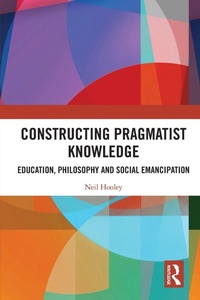
Constructing Pragmatist Knowledge
Education, Philosophy and Social Emancipation
1st Edition
Published on 30. May 2022
Book
Paperback/Softback
200 pages
978-0-367-61198-9 (ISBN)
Description
Constructing Pragmatist Knowledge reintroduces an explicit and systematic philosophical approach to education through American Pragmatism, expanding and detailing the practice of pragmatism itself for practitioners across various fields of social action.
While a number of theorists are referenced, it focuses on the work of the original pragmatists Charles Sanders Peirce, William James, John Dewey, George Herbert Mead and Jane Addams. It is written in a narrative style and connects personal and professional experience of the author with philosophical description, analysis and explanation. Major themes of pragmatism are encountered throughout involving knowledge, experience, inquiry, social acts, dialectic and contradiction, giving rise to human constructs of values, moral conduct and bricolage. Reintroducing pragmatism and epistemology as the focus of teaching and learning heralds revolutionary and democratic change for education systems worldwide and corrects neoliberal tendencies that impose anti-educational ideological, economic and political distortions.
This book will be of interest to academics, graduate students, teachers and pre-service teachers, policy makers and researchers in education, philosophy, sociology and epistemology.
While a number of theorists are referenced, it focuses on the work of the original pragmatists Charles Sanders Peirce, William James, John Dewey, George Herbert Mead and Jane Addams. It is written in a narrative style and connects personal and professional experience of the author with philosophical description, analysis and explanation. Major themes of pragmatism are encountered throughout involving knowledge, experience, inquiry, social acts, dialectic and contradiction, giving rise to human constructs of values, moral conduct and bricolage. Reintroducing pragmatism and epistemology as the focus of teaching and learning heralds revolutionary and democratic change for education systems worldwide and corrects neoliberal tendencies that impose anti-educational ideological, economic and political distortions.
This book will be of interest to academics, graduate students, teachers and pre-service teachers, policy makers and researchers in education, philosophy, sociology and epistemology.
More details
Language
English
Place of publication
London
United Kingdom
Publishing group
Taylor & Francis Ltd
Target group
College/higher education
Postgraduate
Illustrations
6 s/w Tabellen, 6 s/w Abbildungen, 6 s/w Zeichnungen
6 Tables, black and white; 6 Line drawings, black and white; 6 Illustrations, black and white
Dimensions
Height: 234 mm
Width: 156 mm
Thickness: 11 mm
Weight
316 gr
ISBN-13
978-0-367-61198-9 (9780367611989)
Copyright in bibliographic data and cover images is held by Nielsen Book Services Limited or by the publishers or by their respective licensors: all rights reserved.
Schweitzer Classification
Other editions
Additional editions
Book
11/2020
1st Edition
Routledge
€206.10
Shipment within 15-20 days
E-Book
11/2020
1st Edition
Routledge
€55.49
Available for download
E-Book
11/2020
1st Edition
Routledge
€55.49
Available for download
Person
Neil Hooley is an Honorary Fellow, College of Arts and Education, Victoria University Melbourne. He has interests in philosophy of education, democracy and social justice, critical theory and participatory action research. He supports recognition, respect and reconciliation between the Indigenous and non-Indigenous peoples of Australia.
Content
Part I: Beginning Practices 1. Philosophy and Democratic Society 2. Immersion in Beach Inquiries 3. Thinking about Science and the Universe 4. Activism and the Vietnam War; Part II: Transitional Practices 5. Confusions of Teaching and Curriculum 6. Teacher Unionism, Then and Now 7. Community Participation in Education 8. Educational Policy-Making; Part III: Theorising Practices 9. Respecting Indigenous Knowledge in the Regular Classroom 10. Corruption of Higher Education 11. Collapse of the Political Left 12. Bricolage: Closing the Circle of Practice-Theorising