

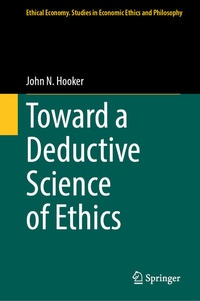
Toward a Deductive Science of Ethics
Description
This book maintains that ethics should be addressed with the same rigor and discipline that we bring to science and mathematics. While recognizing that normative ethics cannot be an empirical science, the book develops a deductive science of ethics inspired by the practices of working mathematicians. It treats traditional frameworks such as deontology and utilitarianism as proof techniques that can be used within a single deductive system. Applying this type of reasoning to a number of current ethical dilemmas, the book demonstrates how such an approach can make progress toward resolving controversial issues. Most of the book relies on careful analysis rather than mathematical notation, although two chapters present an explicitly mathematical treatment of distributive justice, reflecting the author's unusual dual background in philosophy and applied mathematics.
The book is of interest to ethicists, philosophers, and welfare economists engaged in ethics-related research, as well as practitioners who develop ethical policies in business, professional, or public policy contexts. Its rigorous treatment will also be valuable to technical specialists who incorporate ethics into mathematical models and artificial intelligence. The book is also suitable for postgraduate students in these areas.
More details
Person
John Hooker is University Professor of Operations Research and T. Jerome Holleran Professor of Business Ethics and Social Responsibility, Emeritus, at Carnegie Mellon University. He has published more than 200 articles, 12 books, and 6 edited volumes in operations research, normative ethics, mathematical models for distributive justice, fairness in artificial intelligence, cross-cultural management and ethics, philosophy, and music theory. He is a Fellow of the Institute for Operations Research and the Management Sciences (INFORMS), as well as a recipient of the INFORMS Computing Society Prize and the INFORMS Khachiyan Prize for lifetime achievement in optimization. He was also recognized with the Research Excellence Award of the Association for Constraint Programming.
Professor Hooker holds doctoral degrees in philosophy and operations research. His previous ethics-related books include The Structure of Fair Solutions , Taking Ethics Seriously , Business Ethics as Rational Choice , Advanced Introduction to Business Ethics , and Working Across Cultures . He is founding editor-in-chief of the Journal of Business Ethics Education , the only academic journal dedicated to the topic. He developed the undergraduate and postgraduate ethics programs at CMU's Tepper School of Business. He has supervised numerous PhD students and received a Distinguished Academic Leadership Award for his direction and reorganization of the undergraduate business program, as well as teaching awards. His work in cross-cultural ethics is informed by his experiences living and working in ten countries on six continents. As an avocation, he has written a number of musical compositions for piano, chamber groups, and chorus.
Content
Chapter 1. Why a science of Ethics?.- Chapter 2. Ethics as a Cousin of Mathematics.- Chapter 3. Generalizability.- Chapter 4. Respect for Autonomy.- Chapter 5. The Utilitarian Principle.- Chapter 6. Getting started with Applied Ethics.- Chapter 7. Medical Ethics and Bioethics.- Chapter 8. Students and Employees.- Chapter 9. Business Ethics.- Chapter 10. Ethics and Artificial Intelligence.- Chapter 11. Distributive Justice: Axiomatic Arguments.- Chapter 12. Distributive Justice: Reaching Consensus.