

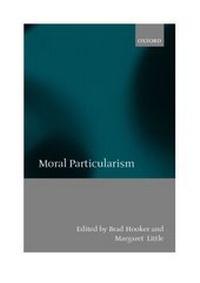
Moral Particularism
Published on 7. December 2000
Book
Hardback
332 pages
978-0-19-823884-3 (ISBN)
Description
Moral Particularism is a timely and penetrating investigation of a theoretical approach that seeks to transform moral philosophy. In the face of continuing disagreement about which general moral principles are correct, there has been a resurgence of interest in the view that correct moral judgements can be only about particular cases. This view, moral particularism, presages a revolution in ordinary moral practice, which has hitherto consisted largely of appeals to general moral principles. Moral particularism also opposes the main aim of most contemporary normative moral theory, which consists in attempts to show that either one general principle or a set of general principles is superior to all its rivals.
Reviews / Votes
The volume is indispensable to anyone working on the topic and useful for upper-level and graduate courses. It does represent the current state of the art. The Philosophical ReviewMore details
Language
English
Place of publication
Oxford
United Kingdom
Publishing group
Oxford University Press
Target group
Professional and scholarly
Illustrations
3 line figures, bibliography, index
Dimensions
Height: 234 mm
Width: 156 mm
Thickness: 23 mm
Weight
636 gr
ISBN-13
978-0-19-823884-3 (9780198238843)
Copyright in bibliographic data and cover images is held by Nielsen Book Services Limited or by the publishers or by their respective licensors: all rights reserved.
Schweitzer Classification
Other editions
Additional editions
Content
1 Brad Hooker, moral particularism - wrong and bad; 2 Roger Crisp, particularising particularism; 3 Joseph Raz, the truth in particularism; 4 Frank Jackson, Philip Pettit, and Michael Smith, ethical particularism and patterns; 5 T.H. Irwin, ethics as an inexact science - Aristotle's ambition for moral theory; 6 Jonathan Dancy, the particularist's progress; 7 David Bakhurst, ethical particularism in context; 8 Jay Garfield, particularity and principle - the structure of moral knowledge; 9 Lawrence Blum, against deriving particularity; 10 Martha Nussbaum, why practice needs ethical theory - particularism, principle, and bad behaviour; 11 David McNaughton and Piers Rawling, unprincipled ethics; 12 Margaret Olivia Little, moral generalities revisited.