

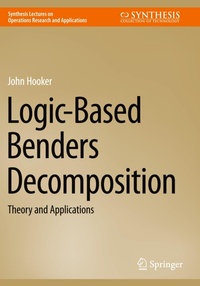
Logic-Based Benders Decomposition
Description
This book is the first comprehensive guide to logic-based Benders decomposition (LBBD), a general and versatile method for breaking large, complex optimization problems into components that are small enough for practical solution. The author introduces logic-based Benders decomposition for optimization, which substantially generalizes the classical Benders method. It can reduce solution times by orders of magnitude and allows decomposition to be applied to a much wider variety of optimization problems. On the theoretical side, this book provides a full account of inference duality concepts that underlie LBBD, as well as a description of how LBBD can be combined with stochastic and robust optimization, heuristic methods, and decision diagrams. It also clarifies the connection between LBBD and combinatorial Benders cuts for mixed integer programming. On the practical side, it explains how LBBD has been applied to a rapidly growingvariety of problem domains. After describing basic theory, this book provides a comprehensive review of the rapidly growing literature that describes these applications, in each case explaining how LBBD is adapted to the problem at hand. In doing so this work provides a sourcebook of ideas for applying LBBD to new problems as they arise.
More details
Other editions
Additional editions
Person
Dr. Hooker is a pioneer in the integration of optimization and constraint programming technologies, having written the first book and co-chaired the first conference on the subject. OR/CP integration now an important element of state-of-the-art optimization software. He also introduced logic-based Benders decomposition for optimization, which substantially generalizes the classical Benders method. It can reduce solution times by orders of magnitude and allows decomposition to be applied to a much wider variety of optimization problems. He was the first to observe the phase transition phenomenon in satisfiability problems. He and T. Hadzic introduced decision diagrams as an optimization method, and several investigators are now pursuing this line of research. In recent research, he draws on his dual background in ethics and operations research to develop optimization models for fairness and distributive justice.