

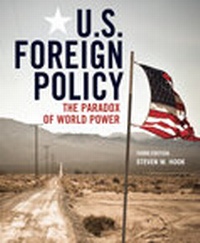
U.S. Foreign Policy
The Paradox of World Power
3rd Edition
Published on 15. July 2010
Book
Paperback/Softback
564 pages
978-1-60426-609-2 (ISBN)
Description
The United States still faces no credible rival to challenge its supremacy, even after years of economic crisis and war. And yet, the very sources that give rise to its primacy - exceptionalism, the diffusion of power, and the involvement of civil society in the foreign policy process - also create vulnerabilities.
The new third edition of U.S. Foreign Policy provides students with a concise and accessible overview of this foreign policy paradox, and highlights the challenges facing policy makers.
Key updates include complete coverage of President Obama's first year in office, the administration's new emphasis on engagement, the ongoing wars in Iraq and Afghanistan, and the economic crisis. Students will also find a thorough review of the lessons of the Bush administration, including examinations of the rivalry between the State and Defense Departments, intelligence breakdowns, human rights controversies, and unilateralism.
Instructors will appreciate the chapter organization, crisp writing, pedagogical features, and overall brevity that they have come to expect from this bestseller.
The new third edition of U.S. Foreign Policy provides students with a concise and accessible overview of this foreign policy paradox, and highlights the challenges facing policy makers.
Key updates include complete coverage of President Obama's first year in office, the administration's new emphasis on engagement, the ongoing wars in Iraq and Afghanistan, and the economic crisis. Students will also find a thorough review of the lessons of the Bush administration, including examinations of the rivalry between the State and Defense Departments, intelligence breakdowns, human rights controversies, and unilateralism.
Instructors will appreciate the chapter organization, crisp writing, pedagogical features, and overall brevity that they have come to expect from this bestseller.
More details
Edition
3rd Revised edition
Language
English
Place of publication
Washington
United States
Publishing group
SAGE Publications Inc
Target group
College/higher education
Professional and scholarly
Edition type
Revised edition
Dimensions
Height: 232 mm
Width: 191 mm
Weight
851 gr
ISBN-13
978-1-60426-609-2 (9781604266092)
Copyright in bibliographic data and cover images is held by Nielsen Book Services Limited or by the publishers or by their respective licensors: all rights reserved.
Schweitzer Classification
Other editions
New editions
Book
07/2013
4th Edition
CQ Press
€99.36
Article exhausted; check for reprint
Person
Steven W. Hook (1959-2022) was professor of political science at Kent State University. In addition to this book, he was co-author of American Foreign Policy Since World War II (CQ Press, 2019, 21st ed., with John Spanier) and author of National Interest and Foreign Aid (Lynne Rienner, 1995). His edited books include U.S. Foreign Policy Today: American Renewal? (CQ Press, 2012, with James M. Scott), the Routledge Handbook of American Foreign Policy (Routledge Press, 2012, with Christopher M. Jones), and Democratic Peace in Theory and Practice (Kent State University Press, 2010). His journal articles have appeared in World Politics, International Studies Quarterly, Asian Survey, Foreign Policy Analysis, International Interactions, and other leading journals. Professor Hook received a BA (1982) in Journalism and Political Science from the University of Michigan and an MA (1990) and PhD (1993) in International Studies from the University of South Carolina. At Kent State, he received the university's Distinguished Teaching Award in 2007 and served as department chair from 2008 to 2012. He was a past president of the Foreign Policy Analysis sections of the American Political Science Association and the International Studies Association.
Content
PART ONE: THE SETTING OF U.S. FOREIGN POLICY
The United States in a Turbulent World
The Expansion of U.S. Power
Dynamics of Decision Making
PART TWO: INSIDE-OUT: GOVERNMENT SOURCES OF FOREIGN POLICY
Presidential Power
Congress Beyond the "Water's Edge"
The Foreign Policy Bureaucracy
PART THREE: OUTSIDE-IN: EXTERNAL SOURCES OF FOREIGN POLICY
Public Opinion at Home and Abroad
The Impact of Mass Communications
Social Movements and Interest Groups
PART FOUR: POLICY DOMAINS
National Security and Defense Policy
Economic Statecraft
Transnational Policy Problems
The United States in a Turbulent World
The Expansion of U.S. Power
Dynamics of Decision Making
PART TWO: INSIDE-OUT: GOVERNMENT SOURCES OF FOREIGN POLICY
Presidential Power
Congress Beyond the "Water's Edge"
The Foreign Policy Bureaucracy
PART THREE: OUTSIDE-IN: EXTERNAL SOURCES OF FOREIGN POLICY
Public Opinion at Home and Abroad
The Impact of Mass Communications
Social Movements and Interest Groups
PART FOUR: POLICY DOMAINS
National Security and Defense Policy
Economic Statecraft
Transnational Policy Problems