

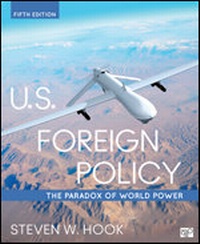
U.S. Foreign Policy
The Paradox of World Power
5th Edition
Published on 29. February 2016
Book
Paperback/Softback
520 pages
978-1-5063-2158-5 (ISBN)
Description
The book addresses international topics such as rapid developments in the global economy, the revival of great-power rivalry, and the growing influence of non-state actors. Domestic coverage includes trends in the U.S. economy, political polarization, bureaucratic rivalries, and the effects of social media as a primary venue for news. The most pressing question is whether U.S. foreign policymakers can manage these dynamics in a manner that preserves U.S. primacy.
Reviews / Votes
"U.S. Foreign Policy: The Paradox of World Power is one of the most complete and comprehensive introductions to U.S. foreign policy available. It is well-written for a student audience, and I am impressed with just how comprehensive it is. Students who read this book will have a superb introduction to American foreign policy and how it is studied." -- Steven Livingston "Hook's text is one of the leading foreign policy textbooks precisely because of its overall structure, approach, and balance of detail that supports the overarching theme-the paradox of power. Each edition improves on the last, providing students with a clear introduction to U.S. foreign policy." -- Peter H. Loedel "Each time I teach the U.S. foreign policy course and use Hook's book, students really read it. The writing style is clear and accessible, and students have even commented on the helpfulness of graphics. All in all, I continue to use U.S. Foreign Policy: The Paradox of World Power because my students respond to it so well." -- Linda AdamsMore details
Edition
5th Revised edition
Language
English
Place of publication
Washington
United States
Publishing group
SAGE Publications Inc
Target group
College/higher education
Edition type
Revised edition
Dimensions
Height: 232 mm
Width: 191 mm
Weight
785 gr
ISBN-13
978-1-5063-2158-5 (9781506321585)
Copyright in bibliographic data and cover images is held by Nielsen Book Services Limited or by the publishers or by their respective licensors: all rights reserved.
Schweitzer Classification
Other editions
Previous edition
Book
07/2013
4th Edition
CQ Press
€99.36
Article exhausted; check for reprint
Person
Steven W. Hook (1959-2022) was professor of political science at Kent State University. In addition to this book, he was co-author of American Foreign Policy Since World War II (CQ Press, 2019, 21st ed., with John Spanier) and author of National Interest and Foreign Aid (Lynne Rienner, 1995). His edited books include U.S. Foreign Policy Today: American Renewal? (CQ Press, 2012, with James M. Scott), the Routledge Handbook of American Foreign Policy (Routledge Press, 2012, with Christopher M. Jones), and Democratic Peace in Theory and Practice (Kent State University Press, 2010). His journal articles have appeared in World Politics, International Studies Quarterly, Asian Survey, Foreign Policy Analysis, International Interactions, and other leading journals. Professor Hook received a BA (1982) in Journalism and Political Science from the University of Michigan and an MA (1990) and PhD (1993) in International Studies from the University of South Carolina. At Kent State, he received the university's Distinguished Teaching Award in 2007 and served as department chair from 2008 to 2012. He was a past president of the Foreign Policy Analysis sections of the American Political Science Association and the International Studies Association.
Content
PART I. The Setting of U.S. Foreign Policy
Chapter 1: The United States in a Turbulent World
Snapshot: America's World Power
Challenges to U.S. Primacy
The Paradox of America's World Power
Conclusion
Chapter 2: The Expansion of U.S. Power
Economic and Territorial Expansion
Fighting Two World Wars
Global Primacy and the Cold War
New Challenges after the Cold War
Conclusion
Chapter 3: Dynamics of Decision Making
The Global Context: Rival Perspectives
Opening the "Black Box" of Domestic Politics
The Impact of Civil Society
Coping with Bureaucratic Politics
The Human Factor
Conclusion
PART II. Inside-Out: Government Sources of Foreign Policy
Chapter 4: Presidential Power
The Constitution's Mixed Blessing
Presidential Prerogative in the "Zone of Twilight"
Structures of the "Presidential Branch"
Judicial Interventions in Foreign Policy
Conclusion
Chapter 5: Congress beyond the "Water's Edge"
Trends in Legislative-Executive Relations
Constraints on Congressional Action
Legislating Foreign Policy
War Powers and the Use of Force
The Power of the Purse
Conclusion
Chapter 6: The Foreign Policy Bureaucracy
Agency Dysfunctions and the Paradox of World Power
The Diplomatic Complex
The Security Complex
The Intelligence Complex
The Economic Complex
Conclusion
PART III. Outside-In: External Sources of Foreign Policy
Chapter 7: Public Opinion at Home and Abroad
Democracy and the Paradox of World Power
Public Opinion since World War II
Group Identities and Foreign Policy Views
Conclusion
Chapter 8: The Impact of Mass Communications
Functions of the News Media
Patterns of Foreign News Coverage
Government Efforts to Control the Message
The Social Media Revolution
Online News and Views from Overseas
Conclusion
Chapter 9: Social Movements and Interest Groups
Group Action and the Paradox
Dynamics of Social Movements
Types of Foreign Policy NGOs
Group Strategies and Tactics
Buying Power: The Corporate Connection
Conclusion
PART IV. Policy Domains
Chapter 10: National Security and Defense Policy
The Foundation of Strategy
Justifying the Use of Force
The Nuclear Shadow
Waging War on Terror
Conclusion
Chapter 11: Economic Statecraft
Models of Political Economy
The Balance of Economic Power
Trade Policy as a "Two-Level Game"
National Interests and Foreign Aid
Economic Sanctions as a Policy Tool
Conclusion
Chapter 12: Transnational Policy Problems
Managing the Global Commons
The Immigration Debate
The Dangers of Weapons Proliferation
Promoting Human Rights and Democracy
Signs of a More Peaceful World
Conclusion
Chapter 1: The United States in a Turbulent World
Snapshot: America's World Power
Challenges to U.S. Primacy
The Paradox of America's World Power
Conclusion
Chapter 2: The Expansion of U.S. Power
Economic and Territorial Expansion
Fighting Two World Wars
Global Primacy and the Cold War
New Challenges after the Cold War
Conclusion
Chapter 3: Dynamics of Decision Making
The Global Context: Rival Perspectives
Opening the "Black Box" of Domestic Politics
The Impact of Civil Society
Coping with Bureaucratic Politics
The Human Factor
Conclusion
PART II. Inside-Out: Government Sources of Foreign Policy
Chapter 4: Presidential Power
The Constitution's Mixed Blessing
Presidential Prerogative in the "Zone of Twilight"
Structures of the "Presidential Branch"
Judicial Interventions in Foreign Policy
Conclusion
Chapter 5: Congress beyond the "Water's Edge"
Trends in Legislative-Executive Relations
Constraints on Congressional Action
Legislating Foreign Policy
War Powers and the Use of Force
The Power of the Purse
Conclusion
Chapter 6: The Foreign Policy Bureaucracy
Agency Dysfunctions and the Paradox of World Power
The Diplomatic Complex
The Security Complex
The Intelligence Complex
The Economic Complex
Conclusion
PART III. Outside-In: External Sources of Foreign Policy
Chapter 7: Public Opinion at Home and Abroad
Democracy and the Paradox of World Power
Public Opinion since World War II
Group Identities and Foreign Policy Views
Conclusion
Chapter 8: The Impact of Mass Communications
Functions of the News Media
Patterns of Foreign News Coverage
Government Efforts to Control the Message
The Social Media Revolution
Online News and Views from Overseas
Conclusion
Chapter 9: Social Movements and Interest Groups
Group Action and the Paradox
Dynamics of Social Movements
Types of Foreign Policy NGOs
Group Strategies and Tactics
Buying Power: The Corporate Connection
Conclusion
PART IV. Policy Domains
Chapter 10: National Security and Defense Policy
The Foundation of Strategy
Justifying the Use of Force
The Nuclear Shadow
Waging War on Terror
Conclusion
Chapter 11: Economic Statecraft
Models of Political Economy
The Balance of Economic Power
Trade Policy as a "Two-Level Game"
National Interests and Foreign Aid
Economic Sanctions as a Policy Tool
Conclusion
Chapter 12: Transnational Policy Problems
Managing the Global Commons
The Immigration Debate
The Dangers of Weapons Proliferation
Promoting Human Rights and Democracy
Signs of a More Peaceful World
Conclusion