

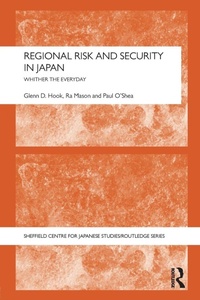
Regional Risk and Security in Japan
Whither the everyday
1st Edition
Published on 15. May 2015
Book
Paperback/Softback
238 pages
978-1-138-82389-1 (ISBN)
Description
Japan's unusual position in the realm of international politics encapsulates a three-fold juxtaposition: both in and out of Asia, both occupied by and a close ally of the United States, and both a key trade partner and a strategic rival of China. Whilst international relations theory offers a number of ways to analyse these relations, this book instead utilizes the concept of risk to provide an innovative perspective on Japan's relations with China, North Korea and the US.
The book elucidates how risk, potential harm and harm are faced disproportionately by certain groups in society. This is demonstrated by providing an empirically rich analysis of the domestic implications of security relations with China, North Korea and the United States through the presence of US troops in Okinawa. Beginning with a theoretical discussion of risk, it goes on to demonstrate how the concept of risk adds value to the study of international relations in three senses. First, the concept helps to break down the boundaries between the international and domestic. Second, the focus on risk and the everyday directs us to ask basic questions about the costs and benefits of a security policy meant to secure the national population. Third, what implications do these two points have for governance? The question is one of governance as Japan's externally oriented security policy produces domestic insecurity shared disproportionately, not equally, as this volume makes clear.
Developing the theory of risk as a tool for understanding international relations, this book will be of great interest to students and scholars of Asian politics, Japanese politics, international relations and security studies, as well as to policy makers and practitioners working in the field.
The book elucidates how risk, potential harm and harm are faced disproportionately by certain groups in society. This is demonstrated by providing an empirically rich analysis of the domestic implications of security relations with China, North Korea and the United States through the presence of US troops in Okinawa. Beginning with a theoretical discussion of risk, it goes on to demonstrate how the concept of risk adds value to the study of international relations in three senses. First, the concept helps to break down the boundaries between the international and domestic. Second, the focus on risk and the everyday directs us to ask basic questions about the costs and benefits of a security policy meant to secure the national population. Third, what implications do these two points have for governance? The question is one of governance as Japan's externally oriented security policy produces domestic insecurity shared disproportionately, not equally, as this volume makes clear.
Developing the theory of risk as a tool for understanding international relations, this book will be of great interest to students and scholars of Asian politics, Japanese politics, international relations and security studies, as well as to policy makers and practitioners working in the field.
Reviews / Votes
"Authored by three European scholars affiliated with the University of Sheffield's East Asia Centre, the work explores Japanese policy related to three broad security issues: China, North Korea, and US military bases in Okinawa... Summing Up: Recommended. Graduate students." - C. W. Sherrill, Troy University, CHOICE"(The book) provides an important linkage between the state and its people regarding security issues by utilizing the risk recalibration process. Thus, the idea of risk used in this book departs from previous studies on risk and treats it as 'a heuristic device to illuminate how the recalibration of risk is manifested as harm to the security of the people'... this book is an important read not only for scholars but also practitioners who deal with these issues on a day-to-day basis." - Wakana Mukai, The University of Tokyo, Japan
More details
Series
Language
English
Place of publication
London
United Kingdom
Publishing group
Taylor & Francis Ltd
Target group
College/higher education
Illustrations
4 s/w Zeichnungen, 4 s/w Abbildungen
4 Line drawings, black and white; 4 Illustrations, black and white
Dimensions
Height: 234 mm
Width: 156 mm
Thickness: 14 mm
Weight
398 gr
ISBN-13
978-1-138-82389-1 (9781138823891)
Copyright in bibliographic data and cover images is held by Nielsen Book Services Limited or by the publishers or by their respective licensors: all rights reserved.
Schweitzer Classification
Other editions
Additional editions
Book
06/2015
1st Edition
Routledge
€243.50
Shipment within 10-20 days
E-Book
05/2015
Routledge
€69.99
Available for download
E-Book
05/2015
Routledge
€69.99
Available for download
Persons
Glenn D. Hook is Toshiba International Foundation Anniversary Research Professor, School of East Asian Studies at the University of Sheffield, UK and director of the National Institute of Japanese Studies, part of the White Rose East Asia Centre, a collaboration between Sheffield and the University of Leeds, UK. His recent books include Japan's International Relations: Politics, Economics and Security (co-author, Routledge, 2012, third edition).
Ra Mason is a lecturer in Asia-Pacific Studies at the University of Central Lancashire, UK, special research fellow with the Japan Society for the Promotion of Science at the University of the Ryukyus (2014-15), Japan, and an honorary fellow of the White Rose East Asia Centre, University of Sheffield, UK. His recent publications include Japan's Relations with North Korea and the Recalibration of Risk (Routledge, 2014).
Paul O'Shea is an assistant professor of Asian Studies at Aarhus University, Denmark and an honorary fellow of the White Rose East Asia Centre, University of Sheffield, UK. He has recently co-edited a volume entitled Risk State: Japan's Foreign Policy in an Era of Uncertainty (2015).
Ra Mason is a lecturer in Asia-Pacific Studies at the University of Central Lancashire, UK, special research fellow with the Japan Society for the Promotion of Science at the University of the Ryukyus (2014-15), Japan, and an honorary fellow of the White Rose East Asia Centre, University of Sheffield, UK. His recent publications include Japan's Relations with North Korea and the Recalibration of Risk (Routledge, 2014).
Paul O'Shea is an assistant professor of Asian Studies at Aarhus University, Denmark and an honorary fellow of the White Rose East Asia Centre, University of Sheffield, UK. He has recently co-edited a volume entitled Risk State: Japan's Foreign Policy in an Era of Uncertainty (2015).
Content
Introduction Part I:The 'China threat' and Sino-Japanese relations Introduction 1. Food security, safety and bioterrorism 2. Transboundary pollution 3. East China Sea dispute 4. Immigration and the demographic crisis Part II: Deconstructing the framing of North Korea Introduction 5. Missile testing 6. North Korean abductions 7. Nuclear testing 8. Drugs and money Part III: Internalizing the US-Japan alliance in Okinawa Introduction 9. Military accidents 10. Military incidents 11. Environmental degradation 12. Noise pollution. Conclusion.