

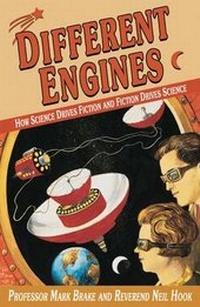
Different Engines
How Science Drives Fiction and Fiction Drives Science
Published on 1. January 2007
Book
Hardback
250 pages
978-0-230-01980-5 (ISBN)
Description
Since its emergence in the seventeenth century, science fiction has been a sustained, coherent and subversive check on the promises and pitfalls of science. In their turn, invention and discovery have forced fiction writers to confront the nature and limits of reality. Different Engines traces the way in which we've imagined the future.
Reviews / Votes
'An excellent starting point for passionate arguments on fascinating subjects.' www.asimovs.com 'In Different Engines, Professor Mark Brake and Reverend Neil Hook take us on a tour of science fiction through the ages. They show how the genre extends far beyond mere entertainment and often provides a profound exploration of the interface between science and society and the impact that new technologies or discoveries, such as that of alien life, are likely to have.' - Lewis Dartnell, The Astrobiology Society of BritainMore details
Series
Edition
2007
Language
English
Place of publication
New York
United States
Target group
College/higher education
Professional and scholarly
Illustrations
biography
Dimensions
Height: 23.5 cm
Width: 15.5 cm
Thickness: 23 mm
Weight
360 gr
ISBN-13
978-0-230-01980-5 (9780230019805)
Schweitzer Classification
Persons
Reverend NEIL HOOK is Associate Senior Lecturer in Science Communication at the University of Glamorgan and an Anglican priest in the Welsh Mountains. Neil's research focuses on the relationship between science and science fiction. His work was recently profiled in the BBC's Science Fiction Britannia series. When not working Neil spends most of his life living in his own science fictional world where he is young, handsome and almost always saves the day.
Professor MARK BRAKE holds a chair in science communication at the University of Glamorgan, UK, where he founded the world's first degree program on the historical interplay between space, science and culture. As an astrobiology and science fiction expert, he appears on and writes for TV and radio most weeks, including BBC, Sky Movies and the Discovery Channel; he is a consultant to the Science Fiction Museum in Seattle and the Australian Centre for Astrobiology. A founder member of NASA's Astrobiology Institute Communication Group, Mark feels we'll only settle the life on Mars debate by visiting the surface with a shovel.
Professor MARK BRAKE holds a chair in science communication at the University of Glamorgan, UK, where he founded the world's first degree program on the historical interplay between space, science and culture. As an astrobiology and science fiction expert, he appears on and writes for TV and radio most weeks, including BBC, Sky Movies and the Discovery Channel; he is a consultant to the Science Fiction Museum in Seattle and the Australian Centre for Astrobiology. A founder member of NASA's Astrobiology Institute Communication Group, Mark feels we'll only settle the life on Mars debate by visiting the surface with a shovel.
Content
A plurality of habitable worlds: the age of discovery Remembrance of things to come: the mechanical age Pulp fiction: the Astounding age Cold War and heat death: the atomic age Stranger in a Strange Land : the new age Information wants to be free: the computer age The Frankenstein century: the age of biology Index