

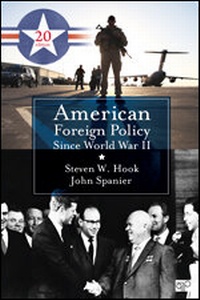
American Foreign Policy Since World War II
20th Edition
Published on 19. May 2015
Book
Paperback/Softback
432 pages
978-1-4833-6853-5 (ISBN)
Description
Hook and Spanier's classic text celebrates its Twentieth Edition with more of the context and analysis that has long made it the standard for guiding students through the complexities of American foreign policy. With each new edition, recent developments confirm the book's overarching theme-that there is an American "style" of foreign policy imbued with a distinct sense of national exceptionalism. Giving students the historical context they need, the book allows them to grasp the functions and frequent dysfunctions of the nation's evolving foreign policy agenda. In this new edition, chapters covering the end of the Cold War have been combined and streamlined, making room for a new chapter that examines the aftershocks of the Arab Spring, political breakdowns in Iraq and Afghanistan, and the rise of the Islamic State. The final chapter considers the revival of power politics in world politics, with Russia and China stepping up their attempts to weaken the United States and create a multipolar world. The book ends by reconsidering America's distinctive style of foreign policy and its resilience amid such turbulence since World War II.
Reviews / Votes
"I have never assigned a book in my thirty years of college teaching that receives as high an evaluation from students as Hook and Spanier's American Foreign Policy since World War II. The reason why students like the book is that it is very well-written and provides a fast-paced account of the history of U.S. foreign policy." -- Timothy White "I have used Hook and Spanier's text both in courses on foreign policy and the United States since 1945, and both specialists and non-specialists found it useful. It is thorough and does a good job of incorporating new evidence. It provides an excellent study of post-World War II foreign policy." -- Richard Filipink "Hook and Spanier's text has been one of my most used and most reliable textbooks. Its chronological approach to the study of American foreign policy is one of its major strengths, making it easy to follow and most logical." -- Leo Joseph Weeks "I consider Hook and Spanier's book to be the most useful survey of post-WWII American foreign policy for undergraduates. I particularly appreciate the authors' incorporation of competing interpretations of major foreign policy events." -- Alexei ShevchenkoMore details
Edition
20th Revised edition
Language
English
Place of publication
Thousand Oaks
United States
Target group
College/higher education
Edition type
Revised edition
Dimensions
Height: 229 mm
Width: 152 mm
Weight
515 gr
ISBN-13
978-1-4833-6853-5 (9781483368535)
Copyright in bibliographic data and cover images is held by Nielsen Book Services Limited or by the publishers or by their respective licensors: all rights reserved.
Schweitzer Classification
Other editions
New editions
Steven W. Hook | John W. Spanier
American Foreign Policy Since World War II - International Student Edition
Book
04/2018
21st Edition
CQ Press
€154.50
Shipment within 15-20 days
Previous edition
Steven W. Hook | John W. Spanier
American Foreign Policy Since World War II
Book
09/2012
1st Edition
CQ Press
€73.31
Article exhausted; check for reprint
Persons
Steven W. Hook (1959-2022) was professor of political science at Kent State University. In addition to this book, he was co-author of American Foreign Policy Since World War II (CQ Press, 2019, 21st ed., with John Spanier) and author of National Interest and Foreign Aid (Lynne Rienner, 1995). His edited books include U.S. Foreign Policy Today: American Renewal? (CQ Press, 2012, with James M. Scott), the Routledge Handbook of American Foreign Policy (Routledge Press, 2012, with Christopher M. Jones), and Democratic Peace in Theory and Practice (Kent State University Press, 2010). His journal articles have appeared in World Politics, International Studies Quarterly, Asian Survey, Foreign Policy Analysis, International Interactions, and other leading journals. Professor Hook received a BA (1982) in Journalism and Political Science from the University of Michigan and an MA (1990) and PhD (1993) in International Studies from the University of South Carolina. At Kent State, he received the university's Distinguished Teaching Award in 2007 and served as department chair from 2008 to 2012. He was a past president of the Foreign Policy Analysis sections of the American Political Science Association and the International Studies Association.
John Spanier received his PhD from Yale University. Since joining the faculty of the University of Florida in 1957, Spanier has lectured at the U.S. State Department's Foreign Service Institute, the Naval War College, military service academies, and several universities. Among his many other books is Games Nations Play.
John Spanier received his PhD from Yale University. Since joining the faculty of the University of Florida in 1957, Spanier has lectured at the U.S. State Department's Foreign Service Institute, the Naval War College, military service academies, and several universities. Among his many other books is Games Nations Play.
Content
Chapter 1 The American Approach to Foreign Policy
Learning from Experience
The Roots of American Primacy
The American Sense of Destiny
Self-Doubts, Revisionism, and Social Construction
Part I: The Cold War
Chapter 2 From World War to Cold War
American Wartime Illusions
The Russo-Soviet Approach to Foreign Policy
Soviet Expansion after World War II
The Strategy of Containment
Declaring Cold War: The Truman Doctrine
Chapter 3 Containment: From Theory to Practice
New Economic and Military Structures
Reviving the Western European Allies
Confronting Revolution in East Asia
Domestic Pressures for a Global Crusade
Eisenhower's 'New Look' in Foreign Policy
Chapter 4 North-South Tensions and the Vietnam War
Developing Countries in the Crossfire
Regional Conflicts in Latin America
Vietnam: The Limits of Containment
Chapter 5 Detente and World-Order Politics
Managing the Superpower Rivalry
Carter's Quest for World Order
War and Peace in the Middle East
Blowback and the Soviet Power Play
Chapter 6 Breakthroughs in the Superpower Struggle
Reagan's Rhetorical Offensive
Expanding U.S. Military Forces
'Rollback' in Developing Countries
Alliance Politics in the Late Cold War
From Confrontation to Conciliation
Chapter 7 The End of the Cold War
Bush's Management of the Soviet Collapse
Endgame: The Collapse of the Core
Reasons for the Soviet Collapse
A Final Appraisal
Part II: The New World 'Disorder'
Chapter 8 Old Tensions in a New Order
Great Expectations after the Cold War
Clinton's Embrace of 'Geoeconomics'
Sources of Global Fragmentation
War and Peace in the Middle East
The Plight of 'Failed States'
Lessons from the Regional Crises
Chapter 9 The Shifting European Landscape
Western Europe: From Community to Union
Jump-Starting Democracy in Eastern Europe
NATO's Search for a New Mission
'Ethnic Cleansing' in the Balkans
U.S.-Russian Relations under Stress
Chapter 10 America Under Fire
Strains in the Unipolar Order
The Growing Threat of 'Sacred Terror'
Terror in the Morning Sky
Elements of Counterterrorism
A Grand Strategy of Primacy and Preemption
Chapter 11 Hot Wars in Afghanistan and Iraq
The Afghanistan Campaign
The Pakistani Tinderbox
Renewed Hostilities against Iraq
Chapter 12 Looking Back, and Facing the Future
Flashbacks to Vietnam
Legacies of the Bush Era
Obama's Call for "Renewal"
American Hegemony at Risk
Chapter 13 Aftershocks of the Arab Spring
Mass Demands for Democracy
Israel's Quest for Internal Security
Iraq's Collapse and the ISIS Challenge
The Afghan Muddle
Chapter 14 The Revival of Power Politics
Russia's Declaration of Cold War II
China's Pacific Challenge
Ongoing Threats of Nuclear Proliferation
Rethinking American Power
Learning from Experience
The Roots of American Primacy
The American Sense of Destiny
Self-Doubts, Revisionism, and Social Construction
Part I: The Cold War
Chapter 2 From World War to Cold War
American Wartime Illusions
The Russo-Soviet Approach to Foreign Policy
Soviet Expansion after World War II
The Strategy of Containment
Declaring Cold War: The Truman Doctrine
Chapter 3 Containment: From Theory to Practice
New Economic and Military Structures
Reviving the Western European Allies
Confronting Revolution in East Asia
Domestic Pressures for a Global Crusade
Eisenhower's 'New Look' in Foreign Policy
Chapter 4 North-South Tensions and the Vietnam War
Developing Countries in the Crossfire
Regional Conflicts in Latin America
Vietnam: The Limits of Containment
Chapter 5 Detente and World-Order Politics
Managing the Superpower Rivalry
Carter's Quest for World Order
War and Peace in the Middle East
Blowback and the Soviet Power Play
Chapter 6 Breakthroughs in the Superpower Struggle
Reagan's Rhetorical Offensive
Expanding U.S. Military Forces
'Rollback' in Developing Countries
Alliance Politics in the Late Cold War
From Confrontation to Conciliation
Chapter 7 The End of the Cold War
Bush's Management of the Soviet Collapse
Endgame: The Collapse of the Core
Reasons for the Soviet Collapse
A Final Appraisal
Part II: The New World 'Disorder'
Chapter 8 Old Tensions in a New Order
Great Expectations after the Cold War
Clinton's Embrace of 'Geoeconomics'
Sources of Global Fragmentation
War and Peace in the Middle East
The Plight of 'Failed States'
Lessons from the Regional Crises
Chapter 9 The Shifting European Landscape
Western Europe: From Community to Union
Jump-Starting Democracy in Eastern Europe
NATO's Search for a New Mission
'Ethnic Cleansing' in the Balkans
U.S.-Russian Relations under Stress
Chapter 10 America Under Fire
Strains in the Unipolar Order
The Growing Threat of 'Sacred Terror'
Terror in the Morning Sky
Elements of Counterterrorism
A Grand Strategy of Primacy and Preemption
Chapter 11 Hot Wars in Afghanistan and Iraq
The Afghanistan Campaign
The Pakistani Tinderbox
Renewed Hostilities against Iraq
Chapter 12 Looking Back, and Facing the Future
Flashbacks to Vietnam
Legacies of the Bush Era
Obama's Call for "Renewal"
American Hegemony at Risk
Chapter 13 Aftershocks of the Arab Spring
Mass Demands for Democracy
Israel's Quest for Internal Security
Iraq's Collapse and the ISIS Challenge
The Afghan Muddle
Chapter 14 The Revival of Power Politics
Russia's Declaration of Cold War II
China's Pacific Challenge
Ongoing Threats of Nuclear Proliferation
Rethinking American Power