

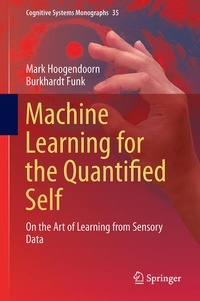
Machine Learning for the Quantified Self
On the Art of Learning from Sensory Data
Published on 5. October 2017
Book
Hardback
XV, 231 pages
978-3-319-66307-4 (ISBN)
Description
This book explains the complete loop to effectively use self-tracking data for machine learning. While it focuses on self-tracking data, the techniques explained are also applicable to sensory data in general, making it useful for a wider audience. Discussing concepts drawn from from state-of-the-art scientific literature, it illustrates the approaches using a case study of a rich self-tracking data set. Self-tracking has become part of the modern lifestyle, and the amount of data generated by these devices is so overwhelming that it is difficult to obtain useful insights from it. Luckily, in the domain of artificial intelligence there are techniques that can help out: machine-learning approaches allow this type of data to be analyzed. While there are ample books that explain machine-learning techniques, self-tracking data comes with its own difficulties that require dedicated techniques such as learning over time and across users.
More details
Series
Edition
1st ed. 2018
Language
English
Place of publication
Cham
Switzerland
Publishing group
Springer International Publishing
Target group
Professional and scholarly
Illustrations
17 s/w Abbildungen, 72 farbige Abbildungen
XV, 231 p. 89 illus., 72 illus. in color.
Dimensions
Height: 241 mm
Width: 160 mm
Thickness: 20 mm
Weight
541 gr
ISBN-13
978-3-319-66307-4 (9783319663074)
DOI
10.1007/978-3-319-66308-1
Schweitzer Classification
Other editions
Additional editions
Mark Hoogendoorn | Burkhardt Funk
Machine Learning for the Quantified Self
On the Art of Learning from Sensory Data
Book
08/2018
Springer
€181.89
Shipment within 10-15 days
Mark Hoogendoorn | Burkhardt Funk
Machine Learning for the Quantified Self
On the Art of Learning from Sensory Data
E-Book
09/2017
Springer
€171.19
Available for download
Content
Introduction.- Basics of Sensory Data.- Feature Engineering based on Sensory Data.- Predictive Modeling without Notion of Time.- Predictive Modeling with Notion of Time.- Reinforcement Learning to Provide Feedback and Support.- Discussion.