

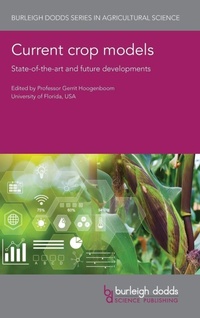
Current Crop Models
State-Of-The-Art and Future Developments
Will be published approx. on 23. December 2025
Book
Hardback
600 pages
978-1-80146-972-2 (ISBN)
Description
Whilst crop models have made significant progress in recent years, different models still diverge and struggle to predict the complex effects of genetic, environmental and management (G x E x M) variables in optimising crop production in the face of climate change.
Current crop models: State-of-the-art and future developments provides a comprehensive overview of the major crop models and the ways they address these challenges. The book explores the development of major crop models such as the Decision Support System for Agrotechnology Transfer (DSSAT), how variables such as crop variety and genetic differences are being addressed, recent model improvements and future model enhancements, as well as examples of current applications to improve crop production.
The book builds on a successful earlier volume published by Burleigh Dodds Science Publishing: Advances in crop modelling for a more sustainable agriculture (2019).
More details
Series
Language
English
Place of publication
Cambridge
United Kingdom
Target group
College/higher education
Professional and scholarly
University and other researchers in crop modelling departments, companies developing decision support systems in agriculture, as well as well as governments and other agencies providing agronomic advice to farmers to support the transition to sustainable agriculture.
Product notice
Paper over boards
Illustrations
Color tables, photos and figures
Dimensions
Height: 235 mm
Width: 157 mm
Thickness: 46 mm
Weight
1260 gr
ISBN-13
978-1-80146-972-2 (9781801469722)
DOI
10.19103/AS.2025.0155
Copyright in bibliographic data and cover images is held by Nielsen Book Services Limited or by the publishers or by their respective licensors: all rights reserved.
Schweitzer Classification
Other editions
Additional editions
E-Book
12/2025
Burleigh Dodds Science Publishing Limited
€226.99
Available for download
Persons
Editor
University of Florida-Gainesville (United States)
Contributions
University of Florida
USDA-ARS
Penn State University
North Carolina State University
Michigan State University
Regrow Ag
USDA-ARS
University of Liege
Centre de cooperation internationale en recherche agronomique pour le developpement (CIRAD), UMR AGAP Institute (France)
Content
Part 1 North America
- 1.The DSSAT crop model ecosystem: Ken Boote, Univeristy of Florida, USA;
- 2.The USDA-SIM crop model: David Fleisher, USDA-ARS, USA;
- 3.The Cycles crop model: Armen Kemanian, Penn State University, USA;
- 4.The EPIC and APEX crop models: Jaehak Jeong, Texas A&M University, USA;
- 5.The SSM-Crop model: Tom Sinclair, North Carolina State University, USA;
- 6.The Ecosys crop model: Kaiyu Guan, University of Illinois, USA;
- 7.The SALUS crop model: Bruno Basso, Michigan State University, USA;
- 8.The DNDC crop model: Bill Salas, Regrow Ag, USA;
- 9.The ALMANAC crop model: Jim Kiniry, USDA-ARS, USA;
Part 2 Europe
- 10.The STICS crop model: Benjamin Dumont, University of Liege, Belgium;
- 11.The SiriusQuality crop model: Pierre Martre, INRAE, France;
- 12.The SARRA-H /SAMARA crop model: Myriam Adam, CIRAD, France;
- 13.The GECROS crop model: Xinyou Yin, Wageningen University, The Netherlands;
- 14.The WOFOST crop model: Allard de Wit, Wageningen University, The Netherlands;
- 15.The LINTUL crop model: Tom Schut, Wageningen University, The Netherlands;
- 16.The SWAP crop model: Iwan Supit, Wageningen University, The Netherlands;
- 17.The SIMPLACE crop and ecosystem management model: Frank Ewert, University of Bonn, Germany;
- 18.The MONICA and HERMES crop models: Claas Nendel, Leibniz Centre for Agricultural Landscape Research, Germany;
- 19.The AquaCrop model: Dirk Raes, Katholieke Universiteit Leuven, Belgium;
- 20.The Daisy crop model: Kiril Manevski, Aarhus University, Denmark;
Part 3 Asia and the Pacific
- 21.The InfoCrop model: Soora Naresh Kumar, Indian Agricultural Research Institute, India;
- 22.The CropGrow model: Yan Zhu, Nanjiang Agricultural University, China;
- 1.The DSSAT crop model ecosystem: Ken Boote, Univeristy of Florida, USA;
- 2.The USDA-SIM crop model: David Fleisher, USDA-ARS, USA;
- 3.The Cycles crop model: Armen Kemanian, Penn State University, USA;
- 4.The EPIC and APEX crop models: Jaehak Jeong, Texas A&M University, USA;
- 5.The SSM-Crop model: Tom Sinclair, North Carolina State University, USA;
- 6.The Ecosys crop model: Kaiyu Guan, University of Illinois, USA;
- 7.The SALUS crop model: Bruno Basso, Michigan State University, USA;
- 8.The DNDC crop model: Bill Salas, Regrow Ag, USA;
- 9.The ALMANAC crop model: Jim Kiniry, USDA-ARS, USA;
Part 2 Europe
- 10.The STICS crop model: Benjamin Dumont, University of Liege, Belgium;
- 11.The SiriusQuality crop model: Pierre Martre, INRAE, France;
- 12.The SARRA-H /SAMARA crop model: Myriam Adam, CIRAD, France;
- 13.The GECROS crop model: Xinyou Yin, Wageningen University, The Netherlands;
- 14.The WOFOST crop model: Allard de Wit, Wageningen University, The Netherlands;
- 15.The LINTUL crop model: Tom Schut, Wageningen University, The Netherlands;
- 16.The SWAP crop model: Iwan Supit, Wageningen University, The Netherlands;
- 17.The SIMPLACE crop and ecosystem management model: Frank Ewert, University of Bonn, Germany;
- 18.The MONICA and HERMES crop models: Claas Nendel, Leibniz Centre for Agricultural Landscape Research, Germany;
- 19.The AquaCrop model: Dirk Raes, Katholieke Universiteit Leuven, Belgium;
- 20.The Daisy crop model: Kiril Manevski, Aarhus University, Denmark;
Part 3 Asia and the Pacific
- 21.The InfoCrop model: Soora Naresh Kumar, Indian Agricultural Research Institute, India;
- 22.The CropGrow model: Yan Zhu, Nanjiang Agricultural University, China;