

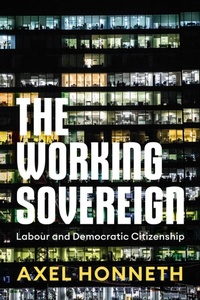
The Working Sovereign
Labour and Democratic Citizenship
1st Edition
Published on 30. August 2024
Book
Hardback
238 pages
978-1-5095-6128-5 (ISBN)
Description
What role does the organisation of labour relations play in the health of a democratic society? Axel Honneth's major new work is devoted to answering this question. His central thesis is that participation in democratic will formation can only proceed from a transparent and fairly regulated division of labour.
The social world of work - where we spend so much of our time - is almost unique in being a space in which we have experiences and learn lessons that we can use to influence the attitudes of a political community. Therefore, by shaping working conditions in a particular way, we have a prime opportunity to foster cooperative forms of behaviour that benefit democracy, both by making mental room for these to flourish and by using the workplace as a rehearsal for democratic interaction in wider society.
A job cannot be so tiring that a worker cannot think about political events; a job cannot pay so little that one cannot engage in political activity in his or her free time; a job cannot demand subordination which inhibits deserved criticism of one's superiors: economic independence, intellectual and physical autonomy, reduction of strain and crushing boredom, sufficient free time, self-respect and the confidence to speak up, and the chance to practice democratic interaction are all things which we must encourage in order to unblock access to democratic participation. Honneth argues that the reality of labour today increasingly undermines this participation - and he sets out the conditions necessary for a reversal of this injustice.
Tracking the development of labour conditions since the birth of capitalism, this important book engages with a vital topic that has been neglected in democratic theory. It will be of great interest to students and scholars in philosophy, sociology, politics and the humanities and social sciences generally.
The social world of work - where we spend so much of our time - is almost unique in being a space in which we have experiences and learn lessons that we can use to influence the attitudes of a political community. Therefore, by shaping working conditions in a particular way, we have a prime opportunity to foster cooperative forms of behaviour that benefit democracy, both by making mental room for these to flourish and by using the workplace as a rehearsal for democratic interaction in wider society.
A job cannot be so tiring that a worker cannot think about political events; a job cannot pay so little that one cannot engage in political activity in his or her free time; a job cannot demand subordination which inhibits deserved criticism of one's superiors: economic independence, intellectual and physical autonomy, reduction of strain and crushing boredom, sufficient free time, self-respect and the confidence to speak up, and the chance to practice democratic interaction are all things which we must encourage in order to unblock access to democratic participation. Honneth argues that the reality of labour today increasingly undermines this participation - and he sets out the conditions necessary for a reversal of this injustice.
Tracking the development of labour conditions since the birth of capitalism, this important book engages with a vital topic that has been neglected in democratic theory. It will be of great interest to students and scholars in philosophy, sociology, politics and the humanities and social sciences generally.
Reviews / Votes
"In our age of political polarization and rising authoritarianism, Axel Honneth makes a powerful and original case for re-centring work as a site for the development of the skills, motivations and broader sympathies needed to revitalize democracy. Empowering workers in cooperative settings, enriching workers' experience of work and enhancing the respect accorded to all occupations are vital tasks not only for improving workers' individual lives but for deepening democratic possibilities."Elizabeth Anderson, University of Michigan
"The now copious literature on the crisis of democracy is very attentive to the political processes of deliberation and largely inattentive to the relationship between the growth of poverty and the shift from stable employment to the normalization of precarious labour relations. Bringing labour back to the centre of democracy is the valuable contribution of this illuminating book, which reminds us that democratic citizens are workers and that there is a mutual dependence between democratic participation and sufficiently good working conditions."
Nadia Urbinati, Columbia University
"With characteristic intellectual rigour, Axel Honneth revives the critical importance of work for democracy. His persuasive arguments for the kind of work able to sustain democratic systems are fresh and urgent. Essential reading for anyone concerned with how the future of work impacts the future of democracy."
Ruth Yeoman, Kellogg College, University of Oxford
"By resuming reflection on the relationship between democratic demand and fairness in labour relations, Axel Honneth is not only breathing new life into a critique of capitalism which seemed out of breath: he also renews the moral and social foundations on which a progressive politics can be reconstructed. An essential book for our time."
Luc Boltanski, Ecole des hautes etudes en sciences sociales, Paris
"A thoughtfully constructed argument in favor of work worth doing, and of workers treated as human beings."
Kirkus Reviews
"Honneth outlines how to measure the well-being of wage workers: that they should earn enough to enjoy a measure of independence; that they should have time to spare; that they should be recognised for the value of their work; and that they should have opportunities for self-improvement. It's a tall order, but his astonishing conclusion is that "working conditions are significantly worse now than they were 50 or 60 years ago"."
Robert Colls, New Statesman
More details
Language
English
Place of publication
Oxford
United Kingdom
Publishing group
John Wiley and Sons Ltd
Target group
Professional and scholarly
Product notice
sewn/stitched
Cloth over boards
Dimensions
Height: 235 mm
Width: 162 mm
Thickness: 23 mm
Weight
467 gr
ISBN-13
978-1-5095-6128-5 (9781509561285)
Copyright in bibliographic data and cover images is held by Nielsen Book Services Limited or by the publishers or by their respective licensors: all rights reserved.
Schweitzer Classification
Other editions
Additional editions
E-Book
08/2024
1st Edition
Wiley
€22.99
Available for download
Persons
Axel Honneth is Jack B. Weinstein Professor of the Humanities at the Department of Philosophy of Columbia University.
Content
Preliminary Remarks
I. Normative Beginnings: Labour in Democratic Society
1. Three Resources for a Critique of Contemporary Labour Relations
2. A Forgotten Tradition
3. Democracy and the Question of a Fair Division of Labour
Excursus I: On the Concept of Social Labour
II. Historical Interlude: The Reality of Social Labour
4. A Spotlight on the Nineteenth Century
5. From 1900 to the Threshold of the Present
6. The Capitalist World of Work Today
Excursus II: On the Concept of the Social Division of Labour
Part III: The Political Struggle for the Future of Social Labour
7. The Politics of Labour
8. Alternatives to the Labour Market
9. Improvements to the Labour Market
Notes
Index
I. Normative Beginnings: Labour in Democratic Society
1. Three Resources for a Critique of Contemporary Labour Relations
2. A Forgotten Tradition
3. Democracy and the Question of a Fair Division of Labour
Excursus I: On the Concept of Social Labour
II. Historical Interlude: The Reality of Social Labour
4. A Spotlight on the Nineteenth Century
5. From 1900 to the Threshold of the Present
6. The Capitalist World of Work Today
Excursus II: On the Concept of the Social Division of Labour
Part III: The Political Struggle for the Future of Social Labour
7. The Politics of Labour
8. Alternatives to the Labour Market
9. Improvements to the Labour Market
Notes
Index