

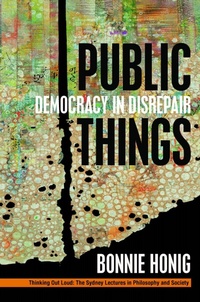
Public Things
Democracy in Disrepair
Published on 1. March 2017
Book
Paperback/Softback
160 pages
978-0-8232-7641-7 (ISBN)
Description
In the contemporary world of neoliberalism, efficiency is treated as the vehicle of political and economic health. State bureaucracy, but not corporate bureaucracy, is seen as inefficient, and privatization is seen as a magic cure for social ills. In Public Things: Democracy in Disrepair, Bonnie Honig asks whether democracy is possible in the absence of public services, spaces, and utilities. In other words, if neoliberalism leaves to democracy merely electoral majoritarianism and procedures of deliberation while divesting democratic states of their ownership of public things, what will the impact be?
Following Tocqueville, who extolled the virtues of "pursuing in common the objects of common desires," Honig focuses not on the demos but on the objects of democratic life. Democracy, as she points out, postulates public things-infrastructure, monuments, libraries-that citizens use, care for, repair, and are gathered up by. To be "gathered up" refers to the work of D. W. Winnicott, the object relations psychoanalyst who popularized the idea of "transitional objects"-the toys, teddy bears, or favorite blankets by way of which infants come to understand themselves as unified selves with an inside and an outside in relation to others. The wager of Public Things is that the work transitional objects do for infants is analogously performed for democratic citizens by public things, which press us into object relations with others and with ourselves.
Public Things attends also to the historically racial character of public things: public lands taken from indigenous peoples, access to public goods restricted to white majorities. Drawing on Hannah Arendt, who saw how things fabricated by humans lend stability to the human world, Honig shows how Arendt and Winnicott-both theorists of livenesss-underline the material and psychological conditions necessary for object permanence and the reparative work needed for a more egalitarian democracy.
Following Tocqueville, who extolled the virtues of "pursuing in common the objects of common desires," Honig focuses not on the demos but on the objects of democratic life. Democracy, as she points out, postulates public things-infrastructure, monuments, libraries-that citizens use, care for, repair, and are gathered up by. To be "gathered up" refers to the work of D. W. Winnicott, the object relations psychoanalyst who popularized the idea of "transitional objects"-the toys, teddy bears, or favorite blankets by way of which infants come to understand themselves as unified selves with an inside and an outside in relation to others. The wager of Public Things is that the work transitional objects do for infants is analogously performed for democratic citizens by public things, which press us into object relations with others and with ourselves.
Public Things attends also to the historically racial character of public things: public lands taken from indigenous peoples, access to public goods restricted to white majorities. Drawing on Hannah Arendt, who saw how things fabricated by humans lend stability to the human world, Honig shows how Arendt and Winnicott-both theorists of livenesss-underline the material and psychological conditions necessary for object permanence and the reparative work needed for a more egalitarian democracy.
Reviews / Votes
"A fast-paced tour de force. Honig explores the role of public things in democratic politics, especially against the background of neoliberal privatization." -- -John Seery George Irving Thompson Memorial Professor of Government and Professor of Politics, Pomona CollegeMore details
Series
Language
English
Place of publication
New York
United States
Target group
Professional and scholarly
Product notice
Paperback (trade)
Dimensions
Height: 226 mm
Width: 149 mm
Thickness: 17 mm
Weight
243 gr
ISBN-13
978-0-8232-7641-7 (9780823276417)
Copyright in bibliographic data and cover images is held by Nielsen Book Services Limited or by the publishers or by their respective licensors: all rights reserved.
Schweitzer Classification
Other editions
Additional editions
E-Book
03/2017
1st Edition
Fordham University Press
€23.49
Available for download
Person
Bonnie Honig is Nancy Duke Lewis Professor of Modern Culture and Media (MCM) and Political Science at Brown University. She is also Affiliated Research Professor at the American Bar Foundation, Chicago. Her most recent books are Antigone, Interrupted; Emergency Politics: Paradox, Law, Democracy; and, as co-editor, Politics, Theory, and Film: Critical Encounters with Lars von Trier.
Content
Preface: Opting Out Introduction: Thinking Out Loud Lecture One: Democracy's Necessary Conditions Lecture Two: Care and Concern: Arendt with Winnicott Lecture Three: Hope and Play: Lear and von Trier Epilogue: Public Things, Shared Space, and the Commons Acknowledgments Notes Bibliography Index