

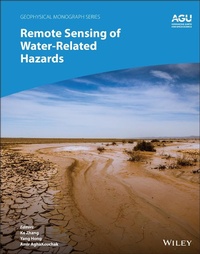
Remote Sensing of Water-Related Hazards
1st Edition
Will be published approx. on 16. May 2022
Book
Hardback
272 pages
978-1-119-15912-4 (ISBN)
Description
Applications of remote sensing technology for monitoring and predicting water-related hazards
Water-related hazards such as floods and droughts have serious impacts on society. Their incidence has increased in recent decades, a trend set to continue with ongoing climate change. Adaptation and mitigation measures require accurate detection, monitoring, and forecasting, much of which comes from remote sensing technologies.
Remote Sensing of Water-Related Hazards takes an interdisciplinary approach, presenting recent advances in the available data, sensors, models, and indicators developed for monitoring and prediction.
Volume highlights include:
* Progress in remote sensing of precipitation, storms, and tornados
* Different techniques for flood mapping, forecasting, and early warning
* Integrated approach for predicting flood and landslide cascading hazards
* Satellite monitoring of water cycle variation, water scarcity, and drought conditions
* Multi-indicator and multi-sensor approaches for quantifying drought impacts
The American Geophysical Union promotes discovery in Earth and space science for the benefit of humanity. Its publications disseminate scientific knowledge and provide resources for researchers, students, and professionals.
More details
Series
Language
English
Place of publication
New York
United States
Target group
Professional and scholarly
Dimensions
Height: 222 mm
Width: 287 mm
Thickness: 20 mm
Weight
978 gr
ISBN-13
978-1-119-15912-4 (9781119159124)
Copyright in bibliographic data and cover images is held by Nielsen Book Services Limited or by the publishers or by their respective licensors: all rights reserved.
Schweitzer Classification
Other editions
Additional editions
Ke Zhang | Yang Hong | Amir AghaKouchak
Remote Sensing of Water-Related Hazards
E-Book
03/2022
1st Edition
Wiley
€165.99
Available for download
Ke Zhang | Yang Hong | Amir AghaKouchak
Remote Sensing of Water-Related Hazards
E-Book
03/2022
1st Edition
Wiley
€161.99
Available for download
Content
Preface Section 1. Monitoring and Detection of Natural Hazards 1. Virtual California: Earthquake statistics, surface deformation patterns, surface gravity changes and InSAR interferograms for arbitrary fault geometrics Kasey Schultz et al. (University of California Davis) 2. Monitoring Fast-Moving Landslide in the Three Gorges Area By Offset Tracking Method with High-Resolution SAR Data Mingsheng Liao et al. (Wuhan University, China) 3. A new method for detecting and monitoring atmospheric natural hazards with GPS RO Riccardo Biondi et al. (University of Graz, Autria) 4. Integration between Satellite and Ground-Based Data for the Improvement of Volcanic Ash Retrievals and Eruption Characterization Stefano Corradini et al. (INGV National Institute of Geophysics and Volcanology, Italy) 5. Detection of eruption-related microwave signals using a satellite-borne microwave radiometer AMSR2 Takashi Maeda (Japan Aerospace Exploration Agency) 6. Oil Spill Detection and Tracking Using Lipschitz Regularity and Multiscale Techniques in Synthetic Aperture Radar Imagery Olaniyi Ajadi and Franz Meyer (University of Alaska Fairbanks) 7. Monitoring of precursor landslide surface deformation using InSAR image in Kuchi-Sakamoto, Shizuoka Prefecture Hiroshi P Sato et al. (Nihon University, Tokyo, Japan) 8. A Landslide Monitoring Network based on Multi-source Spatial Sensors in Li County, Sichuan Province, China Ping Lu et al. (Tongji University, Shanghai, China) 9. Robust Sparse Sensing Using Weather Radar Kumar Vijay Mishra et al. (University of Iowa) 10. Detection of eruption-related microwave signals using a satellite-borne microwave radiometer AMSR2 11. Analysis of Potential Deep-Seated Landslide in Hekeng Watershed by Environment Indices Section 2. Application of Remote Sensing in Investigating Natural Hazards 12. Using infrared remote sensing to determine volcanic ash particle size distribution and its implications Luke Western et al. (University of Bristol, United Kingdom) 13. Landslide Investigations at Salmon Falls Creek Canyon in Idaho Using Satellite-Based Multitemporal Interferometric Synthetic Aperture Radar Techniques Marius Necsoiu et al. (Southwest Research Institute, USA) 14. Using Seismological and electromagnetic method to study the Xishancun Landslide RiSheng Chu et al. (Institute of Geodesy and Geophysics, China) 15. An investigation of pre-eruptive deformation for the 2004 eruption of Mount St. Helens using persistent scatterer interferometry Mar Welch and David Schmidt (University of Washing) 16. Optical and Radar Satellite Remote Sensing for Large Area Analysis of Landslide Activity in Southern Kyrgyzstan, Central Asia Sigrid Roessner et al. (Helmholtz Centre Potsdam GFZ German Research Centre for Geosciences) 17. Using Unmanned Aerial Vehicle (UAV) Imagery to Investigate Surface Displacements and Surface Features of the Super-Sauze Earthflow Samuel Tizzard et al. (University of Lancaster) 18. Revised and Improved Fault Maps of Washoe County, Nevada using Light Detecting and Ranging (LiDAR) Imagery Courtney Brailo et al. (University of Nevada Reno) 19. Using Unmanned Aerial Vehicle (UAV) Imagery to Investigate Surface Displacements and Surface Features of the Super-Sauze Earthflow Samuel Tizzard et al. (University of Lancaster) 20. Using Advanced Remote Sensing Data Fusion Techniques for Studying Earth Surface Processes and Hazards: A Landslide Detection Case Study 21. GPS and Satellite InSAR Observations of Landslide Activity at the Sinking Canyon in South Central Idaho Mohamed H Aly et al. (University of Arkansas) Section 3. Early Warning Systems and Forecasting for Natural Hazards 22. An Ensembel-based Remote-Sensing Driven Flash Flood-Landslide Early Warning System Ke Zhang et al. (University of Oklahoma) 23. Application of remotely sensed data for landslide hazard assessment and forecasting Dalla Bach Kirschbaum et al. (NASA Goddard Space Flight Center) 24. Forecasting Rainfall Induced Landslide using High Resolution DEM and Simple Water Budget Model Paul Kenneth et al. (University of the Philippines, Quezon City, Philippines) 25. Storm-triggerred debris avalanches in the Appalachians and possible trends in a future warming climate Diandong Ren et al. (Curtin University, Australia) 26. Probability hazard map for future vent opening at Etna volcano (Sicily, Italy). Placido Montalto et al. (National Institute of Geophysics and Volcanology, Italy)