

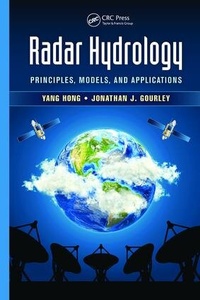
Radar Hydrology
Principles, Models, and Applications
1st Edition
Published on 30. April 2018
Book
Paperback/Softback
196 pages
978-1-138-85536-6 (ISBN)
Description
Radar Hydrology: Principles, Models, and Applications provides graduate students, operational forecasters, and researchers with a theoretical framework and practical knowledge of radar precipitation estimation. The only text on the market solely devoted to radar hydrology, this comprehensive reference:
Begins with a brief introduction to radar
Focuses on the processing of radar data to arrive at accurate estimates of rainfall
Addresses advanced radar sensing principles and applications
Covers radar technologies for observing each component of the hydrologic cycle
Examines state-of-the-art hydrologic models and their inputs, parameters, state variables, calibration procedures, and outputs
Discusses contemporary approaches in data assimilation
Concludes with methods, case studies, and prediction system design
Includes downloadable MATLAB (R) content
Flooding is the #1 weather-related natural disaster worldwide. Radar Hydrology: Principles, Models, and Applications aids in understanding the physical systems and detection tools, as well as designing prediction systems.
Begins with a brief introduction to radar
Focuses on the processing of radar data to arrive at accurate estimates of rainfall
Addresses advanced radar sensing principles and applications
Covers radar technologies for observing each component of the hydrologic cycle
Examines state-of-the-art hydrologic models and their inputs, parameters, state variables, calibration procedures, and outputs
Discusses contemporary approaches in data assimilation
Concludes with methods, case studies, and prediction system design
Includes downloadable MATLAB (R) content
Flooding is the #1 weather-related natural disaster worldwide. Radar Hydrology: Principles, Models, and Applications aids in understanding the physical systems and detection tools, as well as designing prediction systems.
Reviews / Votes
"This is the first book on radar hydrology written by hydrologists. Whereas the excellent knowledge of radar technology by the authors permits an adequate coverage of the principles of rainfall rate estimation by radar, their hydrological background allows them to provide a unique message on the benefits (and on the remaining challenges) in exploiting radar techniques in hydrology. ... In a clear and concise manner, the book combines topics from different scientific disciplines into a unified approach aiming to guide the reader through the requirements, strengths, and pitfalls of the application of radar technology in hydrology-mostly for flood prediction. Chapters include excellent discussion of theory, data analysis, and applications, along with several cross references for further review and useful conclusions."-Marco Borga, University of Padova, Italy
More details
Language
English
Place of publication
London
United Kingdom
Publishing group
Taylor & Francis Ltd
Target group
College/higher education
Graduate students, operational forecasters, and researchers.
Dimensions
Height: 234 mm
Width: 156 mm
Weight
360 gr
ISBN-13
978-1-138-85536-6 (9781138855366)
Copyright in bibliographic data and cover images is held by Nielsen Book Services Limited or by the publishers or by their respective licensors: all rights reserved.
Schweitzer Classification
Other editions
Additional editions
E-Book
09/2018
1st Edition
CRC Press
€123.99
Available for download
E-Book
09/2018
1st Edition
CRC Press
€123.99
Available for download
Book
07/2017
1st Edition
CRC Press
€112.85
The article will not be published
Book
12/2014
1st Edition
CRC Press
€299.50
Shipment within 15-20 days
Persons
Yang Hong is a professor of hydrometeorology and remote sensing in the School of Civil Engineering and Environmental Sciences, adjunct faculty member with the School of Meteorology, co-director of the WaTER Center, faculty member with the Advanced Radar Research Center, and affiliated member of the Center for Analysis and Prediction of Storms at the University of Oklahoma. Dr. Hong also directs the HyDROS Lab at the National Weather Center. Previously, he was a research scientist at NASA's Goddard Space Flight Center and postdoctoral researcher at University of California, Irvine. He holds a BS and MS from Peking (Beijing) University, China and Ph.D from the University of Arizona.
Jonathan J. Gourley is a research hydrologist with the NOAA/National Severe Storms Laboratory and affiliate associate professor with the School of Meteorology at the University of Oklahoma. His research interests include hydrologic prediction across scales ranging from water resources management to early warning of extreme events. Dr. Gourley was the principal inventor of a multisensor rainfall algorithm that was expanded to encompass all radars in North America and deployed to several foreign countries for operational use. He also assembled a comprehensive database that is being used to develop FLASH-a real-time flash flood forecasting system. He holds a BS, MS, and Ph.D from the University of Oklahoma.
Jonathan J. Gourley is a research hydrologist with the NOAA/National Severe Storms Laboratory and affiliate associate professor with the School of Meteorology at the University of Oklahoma. His research interests include hydrologic prediction across scales ranging from water resources management to early warning of extreme events. Dr. Gourley was the principal inventor of a multisensor rainfall algorithm that was expanded to encompass all radars in North America and deployed to several foreign countries for operational use. He also assembled a comprehensive database that is being used to develop FLASH-a real-time flash flood forecasting system. He holds a BS, MS, and Ph.D from the University of Oklahoma.
Content
Introduction to Basic Radar Principles. Radar Quantitative Precipitation Estimation. Polarimetric Radar Quantitative Precipitation Estimation. Multi-Radar Multi-Sensor (MRMS) Algorithm. Advanced Radar Technologies for Quantitative Precipitation Estimation. Radar Technologies for Observing the Water Cycle. Radar QPE for Hydrologic Modeling. Flash Flood Forecasting.