

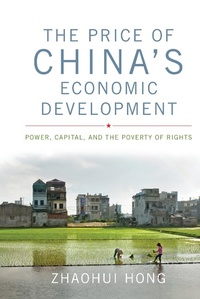
The Price of China's Economic Development
Power, Capital, and the Poverty of Rights
Published on 21. July 2015
Book
Hardback
308 pages
978-0-8131-6115-0 (ISBN)
Description
The People's Republic of China has experienced significant transformations since Deng Xiaoping instituted economic reforms in 1978. Subsequent leaders continued and often broadened Deng's policies, shifting the nation from agrarianism to industrialism, from isolation to internationalism, and from centralized planning to market-based economics. As the world strives to understand the nation's rapid development, few observers have comprehensively examined the social and cultural price of the economic boom for the majority of the Chinese people.
Zhaohui Hong assesses the sociocultural consequences of these reforms in this provocative study. He contends that modern China functions as an oligarchy or plutocracy ruled by an alliance of political power and private capital where the boundaries between the private and public sectors are constantly shifting. This "power-capital institution" based on three millennia of Confucian ideology and decades of Maoist communism exercises monopolistic control of public resources at the expense of civil society and social justice for the majority of citizens.
The Price of China's Economic Development urges policymakers to alter their analytic lens. While industrial and commercial development is quantitatively measured, Hong argues that social progress should be assessed qualitatively, with justice its ultimate goal and fair allocation of resources and opportunity as the main index of success. This sophisticated analysis introduces English speakers to the varied and significant work of contemporary Chinese scholars and substantially enriches the international dialogue.
Zhaohui Hong assesses the sociocultural consequences of these reforms in this provocative study. He contends that modern China functions as an oligarchy or plutocracy ruled by an alliance of political power and private capital where the boundaries between the private and public sectors are constantly shifting. This "power-capital institution" based on three millennia of Confucian ideology and decades of Maoist communism exercises monopolistic control of public resources at the expense of civil society and social justice for the majority of citizens.
The Price of China's Economic Development urges policymakers to alter their analytic lens. While industrial and commercial development is quantitatively measured, Hong argues that social progress should be assessed qualitatively, with justice its ultimate goal and fair allocation of resources and opportunity as the main index of success. This sophisticated analysis introduces English speakers to the varied and significant work of contemporary Chinese scholars and substantially enriches the international dialogue.
More details
Series
Language
English
Place of publication
Lexington
United States
Target group
College/higher education
Professional and scholarly
Product notice
sewn/stitched
Cloth over boards
Dimensions
Height: 236 mm
Width: 162 mm
Thickness: 25 mm
Weight
658 gr
ISBN-13
978-0-8131-6115-0 (9780813161150)
Copyright in bibliographic data and cover images is held by Nielsen Book Services Limited or by the publishers or by their respective licensors: all rights reserved.
Schweitzer Classification
Other editions
Additional editions
E-Book
11/2022
The University Press of Kentucky
€18.18
Available for download
Person
Zhaohui Hong, professor of economic history at Purdue University Calumet, USA, is the author or coeditor of several books, including Dilemmas of Reform in Jiang Zemin's China.