

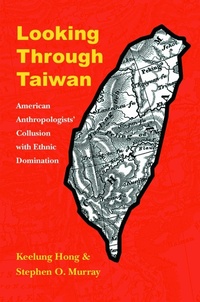
Looking Through Taiwan
American Anthropologists' Collusion with Ethnic Domination
Published on 1. December 2005
Book
Hardback
166 pages
978-0-8032-2435-3 (ISBN)
Description
Anthropologists have long sought to extricate their work from the policies and agendas of those who dominate-and often oppress-their native subjects. Looking through Taiwan is an uncompromising look at a troubling chapter in American anthropology that reveals what happens when anthropologists fail to make fundamental ethnic and political distinctions in their work. Keelung Hong and Stephen O. Murray examine how Taiwanese realities have been represented-and misrepresented-in American social science literature, especially anthropology, in the post-World War II period. They trace anthropologists' complicity in the domination of a Taiwanese majority by a Chinese minority and in its obfuscation of social realities. At the base of these distortions, the authors argue, were the mutual interests of the Republic of China's military government and American social scientists in mischaracterizing Taiwan as representative of traditional Chinese culture. American anthropologists, eager to study China but denied access by its communist government, turned instead to fieldwork on the Republic of China's society, which they incorrectly and disingenuously interpreted to reflect traditional Chinese society on the mainland. Anthropologists overlooked the cultural and historical differences between the island and the mainland and effectively legitimized the People's Republic of China's claim on Taiwan. Looking through Taiwan is a powerful critique of American anthropology and a valuable reminder of the political and ethical implications of social science research and writing.
Reviews / Votes
"The authors make several good cases against anthropological studies of Taiwan. . . . They also show the earlier anthropologists' inability or failure to differentiate between legacy of the colonial Japanese, Taiwanese tradition, and KMT policy. . . . They also give credit where credit is due."-Sylvia Li-chun Lin, China Review InternationalMore details
Series
Language
English
Place of publication
Lincoln
United States
Target group
Professional and scholarly
Product notice
Cloth over boards
Illustrations
Illus.
Dimensions
Height: 233 mm
Width: 155 mm
Thickness: 17 mm
Weight
420 gr
ISBN-13
978-0-8032-2435-3 (9780803224353)
Copyright in bibliographic data and cover images is held by Nielsen Book Services Limited or by the publishers or by their respective licensors: all rights reserved.
Schweitzer Classification
Other editions
Additional editions
Keelung Hong | Stephen O. Murray
Looking Through Taiwan
American Anthropologists' Collusion with Ethnic Domination
E-Book
12/2005
1st Edition
University of Nebraska Press
€20.99
Available for download
Persons
Keelung Hong is the CEO and chairman of Taiwan Liposome Company and the coauthor (with Stephen O. Murray) of Taiwanese Culture, Taiwanese Society: A Critical Review of Social Science Research Done on Taiwan. Stephen O. Murray is the director of El Instituto Obregon in San Francisco, California, and the author of Theory Groups in the Study of Language in North America: A Social History and many other books.
Content
I. Introductory Material 1. Experiences of Being a "Native" Observing Anthropology - Mechanics of the Book; 2. A Brief Overview of American Anthropologists' Investigation of "Others" Before 1955; 3. A Brief Overview of the Governing of Taiwan II. American Social Scientists' Complicity with Domination 4. A Case Study of Pseudo-Objectivity: The Hoover Institution Analysis of 1947 Resistance and Repression; 5. Some American Witnesses of the KMT's 1947 Reign of Terror on Taiwan; 6. Studies of KMT-Imposed Land Reform; 7. American Anthropologists Looking Through Taiwan to See "Traditional" China, 1950-1990 III. 1990s Anthropological Writing Based on Research in Taiwan 8. A Taiwanese Woman Who Became a Spirit Medium: Native and Alien Models of How Taiwanese Identify Spirit Possession; 9. The Non-Obliteration of Taiwanese Women's Names; 10. The Aftermath: Fleeing Democratization