

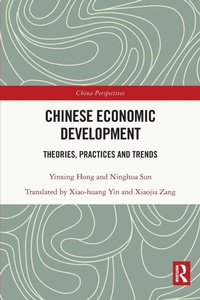
Chinese Economic Development
Theories, Practices and Trends
1st Edition
Published on 9. January 2023
Book
Paperback/Softback
262 pages
978-1-032-01912-3 (ISBN)
Description
The book provides a meticulous analysis of economic development and concomitant problems in China since the late 1970s and advances suggestions on further economic modernisation and transition from both theoretical and practical angles.
Based on theories from development economics and solid empirical studies, the authors, two renowned Chinese economists, provide a perceptive analysis of the Chinese development model in the post-Mao era. They shed light on questions that have perplexed many: How can China sustain the rapid growth of the past 40 years? Is there a unique "China path" to economic progress? They argue compellingly that China's development model has to switch from a manufacturing-driven one to a brand-new approach, centring on scientific and technical innovation and the integration of its existing economic structure into an increasingly complex global economy. Such transformation will help overcome the "middle-income trap" while addressing other institutional and economic challenges.
The book will appeal to students, scholars and policymakers interested in the Chinese and global economies, as well as transnational studies in the post-COVID-19 world. General readers willing to obtain a grasp of Chinese economic development from the insider's perspective will also find it useful.
Based on theories from development economics and solid empirical studies, the authors, two renowned Chinese economists, provide a perceptive analysis of the Chinese development model in the post-Mao era. They shed light on questions that have perplexed many: How can China sustain the rapid growth of the past 40 years? Is there a unique "China path" to economic progress? They argue compellingly that China's development model has to switch from a manufacturing-driven one to a brand-new approach, centring on scientific and technical innovation and the integration of its existing economic structure into an increasingly complex global economy. Such transformation will help overcome the "middle-income trap" while addressing other institutional and economic challenges.
The book will appeal to students, scholars and policymakers interested in the Chinese and global economies, as well as transnational studies in the post-COVID-19 world. General readers willing to obtain a grasp of Chinese economic development from the insider's perspective will also find it useful.
More details
Series
Language
English
Place of publication
London
United Kingdom
Publishing group
Taylor & Francis Ltd
Target group
College/higher education
Professional and scholarly
Postgraduate, Professional, and Undergraduate Advanced
Illustrations
3 s/w Abbildungen, 3 s/w Zeichnungen, 13 s/w Tabellen
13 Tables, black and white; 3 Line drawings, black and white; 3 Illustrations, black and white
Dimensions
Height: 234 mm
Width: 156 mm
Thickness: 16 mm
Weight
442 gr
ISBN-13
978-1-032-01912-3 (9781032019123)
Copyright in bibliographic data and cover images is held by Nielsen Book Services Limited or by the publishers or by their respective licensors: all rights reserved.
Schweitzer Classification
Other editions
Additional editions
Book
07/2021
1st Edition
Routledge
€261.40
Shipment within 10-20 days
E-Book
07/2021
1st Edition
Routledge
€61.99
Available for download
E-Book
07/2021
1st Edition
Routledge
€61.99
Available for download
Persons
Yinxing Hong is Senior Professor in Humanities and Social Sciences at Nanjing University (China). He specialises in macroeconomic theory and policy.
Ninghua Sun is Professor of Economics at Nanjing University. He specialises in macroeconomics, as well as financial derivatives and financial risk management.
Ninghua Sun is Professor of Economics at Nanjing University. He specialises in macroeconomics, as well as financial derivatives and financial risk management.
Content
1. Phases and Goals of Economic Development 2. The Rate and Quality of Economic Development 3. The Consumption Drive of Expanding Domestic Demand and Economic Growth 4. The Sustainability of Economic Development 5. Economic Growth and the Drive for Innovation 6. Industrialization and Upgrading Industrial Structure 7. Urbanization and Agriculture Modernization 8. Regional Economic Development and Coordination 9. Investment-Driven Growth and Financial Development 10. Economic Globalization and Open Economy 11. The Institutional Drive for Economic Development