

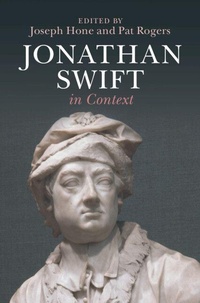
Jonathan Swift in Context
Published on 9. May 2024
Book
Hardback
418 pages
978-1-108-83143-7 (ISBN)
Description
Jonathan Swift remains the most important and influential satirist in the English language. The author of Gulliver's Travels, A Modest Proposal, and A Tale of a Tub, in addition to vast numbers of political pamphlets, satirical verses, sermons, and other kinds of text, Swift is one of the most versatile writers in the literary canon. His writings were always closely intertwined with the English and Irish worlds in which he lived. The forty-four essays collected in Jonathan Swift in Context advance the latest research on Swift in a way that will engage undergraduate students while also remaining useful for scholars. Reflecting the best of current and ongoing scholarship, the contextual approach advanced by this volume will help to make Swift's works even more powerful and resonant to modern audiences.
More details
Series
Language
English
Place of publication
Cambridge
United Kingdom
Product notice
sewn/stitched
Cloth over boards
Illustrations
Worked examples or Exercises
Dimensions
Height: 229 mm
Width: 152 mm
Thickness: 24 mm
Weight
726 gr
ISBN-13
978-1-108-83143-7 (9781108831437)
Copyright in bibliographic data and cover images is held by Nielsen Book Services Limited or by the publishers or by their respective licensors: all rights reserved.
Schweitzer Classification
Other editions
Additional editions
Joseph Hone | Pat Rogers
Jonathan Swift in Context
E-Book
05/2024
Cambridge University Press
€117.99
Available for download
Joseph Hone | Pat Rogers
Jonathan Swift in Context
E-Book
05/2024
Cambridge University Press
€117.99
Available for download
Persons
Content
Part I. Personal: 1. Biography Clive Probyn; 2. Friends and family Emrys Jones; 3. Health and sickness Helen Deutsch; 4. Reason and unreason Allan Ingram; Part II. Publishing History and Legacy: 5. Book trade Stephen Karian; 6. Popular culture Pat Rogers; 7. Translations and reception abroad Hermann J. Real; 8. Critical reception before 1900 Katherine Turner; 9. Critical reception after 1900 James Ward; 10. Reputation in Ireland Aileen Douglas and Ian Campbell Ross; Part III. Literary Background: 11. Ancients and moderns Paddy Bullard; 12. Travel and exploration Shef Rogers; 13. Profession of letters Paul Baines; 14. Women writers Ben Wilkinson-Turnbull; 15. Style and language Cynthia Wall; Part IV. Genres: 16. Satire Clare Bucknell; 17. Pamphleteering and political journalism J. A. Downie; 18. Familiar verse Daniel Cook; 19. Fables and fantasy Jayne Lewis; 20. Parody and hoax Valerie Rumbold; 21. Sermons Ian Higgins; 22. History Joseph Hone; 23. Correspondence Louise Curran; 24. The novel Nicholas Seager; Part V. The External World: England and Ireland: 25. Literary scene: England Brean Hammond; 26. Party politics Joseph Hone; 27. Clubs Corrina Readioff; 28. Walpole and the opposition Christine Gerrard; 29. The Church of England David Manning; 30. Dissent Nicholas McDowell; 31. London Pat Rogers; 32. Literary scene: Ireland Andrew Carpenter; 33. The Church of Ireland Christopher Fauske; 34. Dublin David Dickson; Part VI. Social and intellectual topics: 35. Philosophy Tom Jones; 36. Science Gregory Lynall; 37. Race Joseph Hone; 38. Material culture Kelly Fleming; 39. Gender Katherine Aske; 40. Colonialism Robbie Richardson; 41. The body Leah Benedict; 42. Demography Benjamin Bankhurst; 43. Food Henry Power; 44. Economics Claire Wilkinson.