

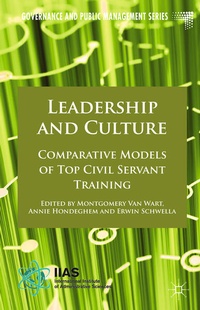
Leadership and Culture
Comparative Models of Top Civil Servant Training
Published on 11. November 2014
Book
Hardback
XIV, 357 pages
978-1-137-45412-6 (ISBN)
Description
This collection examines the leadership training of public administration in 19 countries and provides information on where, what, and how the training occurs as well as the up-to-date cultural, political, economic background for each. Factors affecting perceived importance, quality and robustness of top civil servant training are examined.
More details
Series
Edition
2015 edition
Language
English
Place of publication
London
United Kingdom
Target group
Professional and scholarly
Product notice
sewn/stitched
Cloth over boards
With dust jacket
Illustrations
XIV, 357 p.
Dimensions
Height: 218 mm
Width: 140 mm
Thickness: 28 mm
Weight
640 gr
ISBN-13
978-1-137-45412-6 (9781137454126)
DOI
10.1057/9781137454133
Schweitzer Classification
Other editions
Additional editions

Book
01/2015
Palgrave Macmillan
€53.49
Shipment within 15-20 days

E-Book
11/2014
1st Edition
Palgrave Macmillan
€53.49
Available for download
Persons
Claudia N Avellaneda, Indiana University, USA
Bente Bjørnholt, Danish Institute for Local and Regional Government Research, Denmark
Denita Cepiku, University of Rome Tor Vergata, Italy
Michael Conteh, Namibian Institute of Public Administration and Management (NIPAM), Namibia
Alexandra Couston, Aix Marseille Université, France
Christian de Visscher, Catholic University of Louvain, Belgium
Isabell Egger-Peitler, WU Vienna, Austria
Robert Fouchet, Aix Marseille Université, France
Peter E. Franks, University of Stellenbosch, South Africa
Mark Gal, Corvinus University of Budapest, Hungary and Babes Bolyai University, Romania
Marton Gellen, National University of Public Service, Hungary
Heather Getha-Taylor, University of Kansas, USA
John Halligan, University of Canberra, Australia
Morten Balle Hansen, Aalborg University, Denmark
Alessandro Hinna, University of Rome Tor Vergata, Italy
Cristina Hintea, Babes-Bolyai University, Romania
Sylvia Horton , Honorary Principal Lecturer, University of Portsmouth, UK
Werner Jann, University of Potsdam, Germany
Sangmook Kim, Seoul National University of Science and Technology, South Korea
Monika Knassmüller, WU Vienna, Austria
Peter Leisink, Utrecht University, the Netherlands
Joyce Liddle, Aix Marseille Université, France
Sandro Mameli, National School of Administration, Italy
Yrika Maritz, Namibian Institute of PublicAdministration and Management (NIPAM), Namibia
Merilin Metsma, Tallinn University of Technology, Estonia
Renate E. Meyer, WU Vienna, Austria
Elsie Nghikembua, Namibian Institute of Public Administration and Management (NIPAM), Namibia
Maxime Petit Jean, Catholic University of Louvain, Belgium
Tiina Randma-Liiv, Professor, Tallinn University of Technology, Estonia
Adrian Ritz, Professor, University of Bern, Switzerland
Silke Ruebens, PhD candidate, KU Leuven, Belgium
Pablo Sanabria, Universidad de los Andes, Colombia
Külli Sarapuu, Tallinn University of Technology, Estonia
Leonie Schüssler, University of Bern, Switzerland
Trui Steen, Leiden University, the Netherlands and Catholic University of Leuven, Belgium
Tudor Ticlau, Babes-Bolyai University, Romania
Caspar van den Berg, Leiden University, the Netherlands
Sylvia Veit, University of Potsdam, Germany
Annika Uudelepp, Praxis Centre for Policy Studies, Estonia
Turo Virtanen, University of Helsinki, Finland
Content
Introduction: Understanding the Role and Context of Senior Civil Servant Training; Montgomery Van Wart and Annie Hondeghem PART I: TRAINING CIVIL SERVANTS IN ANGLO-AMERICAN COUNTRIES 1. Australia; John Haligan 2. The United Kingdom Sylvia Horton and Montgomery Van Wart 3. The United States of America Heather Getha-Taylor PART II: TRAINING CIVIL SERVANTS IN EASTERN EUROPEAN COUNTRIES 4. Estonia; Külli Sarapuu, Merilin Metsma, Tiina Randma-Liiv and Annika Uudelepp 5. Hungary; Márk Gál and Márton Gellén 6. Romania; Cristina Hin?eaTudor ?icl?u PART III: TRAINING SENIOR CIVIL SERVANTS IN GERMANIC AND NORTHERN EUROPEAN COUNTRIES 7. Austria; Isabell Egger-Peitler, Monika Knassmüller, Renate Meyer 8. Belgium; Annie Hondeghem, Christian de Visscher, Maxime Petit Jean, and Silke Ruebens 9. Denmark; Bente Bjørnholt, Morten Balle Hansen 10. Finland; Turo Virtanen 11. Germany; Werner Jann and Sylvia Veit 12. The Netherlands; Trui Steen, Caspar van den Berg and Peter Leisink 13. Switzerland; Adrian Ritz and Leonie Schüssler PART IV; TRAINING SENIOR CIVIL SERVANTS IN LATIN EUROPEAN COUNTRIES 14. France; Alexandra Couston, Joyce Liddle and Robert Fouchet 15. Italy; Denita Cepiku, Alessandro Hinna and Sandro Mameli PART V: TRAINING CIVIL SERVANTS IN OTHER COUNTRIES 16. Columbia; Pablo Sanabria and Claudia N. Avelleneda 17. Namibia; Erwin Schwella, Yrika Maritz, Michael Conteh and Elsie Nghikembua 18. South Africa; Peter E. Franks 19. South Korea; Sangmook Kim Conclusions: Understanding the Reasons for the Difference in Importance, Quantity and Quality of SCS Training; Montgomery Van Wart and Annie Hondeghem