

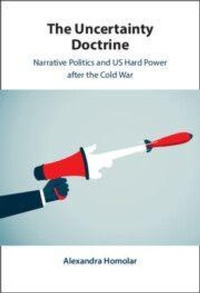
The Uncertainty Doctrine
Narrative Politics and US Hard Power after the Cold War
Published on 14. September 2023
Book
Hardback
260 pages
978-1-009-35511-7 (ISBN)
Description
The post-Cold War era is often seen as a missed opportunity of epic proportions for the United States to turn swords into ploughshares, with much of the blame placed on international developments. The Uncertainty Doctrine challenges the conventional take on post-Cold War history as imposed on the US by events largely outside its control. It shows in rich empirical detail how America's 'peace dividend' did not merely fall by the wayside but was actively undermined by the narrative contests over the security implications of the New World Order. Committed to understanding the ontological significance of narrative in (inter)national security, Alexandra Homolar demonstrates that political agents have the capacity to respond to a systemic shock through discursive adaptation and reorganization. While narrative politics may not always matter in US defense policy, at moments perceived as bifurcation points it can be decisive in why some strategic responses prevail over possible alternatives.
Reviews / Votes
'A deeply impressive and sustained disquisition on one of the most vexed and contentious areas of study: US foreign policy since the end of the cold war. This is a work brimming with ideas and arguments: it deserves a large audience and to become a seminal scholarly text.' Timothy J. Lynch, Professor of American Politics, the University of Melbourne 'A superb book that makes a genuine and highly original contribution to the field of US foreign policy studies. It provides a fascinating challenge to what we think we know about the post-Cold War era and is an essential read for anyone interested in the topic.' Michelle Bentley, Royal Holloway, University of London 'After the Cold War, the 'peace dividend' never materialized. The reason, according to Alexandra Homolar in this fascinating new book, was not 9/11 and the resulting War on Terror. A decade before, she argues, a narrative of 'uncertainty' had come to the fore. ... This is a careful and impressive study of how narrative politics works to cast plausible alternatives to the margins.' Ronald R. Krebs, Professor of Political Science, University of Minnesota 'A meticulously researched study of how security policy ideas emerge into strategic visions and frameworks for military planning. This is a must-read book on how, despite permissive conditions, political and intellectual actors and entrepreneurs can ensure that national security strategies and expenditures remain largely undisturbed.' Inderjeet Parmar, City, University of London 'The book offers theoretical and methodological contributions not just to the security narratives space but also to our understanding of how political actors respond to and capitalize on political events ... the book extends our understanding of uncertainty's uses in the making of security strategy.' Sophie Kaldor, International AffairsMore details
Language
English
Place of publication
Cambridge
United Kingdom
Product notice
sewn/stitched
Cloth over boards
Illustrations
Worked examples or Exercises
Dimensions
Height: 229 mm
Width: 152 mm
Thickness: 16 mm
Weight
517 gr
ISBN-13
978-1-009-35511-7 (9781009355117)
Copyright in bibliographic data and cover images is held by Nielsen Book Services Limited or by the publishers or by their respective licensors: all rights reserved.
Schweitzer Classification
Other editions
Additional editions
Book
03/2025
Cambridge University Press
€37.50
Shipment within 15-20 days
E-Book
09/2023
Cambridge University Press
€105.99
Available for download
E-Book
08/2023
Cambridge University Press
€105.99
Available for download
Person
Alexandra Homolar is a Professor of International Security at the University of Warwick. Her research interests lie at the intersection of security, language and political psychology. Her work has been widely published in journals such as Security Dialogue, European Journal of International Relations, Journal of Strategic Studies, and Review of International Studies.
Content
1. The fruits of victory; 2. Studying narrative politics in motion; 3. Irrational enemies; 4. Wars on multiple fronts; 5. Shield of invulnerability; 6. The future of the uncertainty doctrine.