

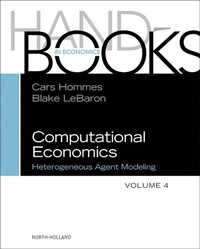
Computational Economics: Heterogeneous Agent Modeling
Heterogeneous Agent Models
Published on 19. June 2018
Book
Hardback
834 pages
978-0-444-64131-1 (ISBN)
Description
Handbook of Computational Economics: Heterogeneous Agent Modeling, Volume Four, focuses on heterogeneous agent models, emphasizing recent advances in macroeconomics (including DSGE), finance, empirical validation and experiments, networks and related applications. Capturing the advances made since the publication of Volume Two (Tesfatsion & Judd, 2006), it provides high-level literature with sections devoted to Macroeconomics, Finance, Empirical Validation and Experiments, Networks, and other applications, including Innovation Diffusion in Heterogeneous Populations, Market Design and Electricity Markets, and a final section on Perspectives on Heterogeneity.
Reviews / Votes
"This timely and very impressive handbook volume provides in-depth survey essays on major recent developments in heterogeneous agent modeling in economics. The editors of the volume and the authors of the individual chapters are pioneers and leading researchers in this emergent area of study. The volume will be an essential resource for economists and graduate students who are working with or interested in heterogeneous agent models." --Journal of Economic LiteratureMore details
Series
Language
English
Place of publication
United States
Publishing group
Elsevier Science & Technology
Target group
Professional and scholarly
Graduate students and professors worldwide studying quantitative economic methods and their applications.
Dimensions
Height: 235 mm
Width: 191 mm
Weight
2060 gr
ISBN-13
978-0-444-64131-1 (9780444641311)
Copyright in bibliographic data and cover images is held by Nielsen Book Services Limited or by the publishers or by their respective licensors: all rights reserved.
Schweitzer Classification
Other editions
Additional editions
Cars Hommes | Blake LeBaron
Computational Economics: Heterogeneous Agent Modeling
E-Book
06/2018
Elsevier
€130.00
Available for download
Persons
Cars Hommes is one of the pioneers in complexity economics. His work on nonlinear complex economic systems challenges the traditional neoclassical paradigm of the representative rational agent in economics. In a rational world the economy is characterized by an average agent (consumer, producer, investor, etc.), who is a perfect optimizer with rational expectations about the future. Hommes' work develops an alternative complexity paradigm based on agent-based behavioral complexity models.He has published more than 100 articles in leading international journals and book chapters and he is the author and editor of four books. He has been Editor of the Journal of Economic Dynamics and Control (2002-2012) and is the president elect of the international Society of Computational Economics. Blake LeBaron has a Ph.D. in Economics from the University of Chicago. He is the Abram L. and Thelma Sachar Chair of International Economics at the International Business School, Brandeis University. He is a Research Associate at the National Bureau of Economic Research, and was a Sloan Fellow. LeBaron also served as director of the Economics Program at The Santa Fe Institute in 1993. LeBaron's research has concentrated on the issue of nonlinear behavior of financial and macroeconomic time series. He has been influential both in the statistical detection of nonlinearities and in describing their qualitative behavior in many series. LeBaron's current interests are in understanding the quantitative dynamics of interacting systems of adaptive agents and how these systems replicate observed real world phenomenon. Also, LeBaron is interested in understanding some of the observed behavioral characteristics of traders in financial markets. This behavior includes strategies such as technical analysis and portfolio optimization, along with policy questions such as foreign exchange intervention. In general, he seeks to find out the empirical implications of learning and adaptation as applied to finance and macroeconomics.
Content
Introduction: Why heterogeneity?
Cars Hommes and Blake LeBaron
Macroeconomics
1. Bounded Rationality and Heterogeneous Agents in Macroeconomics: Microfoundations
William Branch and Bruce McGough
2. Agent-based Macroeconomics (including policy & innovation)
Herbert Dawid and Domenico Delli Gatti
3. Firm Dynamics
Robert Axtell
4. Heterogeneous agents in the Macroeconomy: Reduced-heterogeneity representations
Xavier Ragot
Finance
5. Heterogeneous Agent Models in Finance
Xue-Zhong (Tony) He and Roberto Dieci
6. Leverage Cycles
Doyne Farmer
7. Market Microstructure
Jean-Philippe Bouchaud
Empirical validation and experiments
8. Empirical Validation of Heterogeneous Agent Models
Thomas Lux and Remco Zwinkels
9. Experimental Macroeconomics
Jasmina Arifovic and John Duffy
10. Experimental Games
Rosemarie Nagel and Felix Mauersberger
Networks
11. Complex Financial Networks
Giulia Iori and Rosario N. Mantegna
12. Economic and Social Networks
Sanjeev Goyal
Other Applications
13. Market Design and Electricity Markets
Leigh Tesfatsion
Perspectives on heterogeneity
14. Modeling a Heterogeneous World
Alan Kirman and Rick Bookstaber
Cars Hommes and Blake LeBaron
Macroeconomics
1. Bounded Rationality and Heterogeneous Agents in Macroeconomics: Microfoundations
William Branch and Bruce McGough
2. Agent-based Macroeconomics (including policy & innovation)
Herbert Dawid and Domenico Delli Gatti
3. Firm Dynamics
Robert Axtell
4. Heterogeneous agents in the Macroeconomy: Reduced-heterogeneity representations
Xavier Ragot
Finance
5. Heterogeneous Agent Models in Finance
Xue-Zhong (Tony) He and Roberto Dieci
6. Leverage Cycles
Doyne Farmer
7. Market Microstructure
Jean-Philippe Bouchaud
Empirical validation and experiments
8. Empirical Validation of Heterogeneous Agent Models
Thomas Lux and Remco Zwinkels
9. Experimental Macroeconomics
Jasmina Arifovic and John Duffy
10. Experimental Games
Rosemarie Nagel and Felix Mauersberger
Networks
11. Complex Financial Networks
Giulia Iori and Rosario N. Mantegna
12. Economic and Social Networks
Sanjeev Goyal
Other Applications
13. Market Design and Electricity Markets
Leigh Tesfatsion
Perspectives on heterogeneity
14. Modeling a Heterogeneous World
Alan Kirman and Rick Bookstaber